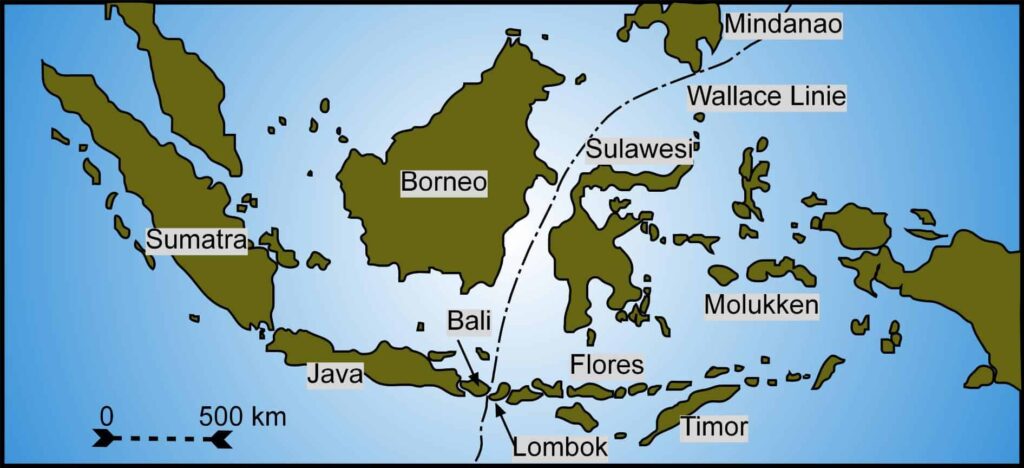
In the 19th century, Alfred Russel Wallace embarked on a journey through the Malay Archipelago that would lead to one of biology’s most intriguing mysteries. While exploring the islands with a butterfly net and notebook, Wallace observed a stark contrast in wildlife between Bali and Lombok, separated by just a 20-mile stretch of water. This observation led to the identification of the Wallace Line, an invisible barrier that has puzzled scientists for over 160 years.
Recent research by biologists from the Australian National University and ETH Zurich has finally shed light on this mystery. Using advanced computer modeling, they discovered that the Wallace Line was formed due to high-speed continental collision and a subsequent global climate shift approximately 35 million years ago.
The Origins of the Wallace Line
Alfred Russel Wallace, a self-taught naturalist, arrived in the Malay Archipelago in 1854 with a mission to understand the origin of species. Over eight years, he traveled more than 14,000 miles and collected over 125,660 specimens, documenting the region’s rich biodiversity. His groundbreaking discovery came in 1856 when he crossed the Lombok Strait and noticed a radical shift in species, leading him to propose the faunal boundary now known as the Wallace Line.
This line delineates two distinct zones of animal and plant life, despite the geographical proximity of the islands. Wallace’s work laid the foundation for biogeography, a field that links the distribution of life to the geological history of the land.
Geological Forces at Play
Understanding the Wallace Line requires a journey back tens of millions of years to a time when the Earth’s map was being reshaped by plate tectonics. Around 50 million years ago, Australia began moving northward after breaking away from Antarctica. This movement eventually led to a collision with the Eurasian plate, forming the Indonesian archipelago.
The archipelago acted as stepping stones for species migration, but the deep ocean trenches and marine barriers of the Wallacea region posed significant challenges. The collision of tectonic plates also triggered changes in global climate, contributing to the formation of the Antarctic Circumpolar Current (ACC) and a global cooling trend.
Asymmetry in Species Exchange
While plate tectonics explained the existence of the Wallace Line, it did not account for the asymmetrical exchange of species. Research showed that species moved more easily from Asia to Australia than in the opposite direction. A 2023 study using the Gen3SIS model revealed that precipitation tolerance was a key factor. Asian species, adapted to humid climates, thrived as they moved eastward, while Australian species struggled in the tropical conditions of Wallacea.
“If you travel to Borneo, you won’t see any marsupial mammals, but if you go to the neighboring island of Sulawesi, you will. Australia, on the other hand, lacks mammals typical of Asia, such as bears, tigers or rhinos,” said lead researcher Dr. Alex Skeels from ANU.
This research highlights how historical climate changes influenced species adaptation and distribution, offering insights into how current climate change might affect biodiversity.
Broader Implications and Future Research
The Wallace Line serves as a testament to how geological and climatic factors shape biodiversity. It is not alone; other lines, such as Weber’s Line and Lydekker’s Line, also mark transitions between Asian and Australian species. These boundaries, while invisible, have significant ecological impacts.
As global temperatures rise, understanding these biogeographical boundaries becomes increasingly urgent. By studying past climate adaptations, scientists hope to predict which species may better adapt to future environmental changes.
The Wallace Line remains a powerful reminder of the complex interplay between Earth’s geological history and the distribution of life. As researchers continue to explore these invisible barriers, they provide crucial insights into the resilience and adaptability of species in a rapidly changing world.