



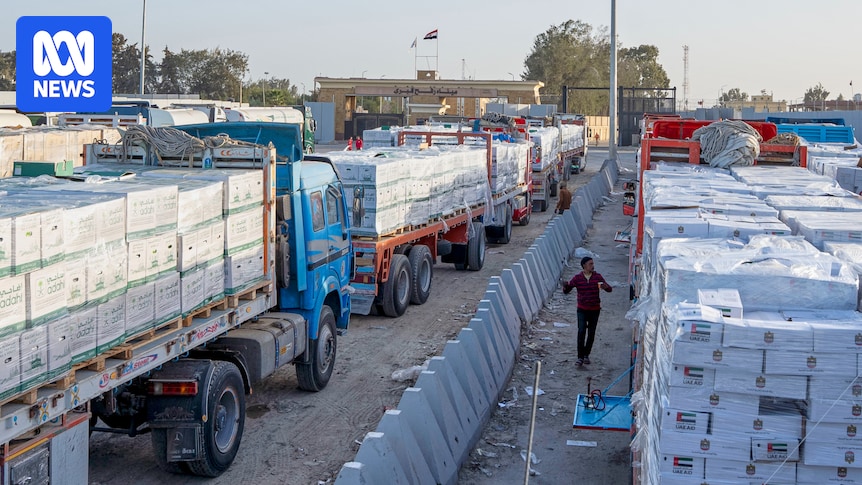
The Rafah border crossing between Gaza and Egypt is set to officially reopen on Monday, providing a crucial passage for Palestinians requiring urgent medical care outside the besieged region. However, aid agencies caution that the reopening may be largely symbolic, as nearly 20,000 Gazans await medical evacuation, yet only a small fraction will be permitted to leave.
The crossing, which serves as the sole exit point not passing through Israel, has been predominantly closed since Israel seized control in May 2024. This reopening marks a significant element of U.S. President Donald Trump’s 20-point peace plan for Gaza, which included reopening Rafah in both directions. The move was delayed until the last hostage from Hamas’s October 7 attack, Ran Gvili, was returned last week.
Symbolic Reopening Amidst Humanitarian Crisis
On Sunday, preparations commenced to test border security in anticipation of Monday’s reopening to a limited number of pedestrians. COGAT, the Israeli military agency overseeing aid to Gaza, confirmed that residents would start passing through the crossing. Israeli authorities have stated that 150 people will be allowed to leave Gaza each day.
However, Sam Rose, the United Nations Relief and Works Agency’s director of affairs, expressed concern, telling ABC that the numbers barely address the overwhelming need, with 18,500 people, including 4,000 children, in urgent need of medical attention abroad.
“These are very, very small numbers. I think it will initially be symbolic because 150 people is nothing given the need,” Rose remarked.
Rose further noted that anyone crossing would traverse an Israeli military-controlled zone, emphasizing the necessity for increased numbers to alleviate the backlog meaningfully.
Impact of the Crossing’s Reopening
The reopening follows Gaza’s deadliest day since the ceasefire began in October, with over 30 people, including seven children, killed in Israeli strikes over the weekend. The Rafah crossing is vital as it represents the only non-Israeli exit for Palestinians in Gaza, serving as a psychological lifeline for those seeking to leave or return.
Israeli Prime Minister Benjamin Netanyahu announced that 50 patients would be allowed to exit daily, each accompanied by two relatives. Concurrently, 50 individuals who left during the war will be permitted to return each day. The European Union, Egypt, and other parties will manage the crossing alongside Israel, though it will remain closed to essential supplies.
“Hopefully this marks the start of a much more manageable and less constrained process for supplies coming in because right now Gaza is completely strangled at that border crossing,” Rose added.
Challenges and Future Implications
The reopening signifies the conclusion of the first phase of the ceasefire deal. The U.S. recently announced the second phase, with President Trump launching his Board of Peace in Davos to oversee Gaza’s reconstruction and governance. The next phase requires Hamas to disarm and Israel to withdraw troops, both presenting significant challenges.
MSF’s Departure from Gaza
Coinciding with the crossing’s reopening, Israel announced the cessation of Doctors Without Borders’ operations in Gaza by February 28, 2026. The organization, known as Médecins Sans Frontières, has not commented but previously stated its decision not to share staff lists. This move is part of Israel’s suspension of over two dozen humanitarian organizations in Gaza for non-compliance with new regulations.
Independent NGOs are crucial in supporting Gaza’s health sector, devastated by years of conflict and supply restrictions. Doctors Without Borders has warned that Israel’s decision will severely impact their work, which includes funding multiple hospitals and clinics.
“Doctors Without Borders has said that Israel’s decision will have a catastrophic impact on its work in Gaza, where it funds six hospitals, two field hospitals, eight health clinics, and two stabilization centers helping children with severe malnutrition.”
The reopening of the Rafah crossing is a pivotal moment in Gaza’s ongoing humanitarian crisis, with implications for the region’s future stability and peace efforts. The international community will be closely monitoring the situation, as the need for increased humanitarian aid and political resolution remains critical.