




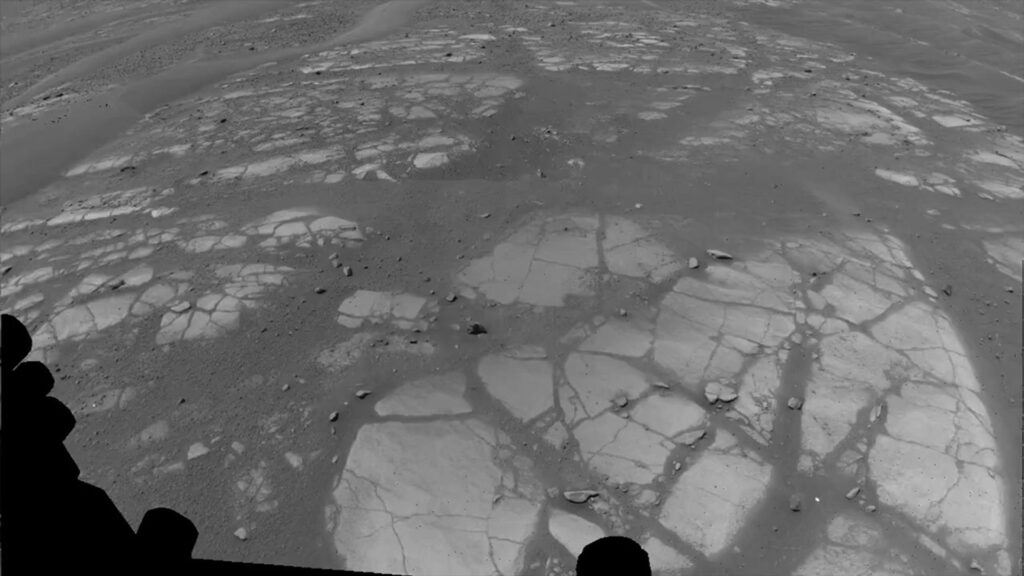
NASA’s Perseverance rover has once again provided a breathtaking glimpse into the Martian landscape, capturing a detailed animation of its drive along the rim of Jezero Crater. The footage, recorded on December 10, 2025, during the rover’s 1,709th Martian day, showcases a journey of 807 feet (246 meters) across the Red Planet’s rugged terrain.
The animation, meticulously crafted by combining 53 pairs of images from the rover’s Navigation Camera (Navcam) with data on orientation, wheel speed, and steering angle, offers a virtual reconstruction of the drive. This remarkable visual was further enhanced by data from Perseverance’s Inertial Measurement Unit, creating a 3D environment with virtual frames inserted approximately every 4 inches (0.1 meters) of the rover’s progress.
Engineering Marvel on Mars
Managed by NASA’s Jet Propulsion Laboratory (JPL) at Caltech, the Perseverance rover continues to push the boundaries of space exploration. Launched as part of NASA’s Mars 2020 mission, Perseverance is tasked with searching for signs of ancient life and collecting samples of rock and regolith (broken rock and soil) for possible return to Earth.
JPL’s expertise in rover technology has been instrumental in Perseverance’s success. The rover’s sophisticated suite of instruments and cameras, including the Navcam, allows it to navigate the Martian surface with precision, capturing high-resolution images that provide invaluable data to scientists back on Earth.
Scientific Goals and Discoveries
Perseverance’s mission is not only about exploration but also about science. Jezero Crater, a 28-mile-wide (45-kilometer-wide) basin, was chosen as the landing site because it is believed to have once been flooded with water and home to an ancient river delta. Scientists are eager to study the crater’s geology and search for signs of past microbial life.
According to Dr. Sarah Johnson, a planetary scientist at Georgetown University, “The images and data from Perseverance are crucial for understanding the history of water on Mars and assessing the planet’s past habitability. Each drive and each image brings us closer to answering the fundamental question of whether life ever existed on Mars.”
Implications for Future Mars Missions
The success of Perseverance has significant implications for future missions to Mars. The rover’s ability to autonomously navigate challenging terrain and its advanced scientific instruments make it a model for future robotic explorers. Moreover, the samples collected by Perseverance are expected to be retrieved by a future mission and returned to Earth, providing scientists with the first-ever samples from another planet.
NASA’s collaboration with international partners, including the European Space Agency, is set to play a crucial role in the Mars Sample Return mission. This ambitious endeavor aims to bring Martian samples back to Earth for detailed analysis, potentially unlocking secrets about the planet’s climate and geology.
Looking Ahead
As Perseverance continues its mission on Mars, the world watches with anticipation. The rover’s journey offers not only scientific insights but also inspiration, reminding us of the possibilities that lie beyond our planet. With each new discovery, Perseverance paves the way for human exploration of Mars, a goal that NASA hopes to achieve in the coming decades.
For more information about the Perseverance rover and its mission, visit NASA’s official website at science.nasa.gov/mission/mars-2020-perseverance/.
“The images and data from Perseverance are crucial for understanding the history of water on Mars and assessing the planet’s past habitability.” – Dr. Sarah Johnson, Planetary Scientist