




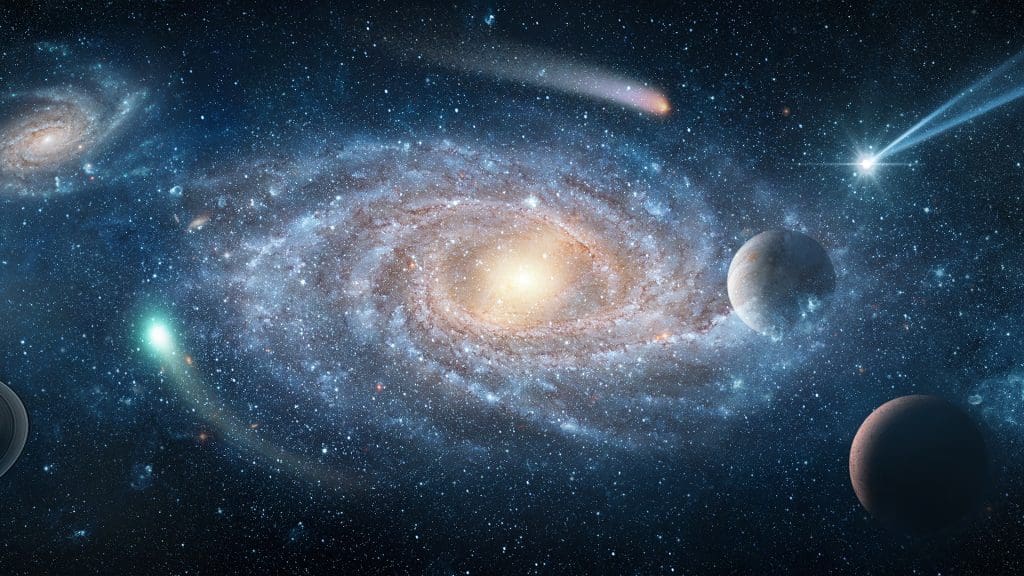
The European Space Agency’s Gaia space telescope has made a groundbreaking discovery, revealing a massive wave rippling through the Milky Way. This discovery, announced by Johannes Sahlmann, Project Scientist at ESA, highlights Gaia’s crucial role in mapping the galaxy’s structure and dynamics. The wave extends tens of thousands of light-years from our Solar System, offering new insights into the galaxy’s evolution.
Gaia, a mission launched by the European Space Agency, aims to map approximately 2 billion stars and other celestial objects. Although this represents only about 1% of the Milky Way’s total stellar content, the data collected is vast enough to extrapolate information about the entire galaxy. The telescope’s ability to capture three-dimensional data enables scientists to create detailed maps of the Milky Way’s structure.
Unveiling the Great Wave
The discovery of the great wave was made possible through Gaia’s precise measurements of stellar positions, distances, and motions. The wave, identified in a 2022 data release, is currently the largest known in our galaxy. Sahlmann explains that while the existence of such waves was anticipated, Gaia’s comprehensive data allowed for precise characterization of these stellar motions.
This discovery is part of Gaia’s core objectives to understand the Milky Way’s functioning and evolution. By analyzing star motions, scientists can explore the relationship between these movements and other large-scale structures, such as the galactic bar and spiral arms. These components interact due to their mass and gravitational influence, introducing complexities that must be considered in theoretical models.
Exploring the Causes and Implications
The wave’s origin is a subject of ongoing investigation. One hypothesis suggests that it could be the result of a collision with a dwarf galaxy. Such interactions can cause large-scale perturbations, altering the distribution of stars. Sahlmann likens this to a rock thrown into a pond, creating ripples on the surface.
Gravitational interactions among celestial bodies, including dark matter, also influence these perturbations. The improved quality of Gaia’s data allows scientists to explore these questions, which were previously difficult to address. The mission has already revealed that the Milky Way is more dynamic and complex than previously thought.
The Role of Young Stars
Young stars play a crucial role in understanding the wave. Unlike older stars, which have made many revolutions around the Galactic Centre and lost information about their origins, young stars retain more information about their formative conditions. This makes them valuable for studying the wave’s characteristics.
Sahlmann notes that using information from both young and old stars provides complementary insights, enhancing our understanding of the galaxy. Young stars are particularly useful due to their brightness and the information they retain about their birth conditions.
Gaia’s Technology and Future Prospects
Launched in 2013, Gaia was designed to investigate the Milky Way’s origin and evolution. It features a 10-meter-diameter sunshade and optical components approximately 3 meters in diameter. The satellite spins continuously, completing a revolution every six hours, and boasts the largest focal plane ever flown in space.
Processing Gaia’s immense dataset presents significant challenges. A consortium of around 450 engineers, scientists, and specialists from across Europe converts the satellite data into publicly available catalogues. The next data release, expected at the end of 2026, will encompass approximately 5.5 years of data, with the final release anticipated by 2030.
Future Research and Missions
Future data releases from Gaia will allow for more sophisticated models and detailed investigations of the wave. Sahlmann anticipates that these studies will enable scientists to confirm the wave’s existence and explore its origins. The next phase of research will focus on star motions, derived from individual position measurements, to enhance our understanding of the wave’s characteristics.
Looking ahead, potential missions could build upon Gaia’s findings. A proposed mission, outlined in ESA’s Voyage 2050 plan, aims to observe in the infrared spectrum to gain insights into the galaxy’s inner regions. This would address the issue of interstellar extinction, which obstructs the view of distant stars.
Gaia’s mission, although the satellite was switched off in March 2025, continues to provide valuable data. The collaboration of dedicated individuals across Europe highlights the teamwork and commitment driving this project. As Gaia’s data is processed and published, it will continue to enhance our understanding of the Milky Way and its place in the universe.