




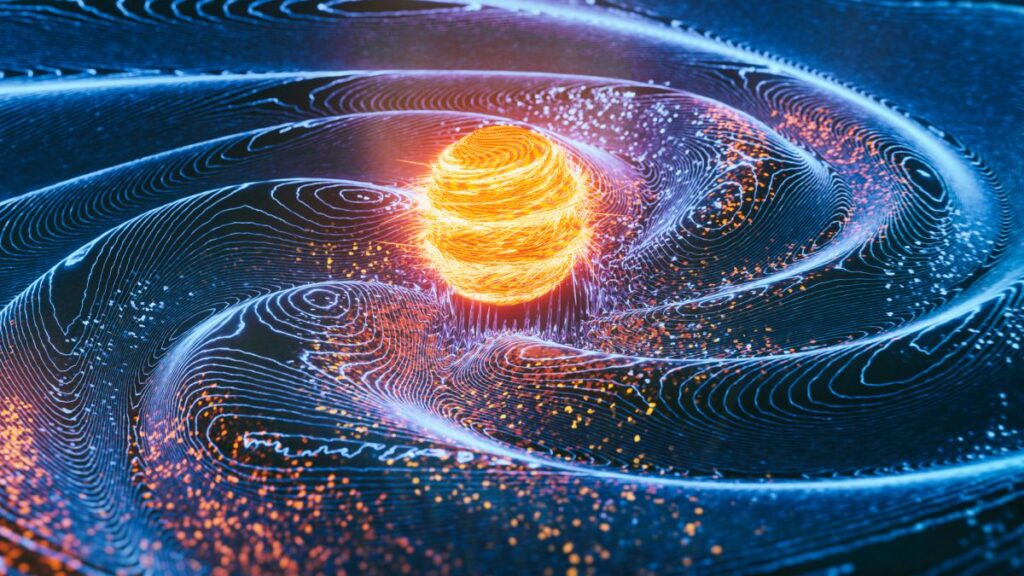
The masses of fundamental particles, such as the Z and W bosons, could originate from the twisted geometry of hidden dimensions, according to a new theoretical paper. This groundbreaking work suggests an alternative to the Higgs field as the source of particle masses, offering fresh insights into the emergence of the Higgs field itself and addressing some persistent gaps in the Standard Model of particle physics.
“In our picture,” explains theoretical physicist Richard Pinčák of the Slovak Academy of Sciences, “matter emerges from the resistance of geometry itself, not from an external field.”
Rethinking the Higgs Field
The Higgs field, first proposed in the 1960s, was a revolutionary concept to explain why fundamental particles have mass. It was a crucial component in the construction of the Standard Model, which serves as the backbone of modern particle physics. The Higgs mechanism, often described as particles moving through an invisible sticky goo, accounts for the varying masses of particles. Those interacting strongly with this “goo” appear heavy, like W and Z bosons, while those with minimal interaction, such as electrons, appear light. Photons, on the other hand, do not interact with it at all.
The existence of the Higgs field was confirmed with the discovery of the Higgs boson at the Large Hadron Collider in 2012. However, the Higgs mechanism does not provide a complete picture. Questions remain about the properties of the Higgs field, its origins, and its inability to explain phenomena like dark matter and dark energy.
The Role of Hidden Geometry
Pinčák and his colleagues propose that clues to these mysteries may lie in the hidden geometry of a seven-dimensional space known as a G2 manifold. A manifold is a mathematical construct used to describe complex geometric shapes, often utilized in theories like string theory to explain the geometry of spacetime and extra dimensions.
These manifolds can possess more directions than the familiar three-dimensional space, requiring up to seven independent directions. The researchers developed a new equation, the G2-Ricci flow, to model how a G2 manifold evolves over time.
“As in organic systems, such as the twisting of DNA or the handedness of amino acids, these extra-dimensional structures can possess torsion, a kind of intrinsic twist,” Pinčák explains. “When we let them evolve in time, we find that they can settle into stable configurations called solitons.”
“These solitons could provide a purely geometric explanation of phenomena such as spontaneous symmetry breaking.”
Implications for the Universe
A soliton is a self-sustaining wave that maintains its shape indefinitely. The researchers discovered that their G2 manifold could relax into such a stable configuration, with torsion that imprints onto W and Z bosons, mimicking the mass-giving effect of the Higgs mechanism.
The findings also suggest that the Universe’s accelerating expansion might be linked to curvature imparted by the torsion of a G2 manifold. If this torsion behaves like a field, it could manifest particles similar to how the Higgs field gives rise to the Higgs boson.
This hypothetical particle, dubbed the Torstone, could potentially be detected through anomalies in particle colliders, cosmic microwave background irregularities, and gravitational wave glitches. While the existence of the Torstone is not yet proven, the study provides a starting point for further investigation.
Looking Forward
Although the concept of hidden dimensions and torsion fields may seem speculative, it echoes the early skepticism surrounding the Higgs field, which took nearly 50 years to confirm. The research published in Nuclear Physics B offers a promising avenue for addressing unresolved questions in particle physics.
“Nature often prefers simple solutions,” Pinčák concludes. “Perhaps the masses of the W and Z bosons come not from the famous Higgs field, but directly from the geometry of seven-dimensional space.”
As the scientific community continues to explore these ideas, the potential for new discoveries in the realm of particle physics remains vast and exciting.