
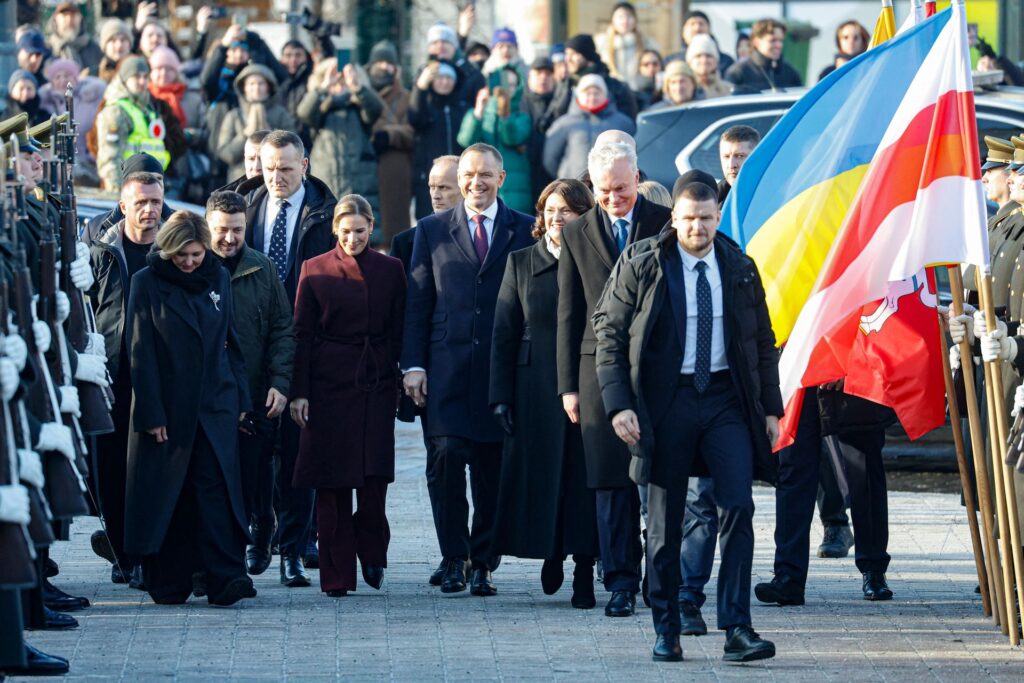
In a poignant speech delivered in Vilnius on January 25, Ukrainian President Volodymyr Zelensky underscored the unity among Poland, Ukraine, and Lithuania, while highlighting the ongoing struggle for true independence in Belarus. He provocatively remarked that Belarusian dictator Alexander Lukashenko’s dog, a white spitz, enjoys more rights than the people of Belarus.
Zelensky’s comments come as a reminder of the peaceful protests in Belarus during 2020, which he described as a missed opportunity for change. “Back then, support for Belarusians was simply not enough,” he lamented. The Ukrainian leader emphasized the increased difficulty, cost, and danger posed by Belarus’s growing dependence on Moscow, a relationship that has not waned.
Belarus’s Role in the Russia-Ukraine Conflict
Since the onset of Russia’s full-scale invasion of Ukraine in 2022, Belarus has played a pivotal role by allowing Russian forces to use its territory for launching attacks. This cooperation extends to Belarusian industries and trade links, which remain integral to Russia’s war efforts. Zelensky highlighted that Russian forces utilize Belarusian territory for drone strikes against Ukraine and as a base for missile operations aimed at Europe.
“That is why Europe must not lose any nation that lives by freedom. That is why Europe must not lose time. That is why every day, all of us in Europe must work for a strong Europe,” Zelensky urged.
His remarks underscore the strategic importance of Belarus in the broader geopolitical landscape, particularly as a platform for Russian military operations and influence over Europe.
Regional Cooperation and Historical Context
Prior to his speech, Zelensky met with Lithuanian President Gitanas Nauseda to discuss pressing issues such as Ukraine’s energy crisis, military cooperation, and the progress of peace talks. The meeting was also attended by Polish President Karol Nawrocki, highlighting the trilateral cooperation among these nations.
Zelensky emphasized the importance of regional partnerships, stating, “Today in Vilnius, we are coordinating with our partners in the region — Lithuania and Poland. We are working with every leader to strengthen Ukraine. Everyone must clearly understand the threat coming from Russia, and it is our nations that understand this best.”
The visit coincided with the anniversary of the January Uprising (1863-64), a historical event of symbolic significance for Lithuania, Poland, Belarus, and Ukraine. The uprising aimed to liberate the peoples of the Grand Duchy of Lithuania and the Kingdom of Poland from the Russian Empire, drawing parallels to the current struggle against Russian aggression.
Support and Solidarity
During his visit, Zelensky also acknowledged the “unprecedented” support provided by Poland and Lithuania since the start of the full-scale invasion. He extended his gratitude to other European countries, the U.S., Canada, and Japan for their continued assistance.
“In 1863, the insurgents could not even dream of such unity – and today, that unity is working. The European Union exists and grows stronger every year,” Zelensky noted.
The visit took place amid ongoing Russian attacks on Ukraine’s critical infrastructure, which have left thousands of Ukrainians without essential services such as heat, electricity, and water. In Kyiv alone, over 1,600 residential buildings remain without heat, underscoring the humanitarian toll of the conflict.
As the situation evolves, the unity among European nations and their allies remains crucial in addressing the challenges posed by Russian aggression and supporting the sovereignty of nations like Belarus and Ukraine.