




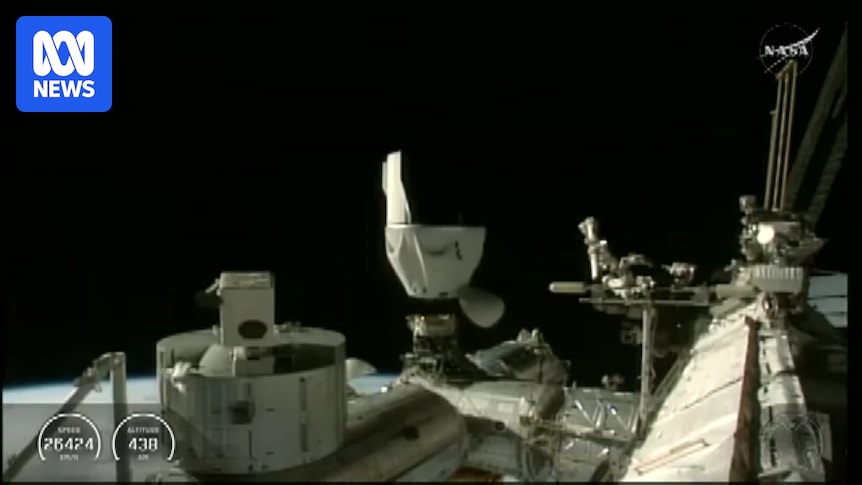
A SpaceX Crew Dragon capsule has undocked from the International Space Station (ISS) and is making its way back to Earth, carrying a four-member crew that includes an astronaut with a “serious medical condition.” The capsule’s return marks an urgent mission to ensure the affected astronaut receives immediate medical attention upon landing.
The Crew Dragon, which includes two NASA astronauts, a Japanese crewmate, and a Russian cosmonaut, began its descent from orbit at approximately 9:20 AM AEDT (2220 GMT). The spacecraft is expected to splash down in the Pacific Ocean, off the coast of California, early Thursday local time.
Urgent Return from Space
The decision to bring the Crew-11 mission back ahead of schedule was announced on January 8. NASA Administrator Jared Isaacman stated that one of the astronauts required urgent medical care that could only be provided on Earth. However, NASA has not disclosed the identity of the affected astronaut or the specifics of the medical condition, citing privacy concerns.
NASA astronauts Mike Fincke and Zena Cardman, along with Roscosmos cosmonaut Oleg Platonov and JAXA astronaut Kimiya Yui, were seen in a live NASA webcast, strapped into the Crew Dragon cabin. They were wearing their distinctive white and black space suits as the capsule smoothly separated from the ISS, which was orbiting 418 kilometers above the Earth at the time.
Mission Details and Background
The Crew-11 mission, which launched from Florida in August, was initially set to continue for several more weeks. The crew’s tasks included a planned spacewalk to install hardware outside the ISS, which was canceled on January 7 due to the medical issue. NASA Chief Health and Medical Officer James Polk clarified that the emergency did not result from an operational injury.
The mission, if concluded as planned with the upcoming splashdown, will have lasted a total of 167 days. This mission is part of NASA’s ongoing collaboration with international partners, including Russia’s Roscosmos and Japan’s JAXA, to maintain a continuous human presence in space.
Expert Opinions and Historical Context
Space missions are inherently risky, and the health of astronauts is a top priority for space agencies. Dr. Sarah Johnson, a space medicine expert, noted, “The decision to return a crew early is never taken lightly. It underscores the importance of having robust medical protocols and the ability to respond quickly to health issues in space.”
This situation is reminiscent of past incidents where medical emergencies have altered mission plans. In 1970, the Apollo 13 mission famously faced a life-threatening situation that required an emergency return to Earth. While technology and medical capabilities have advanced significantly since then, the fundamental challenges of space travel remain.
Looking Ahead
As the Crew Dragon approaches its splashdown, recovery teams are on standby to ensure a swift and safe retrieval of the astronauts. The capsule’s return will be closely monitored, and the affected astronaut will receive immediate medical evaluation and care.
This incident highlights the ongoing challenges of long-duration spaceflight and the critical importance of international cooperation in addressing unexpected events. As space agencies continue to push the boundaries of exploration, ensuring the safety and well-being of astronauts remains a paramount concern.
The successful completion of this mission will not only bring relief to the crew and their families but also provide valuable insights into managing medical emergencies in space, paving the way for future missions to the Moon, Mars, and beyond.