




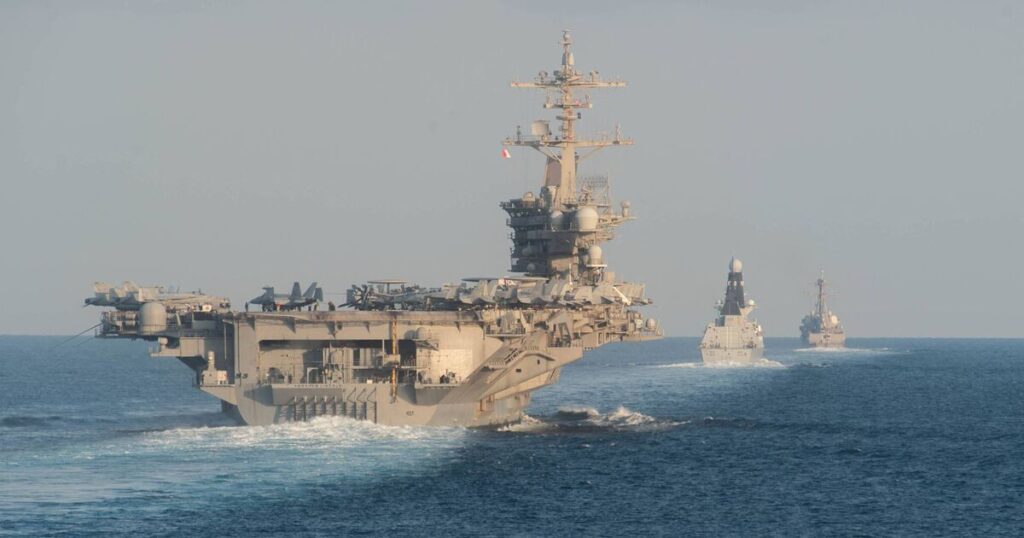
In a significant development amid escalating tensions in the Gulf, Iran has reportedly deployed 1,000 “strategic drones” across its armed forces. This move appears to be a direct response to the United States’ recent military maneuvers, as President Donald Trump has dispatched a formidable naval “armada” to the Gulf Coast. The Iranian state news outlet Tasnim, closely associated with the Islamic Revolutionary Guard Corps (IRGC), confirmed the deployment, although it withheld photographs to protect “military secrets.”
The deployment of these drones comes as President Trump announced on Truth Social that the naval fleet, led by the Aircraft Carrier Abraham Lincoln, is prepared to deliver a strike “far worse” than last June’s Operation Midnight Hammer, which targeted Iran’s nuclear facilities. Trump emphasized the fleet’s readiness to act with “speed and violence” if necessary, urging Iran to negotiate a deal to prevent further military action.
Escalating Military Postures
The announcement of Iran’s drone deployment follows a series of provocative exchanges between the US and Iran. President Trump’s bold statements on social media have underscored the seriousness of the situation, as he warned Iran to “MAKE A DEAL” to avoid another destructive military operation. In response, Iranian officials have issued stern warnings, suggesting that any US military action would be considered an act of war, with immediate and unprecedented retaliation targeting key locations.
The current situation is a continuation of the heightened tensions that have characterized US-Iran relations in recent years. The Trump administration’s withdrawal from the Joint Comprehensive Plan of Action (JCPOA) in 2018 and the subsequent imposition of sanctions have exacerbated hostilities. Iran’s recent advancements in its nuclear and missile programs have further strained diplomatic efforts.
Historical Context and Expert Opinions
Historically, the Gulf region has been a flashpoint for international conflict, with the US and Iran often at odds over strategic interests. The deployment of drones by Iran is seen by analysts as a strategic move to bolster its defense capabilities and deter potential airstrikes. According to military experts, drones provide Iran with a cost-effective means of surveillance and potential offensive capabilities, complicating US military calculations.
Dr. Ali Rezaei, a Middle East security analyst, explained, “The use of drones by Iran is a game-changer in the region. It allows them to project power without direct confrontation, which is crucial given the asymmetrical nature of their military strategy against a superior US force.”
“A limited strike is an illusion. Any military action, from America from any origin and at any level, will be considered the start of war, and its response will be immediate, all out, and unprecedented, targeting the heart of Tel Aviv and all supporters of the aggressor,” a senior adviser to Supreme Leader Ali Khamenei stated.
Implications and Future Outlook
The deployment of US naval forces and Iran’s strategic drones raises the stakes in an already volatile region. The potential for miscalculation or accidental engagement is high, with both sides demonstrating a readiness to escalate. The international community is closely monitoring the situation, with calls for restraint and renewed diplomatic efforts to prevent a full-scale conflict.
As the US and Iran continue to navigate this precarious situation, the focus remains on diplomatic channels to resolve the underlying issues. The failure of initial talks concerning Iran’s nuclear and missile programs highlights the challenges ahead. However, the urgency of the situation may compel both sides to reconsider their positions and seek a peaceful resolution.
In the coming weeks, the world will be watching closely to see if cooler heads prevail or if the Gulf region will once again become the epicenter of international conflict. The stakes are high, and the consequences of failure could be catastrophic for the region and beyond.