Minneapolis: Local activist and chef Michael Wilson led a crowd in a tribute to Minneapolis nurse Alex Pretti, when a woman kneeling beside the memorial suddenly emitted a guttural scream. “Peace,” she yelled. “Peace.” Her call was soon echoed by another woman, who shouted, “I’m a nurse. We want peace.” The hundred or so mourners gathered on the roadside joined in a spontaneous chant: “All. Nurses. Want. Peace.”
Despite the freezing temperatures of minus 20 degrees, the crowd continued to grow throughout the day. Wilson, taking back control of the gathering, reminded everyone, “This man was a medic, y’all. He was a nurse. For veterans. Wow, y’all. They’re telling us two plus two equals five. They’re telling us a nurse for the VA [Veterans Affairs] was a domestic terrorist.”
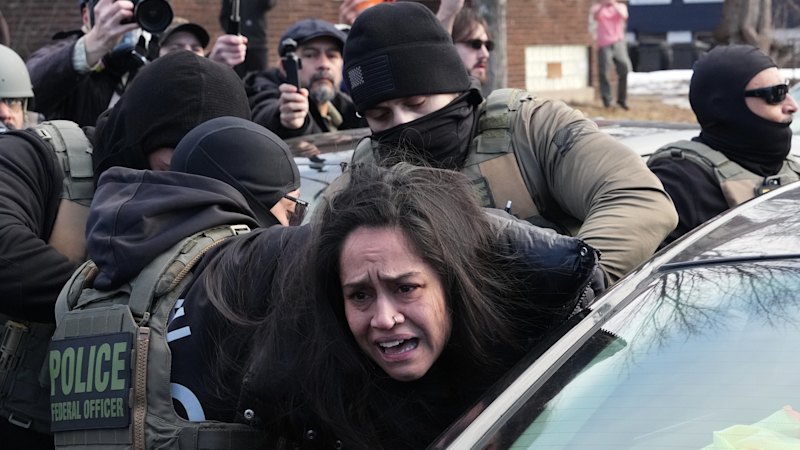
Pretti’s death on Saturday at the hands of federal immigration agents has sent shockwaves across the nation. However, in Minneapolis, where another American citizen, Renee Good, was shot dead by federal agents just three weeks prior, and where George Floyd was killed by police in 2020, the reaction is beyond shock—it’s all-out despair.
Community Outrage and Calls for Change
Debbie Claypool, a 58-year-old advertising worker from nearby Fridley, expressed her grief, stating, “I’m grieving for democracy. This is fascism. I’m a child of a mother that was a German Jew in Nazi Germany, so this kind of hits home for me. This can’t happen. We’ve got to get rid of ICE [Immigration and Customs Enforcement].”
The sentiment against ICE is palpable on the streets of Whittier, the suburb where Pretti was killed. Bus stops are covered in “F— ICE” graffiti, and shop windows display posters for protests and legal advice for immigrants: “Know your rights.” A graffiti tag at the Spyhouse coffee shop escalates the rhetoric with “Kill ICE.”
When Donald Trump was inaugurated as president, he delivered a stark speech, promising, “This American carnage stops right here and stops right now.” However, in Minneapolis, a unique brand of American carnage appears to have taken hold, characterized by masked men patrolling the streets, federal police clashing with locals, and a government seemingly at odds with its citizens.
Historical Context and Government Response
The Trump administration has focused on Minneapolis more than other cities like Los Angeles or Chicago. With 3,000 ICE agents dispatched to the area, Trump and his team have aggressively pursued Minnesota’s governor, Tim Walz, over an alleged welfare fraud scandal involving Somali migrants, accusing him and other Democratic leaders of inciting hysteria about ICE and being responsible for the deaths of Good and Pretti.
Vice President JD Vance commented on the situation via social media, stating, “This level of engineered chaos is unique to Minneapolis. It is the direct consequence of far-left agitators, working with local authorities.”
At the memorial for Pretti, Josephine Guilbeau, a former US Army intelligence analyst, led the crowd in the Lord’s Prayer. Guilbeau, who was previously arrested for interrupting a Senate hearing, expressed her reason for attending: “I flew in this morning because I needed to mourn. I want to mourn what I’m witnessing. I don’t want to make this normal. I don’t want anyone in this country to normalize what we’re witnessing.”
Public Opinion and Political Divide
In this charged atmosphere, gauging public opinion can be challenging. Polls indicate that most Americans are uneasy about ICE’s tactics and rate Trump negatively on immigration, even if they support his efforts to secure the southern border. This sentiment is particularly strong among Democrats, and Minneapolis is one of the bluest cities in the nation.
Liz Lee, a Minneapolis resident, shared her concerns: “It’s generally so unsettling even if you’re not a protester to feel like on any given corner, street, anywhere, you just walk out of your home and there could be armed agents taking you down, taking community members down, detaining observers.”
Conversely, an Uber driver from New York provided a different perspective, questioning the protesters’ arguments and expressing confusion over the left-wing stance on immigration. He stated, “I don’t have a problem with ICE doing their job, but I’ve got a problem with ICE doing their job poorly. If they’re shooting people left and right that don’t deserve to be shot, or otherwise could be handled better, well then I would prefer not.”
Protests and the Path Forward
Back in the city center, hundreds of demonstrators gathered for a rally despite the frigid temperatures. Among them was Carolyn Pare, a former Minnesota resident who returned to protest in the wake of Pretti’s death. Pare, along with her friends, emphasized the need to “pay it back and tell people what it really looks like, and not let it happen.”
When asked about the Trump administration’s argument that the protesters should not have been there, Pare vehemently disagreed: “Nobody deserves to die. George Floyd didn’t deserve to die. Who are we that we’re all so judgmental that we can say who deserves to live and die? The reality is what we’re doing to people is just awful.”
The events in Minneapolis highlight a deepening divide in America over immigration policy and federal enforcement tactics. As the city grapples with these issues, the broader implications for national policy and community relations remain uncertain.
Stay informed with updates from our foreign correspondents by signing up for our weekly What in the World newsletter.