



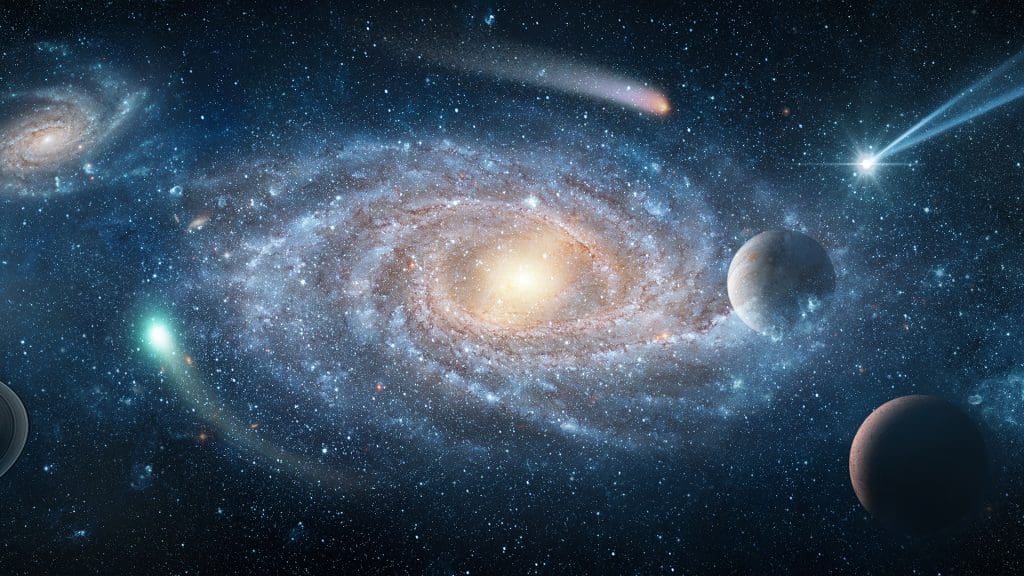
The European Space Agency’s Gaia space telescope has made a groundbreaking discovery: a vast wave rippling across the Milky Way galaxy. This revelation was discussed in detail by Johannes Sahlmann, Project Scientist at ESA, in an interview with Editor Maddie Hall. The discovery underscores Gaia’s mission to deepen our understanding of the Milky Way’s structure and evolution.
Launched in 2013, Gaia aims to map approximately 2 billion stars and other celestial objects, representing about 1% of the Milky Way’s total stellar content. Despite this seemingly small percentage, the data collected allows scientists to extrapolate valuable insights into the galaxy’s dynamics. The discovery of the great wave, extending tens of thousands of light-years from our Solar System, is a testament to Gaia’s exceptional capabilities in capturing three-dimensional data.
The Significance of the Great Wave
The great wave was identified through Gaia’s precise measurements of stellar positions, distances, and motions, published in a 2022 data release. While the existence of such waves had been anticipated, Gaia’s ability to conduct both qualitative and quantitative studies has facilitated this discovery. The wave is currently the largest known in our galaxy, covering a vast area of the Milky Way.
According to Sahlmann, understanding these waves is crucial for achieving Gaia’s fundamental goal of comprehending how our galaxy functions and evolves. The multi-dimensional measurements of star motions have opened new avenues for understanding the relationship between these motions and other large-scale structures within the Milky Way.
Exploring the Causes of the Great Wave
The discovery raises intriguing questions about the origins of such waves. One hypothesis is that they may result from a collision with a dwarf galaxy. Sahlmann explains that gravitational interactions between galaxies can create a range of observable effects in the Milky Way. These interactions can cause the galactic disk to wobble and warp, altering the distribution of stars.
“An analogy often used to explain this to the general public is that of a pond: if you throw a rock into the water, it creates ripples on the surface, similar to the perturbations in our Milky Way,” Sahlmann noted.
However, the dynamics are complex, driven by gravitational interactions among various celestial bodies. In addition to galaxy collisions, other factors such as dark matter also influence these perturbations.
The Role of Young Stars
Young stars play a crucial role in understanding the great wave. Unlike older stars, which have made many revolutions around the Galactic Centre and lost information about their origins, young stars retain more information about their formative conditions. This makes them particularly useful for studying the wave’s characteristics.
Sahlmann highlights that using information from both young and old stars can provide complementary insights, enhancing our understanding of the galaxy. Young stars, being bright, are easier to observe with high precision, making them ideal probes for this research.
Gaia’s Technological Marvel
Gaia’s technological prowess is central to its success. The satellite features a 10-meter-diameter sunshade and optical components approximately 3 meters in diameter. It boasts the largest focal plane ever flown in space, with nearly 1 billion pixels across 106 charge-coupled devices (CCDs). The satellite spins continuously, completing a revolution every six hours, and collects over 3 trillion individual observations.
Processing this immense dataset is a formidable challenge, undertaken by a consortium of roughly 450 engineers, scientists, and specialists from across Europe. The data is converted into publicly available catalogues, hosted at the European Space Astronomy Centre near Madrid.
Future Prospects and Missions
Looking ahead, the Gaia mission promises even more insights. The next data release, expected at the end of 2026, will encompass approximately 5.5 years of Gaia data, with the final release anticipated not before the end of 2030. These releases will allow for more sophisticated models and detailed investigations into the great wave and other phenomena.
Sahlmann emphasizes the potential for future missions to build upon Gaia’s findings. A proposed mission concept, outlined in ESA’s Voyage 2050 plan, aims to observe in the infrared spectrum, overcoming the limitations of interstellar extinction and providing insights into the inner regions of the galaxy.
“Great Waves have been observed in other galaxies, although not with the same level of detail as in the Milky Way,” Sahlmann added. “The advantage of studying our own galaxy is that our position within it allows for a more intricate analysis.”
Collaboration between ESA’s science missions, such as Gaia and the Euclid mission, which focuses on cosmology, will likely yield significant scientific insights, enhancing our understanding of the Milky Way within the broader context of the Universe.
While the Gaia satellite was switched off in March 2025 due to running out of the gas necessary for position control, the mission is far from over. The data collected will continue to be processed and published, with the final release scheduled not before the end of 2030. This ongoing work highlights the dedication of the international team involved in this monumental project.