

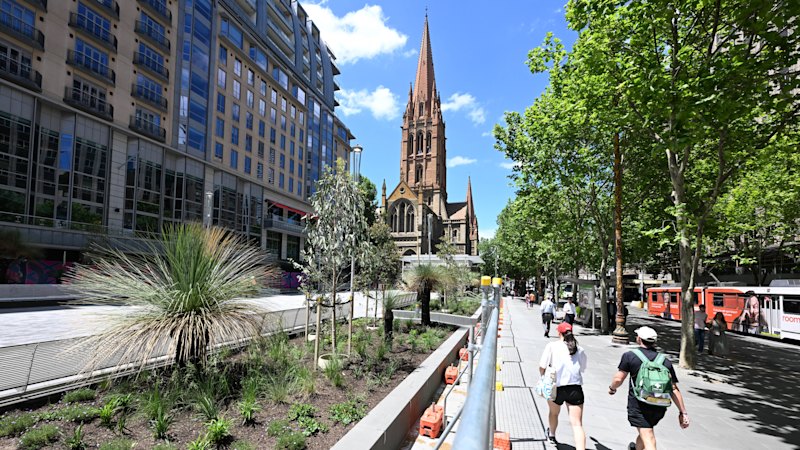
Melbourne’s City Square, once criticized as the city’s “greatest blight,” is set to reopen this Sunday, coinciding with the much-anticipated launch of the Metro Tunnel. This transformation promises to breathe new life into the urban landscape, offering a fresh gathering space for the community.
The square, located opposite the Town Hall, has been closed for eight years. Craig Guthrie, principal landscape architect and urban designer at Hassell, expressed his hopes for the square’s new iteration. “There is the new station entry, quite a grand station entry, which you can already see now,” he stated. “The rest of the square will be a new community space for events, informal and formalized events, with lots of seating around the edge to look into.”
The Transformation of City Square
The redevelopment of City Square marks a significant shift in focus towards First Nations history. The removal of the Burke and Wills statue, now in storage with plans for relocation, underscores this change. Guthrie noted, “The previous designs of the City Square have been very colonial, so this will be giving a completely fresh outlook about the history it’s expressing.”
Mel Dodd, Dean of Art, Design, and Architecture at Monash University, described the space as “a bit of a sad square” and hopes the influx of people accessing the Metro Tunnel will invigorate it. “Providing the function of a transport interchange gives it some functionality that I think civic spaces often need,” she remarked. “Before that it had the sense of being a square without necessarily a strong purpose except being adjacent to the edge of a large hotel.”
A New Era for Public Spaces
The revamped square features a large canopy with a white slatted roof over the entrance to the new Town Hall station. Familiar elements like the Mockridge fountain and the Brunetti cafe have been replaced. The fountain’s space now hosts a digital artwork, with cascading digital lights imitating water.
Retail spaces along the Westin hotel remain boarded up, but a smoking ceremony dish, developed with Wurundjeri elder Aunty Joy Wandin Murphy, adds cultural depth. Around the station entrance, Wurundjeri text is carved into the stone, welcoming visitors with “Wominjeka Kirrip, Welcome Friends.”
“It’s like a little lung for Swanston Street and Collins Street, it’s a gap, you can have a breather,” said Dodd.
Community Reactions and Future Prospects
Southbank resident Tina Kuang, observing the construction for years, expressed her amazement at the modern design. “I’m quite amazed, especially the modern building’s link with the church,” she said. “You see the history and the modern city combining.”
The square’s redesign includes a small visitors’ hub and a two-tiered concourse with shops and food outlets, featuring brands like Brunetti Oro, Sushi Jiro, McDonald’s, Starbucks, KFC, and an IGA supermarket.
Recently, a surprise concert featuring Jimmy Barnes, Kate Ceberano, and Ian Moss offered a sneak peek of the square’s potential as a vibrant community hub. Premier Jacinta Allan announced the event as “live and free at Metro Tunnel’s new City Square.”
Historical Context and Challenges
City Square’s history is marked by its absence in Robert Hoddle’s original 1837 grid design for Melbourne, a choice to avoid spaces for mass protest. The square was eventually introduced in 1968, opened by Queen Elizabeth II in 1980, and has since faced numerous challenges, including proposals for a casino and partial sell-off for the Westin hotel.
Reports in The Age have described the square as “sad”, “grey and desolate”, and “a large and well-watered expanse of grey stone: thick on ornament, thin on comfort”.
Rory Hyde from the University of Melbourne commented on the square’s new identity. “It’s like the square now belongs to the Metro Tunnel, which shifts the whole hierarchy,” he noted. “Does it just become a kind of foyer to the train, rather than a space of democracy or protest or speeches or coming together, which is what a really important city square should do.”
Transport Minister Gabrielle Williams described the redevelopment as “a serious glow-up” for City Square, emphasizing its greener and more welcoming environment. Despite its challenges, the square’s new design offers a blend of historical homage and modern functionality.
As Melbourne prepares for the Metro Tunnel’s opening, City Square stands ready to redefine its role in the city’s public life, offering a space for both transit and community engagement.