



Scientists are urgently working to contain a new outbreak of the coral-eating crown-of-thorns starfish (COTs) on the Great Barrier Reef, which experts warn could become one of the most severe in 60 years. The Great Barrier Reef Marine Park Authority (GBRMPA) has identified the outbreak between Cairns and Lizard Island, a critical 240-kilometer stretch known for its high coral diversity and tourism activities.
This development follows four documented COTs outbreaks on the Great Barrier Reef since the 1960s, with the most recent beginning in 2010 and still being managed today. According to studies, these outbreaks typically occur in cycles of approximately 17 years, making the current situation ahead of schedule. GBRMPA chief scientist Roger Beeden expressed significant concern as a fifth wave emerges in the same northern region while the fourth wave remains under control.
“We’re beginning to see a build-up in adult crown-of-thorns starfish and we need to get on top of it as fast as we possibly can,” said Dr. Beeden.
Coral Killer on the Move
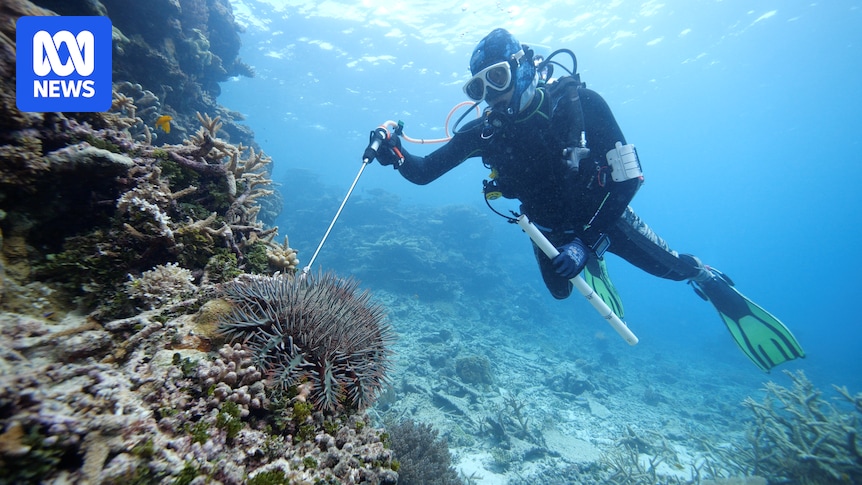
The crown-of-thorns starfish, native to the reef, can devastate coral populations when their numbers become unmanageable. Each starfish consumes coral equivalent to the size of its body daily. Long-term monitoring by the Australian Institute of Marine Science indicates that COTs are a major driver of coral loss, responsible for up to 40% of coral decline over four decades of observation.
“Think a bit like plague locusts,” Dr. Beeden explained. “When we get very large numbers, they can have a very large impact upon coral cover on the Great Barrier Reef. One single starfish can produce hundreds of millions of eggs, which can then spread through the marine park with the current flow.”
Starfish Wars
In response, the COTs control program deploys specialist dive teams to locate and inject individual starfish. Dive supervisor Adam Skerritt, who recently completed a 15-day rotation, described the process as slow, physical, and highly methodical. Divers often identify COTs by their scar trails, which resemble toothpaste, before injecting them with cow bile or vinegar.
Skerritt noted that areas between Irene Reef and Lizard Island are particularly affected. “Startle Reef, for example — we’ve seen a lot there,” he said. The worst outbreak he witnessed occurred two years ago when divers encountered about 100 starfish per dive per person.
“When you get that many in a small area, it can spread across the entire reef system very quickly,” Skerritt added.
World Heritage Status and Tourism at Stake
The control program, costing approximately $25 million annually, is crucial for protecting the reef, which contributes about $9 billion each year to the local economy and supports thousands of jobs in Far North Queensland. Sheridan Morris, managing director of the Reef and Rainforest Research Centre, emphasized the program’s importance in providing real-time data for timely responses.
“In the face of bleachings and cyclones and climate change, what you have to do is remove pressures,” Morris stated.
The COTs control program is a vital component of the federal government’s strategy to actively manage the Great Barrier Reef amid escalating climate pressures. Environment Minister Murray Watt recently announced an additional $1.4 million in funding, underscoring the program’s significance in reef protection.
Australia is preparing a State of Conservation report for UNESCO, due by February 1, detailing progress on climate change, water quality, and reef management, including pest control initiatives like COTs culling. Sunlover Reef Cruises master reef guide Michelle Barry highlighted the reef’s health as essential to millions of tourists visiting each year.
“Having tourists every day seeing what we’re doing, in addition to having a great time on the reef, is really important,” Barry said. “You can see that science and good times can be had together.”
The ongoing efforts to manage the crown-of-thorns starfish outbreak will be crucial in preserving the Great Barrier Reef’s ecological and economic value, ensuring its resilience against future environmental challenges.