

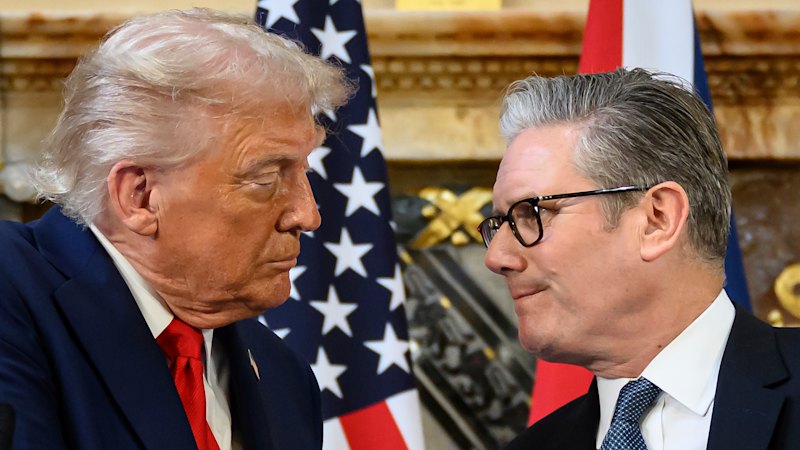
US President Donald Trump has ignited a storm of criticism across Europe after making controversial claims about the role of allied troops in Afghanistan. During an interview with Fox News, Trump suggested that allied forces “stayed a little back” from the front lines, prompting backlash from war veterans, political leaders, and even members of the British royal family.
UK Prime Minister Keir Starmer was among the first to demand an apology, labeling Trump’s comments as “insulting” and “appalling.” His stance was echoed by conservative leaders and families of veterans who served in Afghanistan, who described the remarks as a “disgraceful” affront to the sacrifices made by their loved ones.
International Backlash and Media Frenzy
The uproar quickly dominated British media and spread to other NATO allies, including France. Trump’s remarks, made during the World Economic Forum in Davos, questioned the reliability of NATO allies and minimized their contributions to the Afghanistan conflict. He stated, “We get along very well with NATO, I think, but I’ve always said will they be there if we ever needed them, and that’s really the ultimate test. And I’m not sure of that.”
These comments were met with strong rebuttals, highlighting the historical inaccuracies in Trump’s statements. Notably, NATO allies have been instrumental in various conflicts, especially following the September 11 attacks, when the US invoked the NATO treaty for support.
Responses from Veterans and Royalty
Prince Harry, who served in Afghanistan as an Apache helicopter co-pilot, added his voice to the growing criticism. He emphasized the shared sacrifices and the historical significance of NATO’s collective response to the 9/11 attacks. “In 2001, NATO invoked Article 5 for the first – and only – time in history,” he stated. “It meant that every allied nation was obliged to stand with the United States in Afghanistan, in pursuit of our shared security. Allies answered that call.”
Former paratrooper Ben Parkinson, who was severely injured in Afghanistan, expressed his shock at Trump’s remarks, while his mother called them “disgraceful.” The backlash extended to France, where military historian Michel Goya condemned Trump’s comments on social media.
Historical Context and NATO’s Role
Trump’s assertion that the US has never asked anything of NATO allies is factually incorrect. The US has relied on NATO support in major conflicts since World War II. Under Article 5 of the NATO treaty, an attack on one member is considered an attack on all, a principle invoked after the 9/11 attacks.
NATO allies, including Australia, the UK, and Canada, deployed troops to Afghanistan, often serving in front-line positions. Australian forces, for example, were stationed in Uruzgan province alongside Dutch troops, engaging in direct combat operations.
“For every two Americans who paid the ultimate price, there was one soldier from another NATO country who did not come back to his family – from the Netherlands, from Denmark, and particularly from other countries,” stated NATO Secretary General Mark Rutte.
Implications for US-European Relations
The controversy raises questions about the future of US-European relations, especially in light of upcoming diplomatic events. King Charles III’s planned visit to the US to commemorate the 250th anniversary of the Declaration of Independence now faces scrutiny, given Trump’s past admiration for the royal family.
Polish Prime Minister Donald Tusk also weighed in, recalling his visit to Afghanistan in 2011 after the deaths of Polish soldiers. “The American officers who accompanied me then told me that America would never forget the Polish heroes. Perhaps they will remind President Trump of that fact,” Tusk posted on social media.
As the international community grapples with the fallout from Trump’s remarks, the incident underscores the complex dynamics within the NATO alliance and the enduring importance of historical alliances in global security.