

Hundreds of public schools in New South Wales (NSW) have installed synthetic turf on their grounds, sparking concerns about the surface’s impact on children’s health and the environment. A recent survey by the Department of Education revealed that 58% of the state’s 2,200 public schools now feature synthetic turf.
This revelation marks the first time the department has disclosed the extent of synthetic turf usage in schools, a decision prompted by growing public scrutiny. The material, often promoted as a low-maintenance alternative to natural grass, is facing backlash due to its potential health risks and environmental impact.
Concerns Over Health and Environmental Impact
The synthetic turf, made from plastic, can reach extreme temperatures and leach harmful chemicals and microplastics into the environment. A department spokesman acknowledged these risks, noting that the air temperature above artificial turf can exceed comfortable levels, contributing to the urban heat island effect.
“The synthetic turf has been installed at these schools over many years, with extents ranging from a few square meters to full-size soccer fields,” the spokesman said. “We are aware that air temperature above artificial turf has the potential to exceed a comfortable temperature and contributes to the urban heat island effect.”
“The department works to reduce the heat island effect through shading of synthetic turf, turf infill choice, material choices, and irrigation.”
Advocacy and Research Efforts
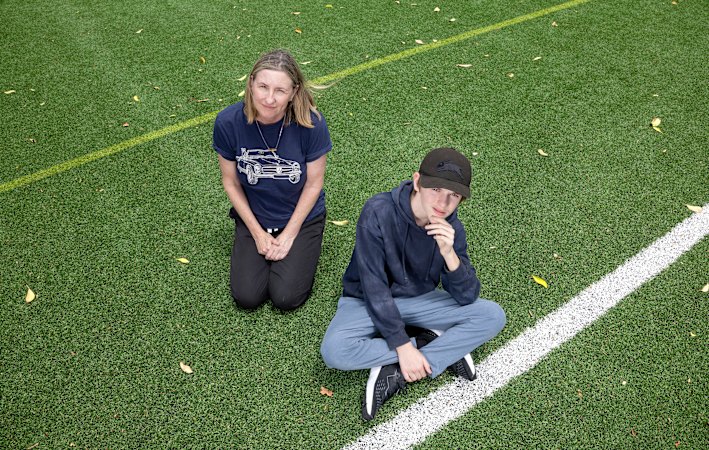
Sydney mother and co-founder of the National Turf Alliance, Catriona Carver, took it upon herself to estimate the number of schools with synthetic turf by cross-referencing satellite images, manufacturers’ websites, and school communications. Her findings indicated that at least one-third of schools in Greater Sydney have synthetic turf, including 150 schools in high bushfire risk zones.
A 2023 report by the NSW chief scientist and engineer advised against synthetic sports fields in high bushfire and flood risk areas, citing the presence of biological pathogens and toxic chemicals. Carver emphasized the need for more information on the long-term health impacts of synthetic turf.
“[Synthetic turf] has some benefits to play, but it’s got too many negatives for long-term health for children, and too much is unknown,” Carver said.
Expert Insights on Heat and Safety
Professor Sebastian Pfautsch from Western Sydney University has been researching the effects of heat and synthetic turf in schools since 2019. His studies, involving nearly 1,000 students, revealed that synthetic turf can reach temperatures as high as 75 degrees Celsius, compared to 37 degrees for natural grass.
Pfautsch noted that the radiant heat from synthetic surfaces also affects nearby classrooms, increasing the need for air conditioning. At Granville Boys High School, temperatures reached 48.2 degrees Celsius, exacerbated by the enclosed space and surrounding buildings.
“When you go for recess and your lunch break, and it’s very hot when you get back to the classroom, it takes much longer to find concentration again,” Pfautsch said.
Future Considerations and Community Response
In response to these findings, a NSW School Infrastructure spokesman stated that natural turf is preferred whenever possible, with synthetic materials used only in high-use or shaded areas. The department is updating its facilities standards based on feedback from schools.
Meanwhile, local councils are reconsidering the use of synthetic turf. Ku-ring-gai Council is debating the removal of synthetic turf at Charles Bean Oval, used by Lindfield Learning Village, due to contamination concerns.
Parents like Julia Hobson have voiced their worries, stating that children are afraid to play on synthetic fields due to health risks.
“That’s unacceptable, that in a school environment, you’re having to make those decisions to avoid an area to make your kids feel safe,” Hobson said.
As the debate continues, Carver insists that the only solution to the heat problem posed by synthetic turf is its removal.
“Heat is the biggest thing that nobody can change. You either cover it all up, or you don’t have it. There’s no other way because you can’t do anything about it,” she said.