


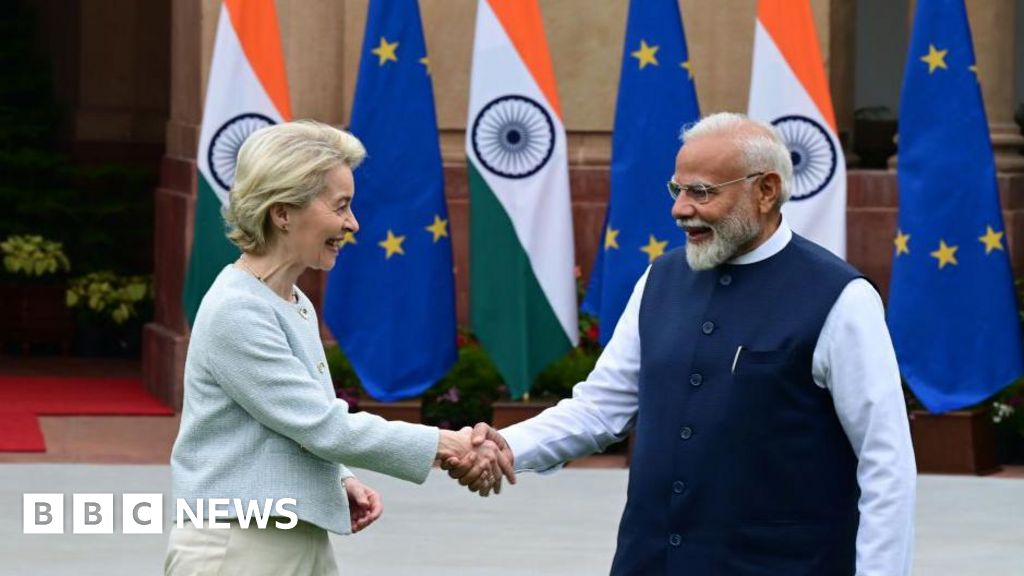
European Council President Antonio Luis Santos da Costa and European Commission President Ursula von der Leyen are set to attend India’s Republic Day celebrations next Monday as chief guests. Beyond the ceremonial grandeur, the visit holds significant diplomatic weight, with both leaders aiming to advance free trade talks with India, Asia’s third-largest economy. This initiative comes at a critical geopolitical juncture for Europe, as President Donald Trump has oscillated between escalating and de-escalating trade tensions with European allies.
The presence of these high-profile European leaders underscores India’s strategic pivot towards strengthening global trade ties, especially as it grapples with the impact of Washington’s hefty 50% tariffs. According to Chietigj Bajpaee of Chatham House, “It sends a signal that India maintains a diversified foreign policy… and that it is not beholden to the whims of the Trump administration.”
Progress Towards a Landmark Trade Agreement
Reports suggest that a landmark trade agreement between India and the EU could be announced as early as January 27, during a high-level summit. Both Ursula von der Leyen and India’s Trade Minister Piyush Goyal have referred to this potential agreement as the “mother of all deals,” highlighting its significance after nearly two decades of negotiations.
This prospective deal would be India’s ninth free trade agreement in four years, following successful negotiations with countries like the UK, Oman, and New Zealand. For the EU, it builds on recent agreements with the Mercosur trading bloc, Japan, South Korea, and Vietnam.
“Both sides now seek reliable trade partners, as threats arising out of the geopolitics have created a tumultuous environment for commerce. The urge is equally strong – for India to offset US tariff issues, and the EU to offset trade dependence on China which it considers unreliable,” says Sumedha Dasgupta, senior analyst at the Economist Intelligence Unit.
Economic and Diplomatic Implications
For the European Union, closer trade ties with India are crucial given India’s burgeoning economic stature. As the world’s fourth-largest and fastest-growing major economy, India is projected to surpass Japan in GDP, reaching over $4 trillion. Von der Leyen emphasized at the World Economic Forum in Davos that a partnership with India would create a free market encompassing two billion people, representing a quarter of global GDP.
From India’s perspective, the EU is already its largest trading partner. An agreement would restore the Generalised System of Preferences (GSP), which previously removed import duties for developing countries’ products entering the EU. Ajay Srivastava of the Global Trade Research Initiative notes, “India exported about $76 billion of goods to the EU while importing $61 billion, earning a trade surplus, but the withdrawal of EU GSP benefits in 2023 eroded competitiveness for many Indian products.”
However, India is likely to protect sensitive sectors such as agriculture and dairy, while gradually reducing tariffs on cars, wine, and spirits, consistent with its approach in past deals. Bajpaee explains, “India’s proclivity has been to adopt a phased approach towards negotiating trade deals by moving more politically-sensitive issues into subsequent rounds of negotiation.”
Challenges and Future Prospects
Despite progress, significant challenges remain. Europe seeks stronger intellectual property protections, while India is concerned about the EU’s new Carbon Border Adjustment Mechanism (CBAM), which acts as a border charge on Indian exports. Srivastava warns, “This is particularly damaging for MSMEs [micro, small, and medium-sized enterprises], which face high compliance costs and complex reporting requirements.”
Whether the deal becomes a “growth-enabling partnership or a strategically asymmetric deal” hinges on resolving these issues. Nonetheless, analysts believe the agreement could expedite the decoupling of trade from the US and other unreliable partners, reducing vulnerabilities to fluctuating tariffs and export controls.
“Ultimately it could expedite trade decoupling from the US and other unreliable partners. It will mean reducing dependencies on Trump’s America – or China for that matter – reducing vulnerabilities to on-again, off-again tariffs, export controls and the general weaponisation of supply chains,” says Alex Capri of the National University of Singapore.
While concerns over India’s carbon emissions and human rights record persist in Europe, India’s planned reduction of Russian crude oil purchases from November 2025 could facilitate smoother passage of the deal through the EU parliament. Dasgupta concludes, “Political friction with the US since early 2026 means that EU leaders will now be more welcoming towards this trade deal than they would have otherwise been.”