

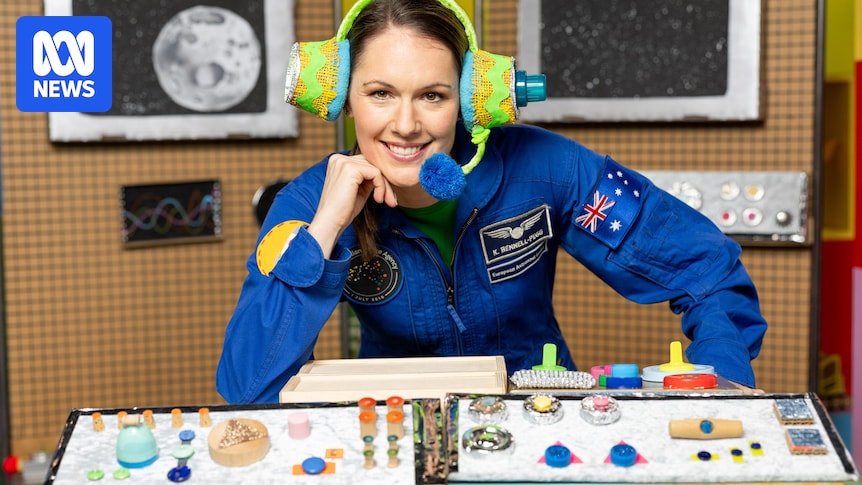
When Katherine Bennell-Pegg was named the Australian of the Year, she seized the opportunity to clarify misconceptions about her field. “Space isn’t about escaping the Earth,” the space engineer and trained astronaut told ABC Radio’s Hamish Macdonald. “It’s about helping us to see it more clearly.”
This perspective echoes the sentiments of English cosmologist Fred Hoyle, who in his 1950 book, The Nature of the Universe, highlighted space’s ability to alter our perception of Earth.
“Once a photograph of the Earth, taken from outside, is available, we shall in an emotional sense acquire an additional dimension,” Hoyle wrote. “Let the sheer isolation of the Earth become plain … and a new idea as powerful as any in history will be let loose.”
For Bennell-Pegg, the journey to becoming a space pioneer began in her childhood on Sydney’s northern beaches. “When I was very young, I used to like lying on the grass looking up through the gum tree canopies in my garden,” she recalled. Her mother, a physics graduate, would explain the cosmos to her, igniting a lifelong passion for space exploration.
From Dreams to Reality
In 2024, Bennell-Pegg became the first Australian to qualify as an astronaut under Australia’s space program, marking a significant milestone in her ongoing adventure. Her ambition was evident early on. “In Year 8, school asked us to all write down three things we wanted to be when we grew up, and I just wrote one: ‘astronaut’,” she said.
Despite her mother’s fear of flying, Bennell-Pegg learned to fly as a teenager, even before obtaining her driver’s license. Her initial attempt to join the air force as a pilot was thwarted by a medical postponement, but this setback did not deter her. She pursued engineering and physics at the University of Sydney, where she was inspired by fellow Australian astronaut Andy Thomas.
After graduating in 2007, Bennell-Pegg sought further education and experience abroad, including internships at NASA and the European Space Agency. “I got to help launch rockets under the aurora in northern Sweden, and I’m so grateful that I got to learn so much because ultimately I could bring it back home,” she said.
A Vision for Australia’s Future in STEM
Now residing in Adelaide with her two daughters, Bennell-Pegg serves as the director of space technology at the Australian Space Agency. Her Australian of the Year acceptance speech emphasized the importance of securing Australia’s future in science, technology, engineering, and maths (STEM). This is a lesson she aims to pass on to her children, who accompanied her to Germany during her astronaut training at the European Astronaut Centre.
Selected from over 22,000 applicants, Bennell-Pegg graduated from the astronaut program in 2024. While she has not yet traveled to space, she remains optimistic. “Every day you need to believe it’s going to happen,” she stated. “I hope I go to space but this is very new for Australia so step by step — we’ll see what the future holds.”
The Broader Implications
Bennell-Pegg’s journey highlights the potential for a rewarding career in STEM fields, even if the ultimate goal of space travel remains elusive. “The wonderful thing about an astronaut dream — for any parents out there whose kids aspire to that — is that the back-ups are all really fantastic,” she said. “You can have a career first in almost any STEM field and becoming an astronaut is just that cherry on the top.”
Her story serves as an inspiration for future generations, encouraging young Australians to pursue careers in STEM and contribute to the nation’s growing presence in space exploration. As Bennell-Pegg continues her work with the Australian Space Agency, her vision and leadership are poised to shape the country’s scientific and technological landscape for years to come.