



Scientists have taken a significant step toward realizing the world’s first practical nuclear clock. In a study published today in Nature, researchers unveiled a novel method for probing the minute “ticking” of the thorium-229 nucleus without the need for specialized transparent crystals. This breakthrough could pave the way for a new class of timekeeping devices so precise they could revolutionize navigation, communications, earthquake and volcano prediction, and deep-space exploration.
The advancement builds on a landmark achievement from last year when the team successfully used a laser to excite the nucleus of thorium-229 inside a transparent crystal—a feat that had been in development for 15 years. Now, researchers have replicated these results using a fraction of the material and a method that is both simpler and more cost-effective, potentially ushering in a new era of nuclear clock technology.
Revolutionizing Timekeeping with Thorium-229
Dr. Harry Morgan, co-author of the research and Lecturer in Computational and Theoretical Chemistry at The University of Manchester, explained the significance of this development. “Previously, the transparent crystals needed to hold thorium-229 were technically demanding and costly to produce, which placed real limits on any practical application,” he stated. “This new approach is a major step forward for the future of nuclear clocks and leaves little doubt that such a device is feasible and potentially much closer than anyone expected.”
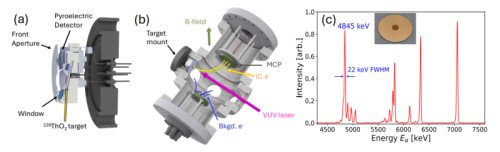
In the study, the team excited the thorium nucleus within a microscopic thin film of thorium oxide. This was achieved by electroplating a minute amount of thorium onto a stainless-steel disc—a process akin to gold-plating jewelry. This radical simplification of their previous method marks a significant leap forward.
Technical Breakthroughs and Implications
The thorium nuclei absorb energy from a laser and subsequently transfer that energy to nearby electrons, which can then be measured directly as an electric current. This method, known as conversion electron Mössbauer spectroscopy, has been in use for years but typically requires high-energy gamma rays at specialized facilities. This study marks the first time it has been demonstrated with a laser in an ordinary laboratory setting.
Crucially, this technique demonstrates that thorium-229 can be studied within more common materials than previously thought, removing a significant barrier to developing practical nuclear clocks. The research offers new insights into how thorium-229 behaves and decays, potentially informing future nuclear materials and energy research.
“We had always assumed that in order to excite and then observe the nuclear transition the thorium needed to be embedded in a material that was transparent to the light used to excite the nucleus. In this work, we realized that is simply not true,” said UCLA physicist Eric Hudson, who led the research. “We can still force enough light into these opaque materials to excite nuclei near the surface and then, instead of emitting photons like they do in transparent materials like the crystals, they emit electrons which can be detected simply by monitoring an electrical current – which is just about the easiest thing you can do in the lab.”
Potential Applications and Future Prospects
Like atomic clocks, nuclear clocks rely on the natural “ticking” of single atoms. However, while atomic clocks involve electron processes, nuclear clocks use oscillations within the nucleus itself. This makes them far less sensitive to external disturbances, offering the potential for orders of magnitude greater accuracy.
Nuclear clocks could even predict earthquakes and volcanic eruptions. According to Einstein’s theory of general relativity, nuclear clocks should be sensitive to slight changes in Earth’s gravity due to the movement of magma and rocks deep underground. By deploying nuclear clocks across earthquake-prone regions like Japan, Indonesia, or Pakistan, scientists could monitor subterranean activity in real-time and potentially predict tectonic events before they occur.
Dr. Morgan added, “In the long term, this technology could revolutionize our ability to prepare for natural disasters. It’s incredibly exciting to think that thorium clocks can do things we previously thought were impossible, as well as improving everything we currently use atomic clocks for.”
The research was funded by the National Science Foundation and involved collaborations with physicists from the University of Nevada Reno, Los Alamos National Laboratory, Ziegler Analytics, Johannes Gutenberg-Universität at Mainz, and Ludwig-Maximilians-Universität München.
This groundbreaking research was published in the journal Nature, under the full title: “Laser-based conversion electron Mössbauer spectroscopy of 229ThO2” with DOI: 10.1038/s41586-025-09776-4.