




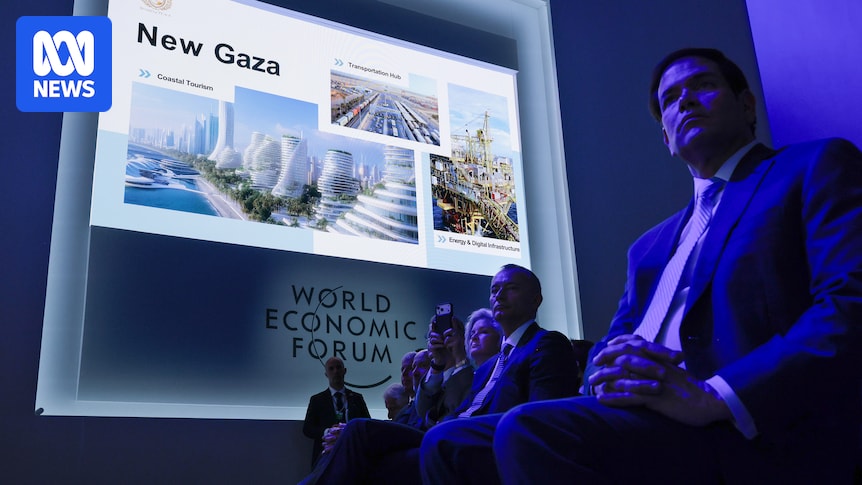
US officials have unveiled an ambitious vision for a “New Gaza,” proposing to transform the war-torn Palestinian territory into a luxurious seaside resort filled with skyscrapers. This bold plan, presented at the World Economic Forum in Davos, Switzerland, suggests that such a transformation could occur within three years. The announcement comes in the wake of a devastating conflict sparked by Hamas’s attack on Israel in October 2023, which left much of Gaza in ruins and displaced countless residents.
The US-brokered ceasefire, which took effect last October, has reduced the intensity of the conflict, but for many Gazans, the humanitarian crisis persists. “We’re going to be very successful in Gaza. It’s going to be a great thing to watch,” stated US President Donald Trump as he introduced his controversial Board of Peace conflict-resolution body. Emphasizing his real estate background, Trump highlighted Gaza’s prime location, envisioning it as a potential hub of prosperity.
The Vision for a ‘Mediterranean Utopia’
Jared Kushner, Trump’s son-in-law and a key envoy for the Gaza ceasefire, outlined his “master plan” for the region. With a presentation featuring images of sleek apartment towers and a tree-lined promenade, Kushner promised a “Mediterranean utopia” rising from the current devastation. “In the Middle East, they build cities like this for two or three million people in three years,” Kushner asserted, emphasizing the feasibility of the project.
Kushner projected investments of at least $25 billion to rebuild Gaza’s infrastructure and public services. He claimed that within a decade, the territory’s GDP could reach $10 billion, with households enjoying an average income of $13,000 annually, thanks to “100-percent full employment and opportunity for everybody there.”
“It could be a hope. It could be a destination, have a lot of industry and really be a place that the people there can thrive.” — Jared Kushner
Challenges and Criticisms
Despite the optimistic presentation, the plan has faced significant criticism and skepticism. The absence of Egyptian President Abdel Fattah al-Sisi, who had previously spearheaded a reconstruction plan for Gaza, was notable. While the Egyptian initiative was supported by Arab nations and welcomed by the European Union, it appears sidelined in the US’s new vision.
Ali Shaath, Gaza’s recently appointed administrator under Trump’s Board of Peace, acknowledged the Egyptian plan as the “foundation” of the current reconstruction efforts. Meanwhile, a top UN official warned that Gazans continue to live in “inhumane” conditions, with entire neighborhoods, hospitals, and schools heavily damaged or destroyed.
“That’s not sustainable. It doesn’t give these people dignity. It doesn’t give them hope.” — Jared Kushner on Gaza’s reliance on aid
Economic and Political Implications
Kushner emphasized the need for the full disarmament of Hamas, as stipulated in the October ceasefire, to encourage investment in Gaza. “We’ll announce a lot of the contributions that will be made in a couple of weeks in Washington,” he said, suggesting forthcoming financial commitments to the project.
The conflict’s toll has been severe. Hamas’s October 7, 2023, attack on Israel resulted in the deaths of 1,221 people, with 251 taken hostage. Israel’s subsequent assault on Gaza has claimed at least 71,562 lives, according to figures from Gaza’s health ministry, which the United Nations considers reliable. Additionally, the ministry reported 477 Palestinian deaths since the ceasefire began on October 10.
Looking Ahead
The proposed transformation of Gaza into a “Riviera of the Middle East” remains a contentious topic. While the vision promises economic growth and improved living conditions, the reality of achieving such a transformation is fraught with challenges. The ongoing humanitarian crisis, political complexities, and historical tensions in the region present significant hurdles.
As the world watches, the success of this ambitious plan will depend on a delicate balance of diplomacy, investment, and sustained international cooperation. The coming months will be crucial in determining whether the vision for a “New Gaza” can become a reality or remains an elusive dream.