


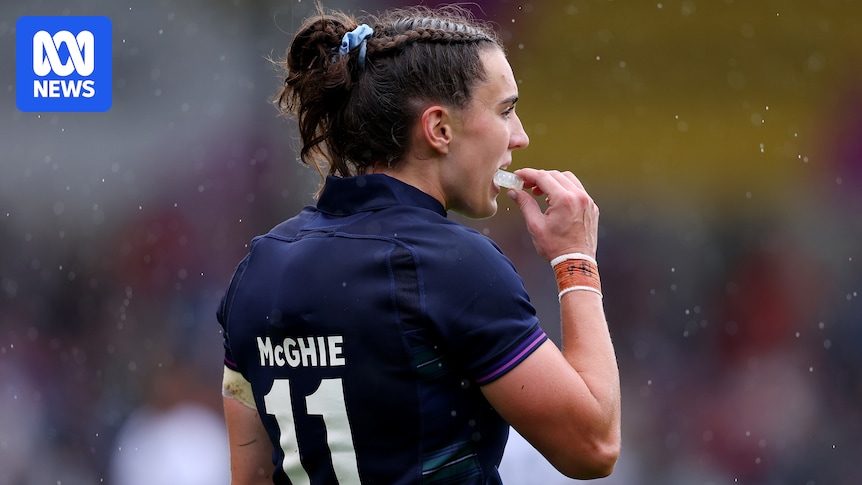
This year’s Women’s Rugby World Cup, held in England, is not only breaking viewership records but also pioneering a revolutionary approach to managing concussions. The tournament has seen a significant surge in viewership, surpassing the entire 2022 tournament figures over the first weekend alone. However, it is the introduction of flashing mouthguards that may leave a lasting impact on the sport and beyond.
Concussions have become a growing concern across various sports, highlighted by increasing cases of chronic traumatic encephalopathy (CTE) diagnosed posthumously. This includes notable cases such as former West Coast Eagle Adam Hunter. In response, players from the 16 participating nations are trialing LED mouthguards that light up upon sustaining an impact potentially leading to a concussion.
How the Mouthguards Work
The innovative mouthguards, developed under the guidance of World Rugby’s science and medical manager Dr. Lindsay Starling and consultant Dr. Eanna Falvey, are designed to predict rather than diagnose concussions. Dr. Falvey, who has previously worked with the British and Irish Lions, explains, “We know that bigger impacts are more likely to cause a concussion event, so what we’ve done is used the mouthguard to identify those large impacts.”
The mouthguards feature an in-built sensor and a ‘threshold’ system. When a player experiences an impact exceeding a certain force, the mouthguard flashes red and sends a Bluetooth signal to support staff, indicating the need for a head injury assessment (HIA). While a prototype developed in 2022 sent Bluetooth alerts, the current model adds the visual cue of flashing lights.
“What we’ve seen from our data set is that most of the concussion events happen above the threshold, but there are some that sit lower, and that’s what we’re currently evaluating,” Dr. Falvey explains.
Gender Differences in Concussion Experiences
Data collected from the mouthguards reveal that women and men experience concussions differently, with the alert threshold set lower for women. Dr. Falvey notes that while women may experience less intense hits, they tend to be concussed at lower intensities, resulting in a similar overall number of concussions as men. Female athletes also report more symptoms and for longer durations.
Dr. Starling emphasizes the added benefit of this research, stating, “It’s really helpful, even if those symptoms aren’t related to a concussion incident, because it’s a check-in point for our medical teams to understand what’s going on with our players and sometimes uncover some underlying things that we need to work on.”
Future of Individualized Concussion Management
The team behind the mouthguards is keen to move towards individualizing thresholds based on personal concussion history, symptom count, and recovery patterns. Dr. Falvey envisions a future where mouthguards are tailored to individual players, enhancing their effectiveness. However, this requires extensive data collection over time.
“To individualize, you need to have a lot of data on a person, so we need players to wear their mouthguards for a [long] period of time to really understand what that player’s picture looks like,” Dr. Starling explains.
Implications for Community Sports
The data being collected at the elite level is expected to benefit community sports participants. Dr. Falvey highlights that while parents often worry about their children playing rugby, the intensity of hits is significantly lower at the community level. The LED mouthguards could serve as an early warning system for concussions, even without official monitoring.
World Rugby is also collaborating with Biocore, a US company working with the NFL, to gather additional data on impact measures. The insights gained could extend beyond sports, with interest from organizations such as the FBI and the American Department of War, concerned about head impacts in military training.
“My attitude on this is that the data is not a competitive thing, this is something we can all share and learn from each other,” Dr. Falvey said. “From our point of view rugby is lucky because we cover over 120 countries, so we have huge scope to look at this, and the data is hugely transferable, not just to contact sports.”
As the Women’s Rugby World Cup continues to unfold, the flashing mouthguards represent a significant step forward in player safety, with potential implications reaching far beyond the rugby field.