




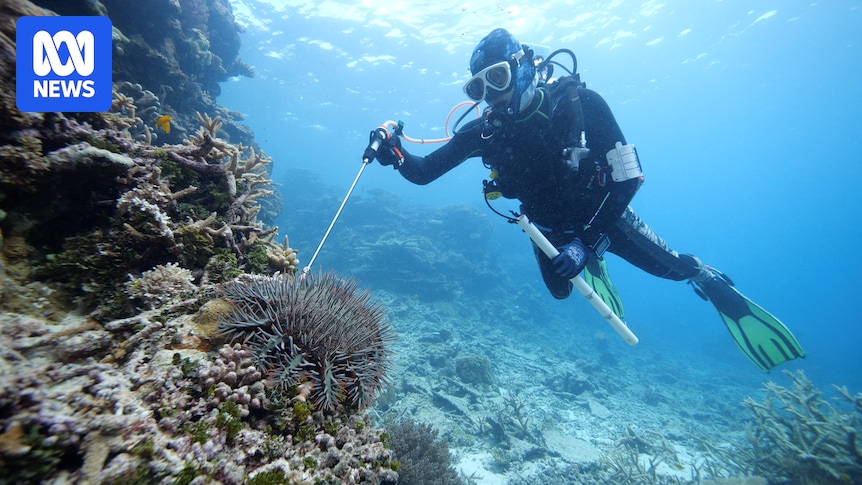
Scientists are urgently working to contain a new outbreak of the coral-devouring crown-of-thorns starfish (COTs) on the Great Barrier Reef, which experts warn could become one of the most devastating in 60 years. The Great Barrier Reef Marine Park Authority (GBRMPA) has identified the outbreak between Cairns and Lizard Island, a 240-kilometre stretch renowned for its rich coral diversity and bustling tourism activity.
This development comes amidst ongoing efforts to manage a previous outbreak that began in 2010. Historically, the Great Barrier Reef has experienced four significant COTs outbreaks since the 1960s, with cyclic patterns emerging approximately every 17 years. However, the current situation is unfolding sooner than expected, raising concerns among marine scientists.
Understanding the Threat
GBRMPA’s chief scientist, Roger Beeden, expressed significant concern over the situation, noting that while the fourth outbreak is still being controlled, a fifth wave is emerging in the same northern region. “We’re beginning to see a build-up in adult crown-of-thorns starfish and we need to get on top of it as fast as we possibly can,” Beeden emphasized.
Under the COTs control program, six dedicated vessels are deployed across priority reefs. However, Beeden indicated that these efforts would need to be doubled to effectively manage the new outbreak. The starfish, though native to the reef, can cause extensive coral damage when their numbers become unmanageable. On average, each starfish consumes coral equivalent to the size of its body daily, posing a substantial threat to the reef’s ecosystem.
Impact and Control Measures
Long-term monitoring by the Australian Institute of Marine Science has highlighted the crown-of-thorns starfish as a major driver of coral loss, responsible for up to 40 percent of coral decline over the past four decades. “Think a bit like plague locusts,” Beeden explained. “When we get very large numbers they can have a very large impact upon coral cover on the Great Barrier Reef.”
In response, specialized dive teams under the control program spend extensive periods at sea, locating and injecting individual starfish with cow bile or vinegar to curb their numbers. Dive supervisor Adam Skerritt, who recently completed a 15-day rotation, described the work as slow and methodical. “Most of the time we don’t actually see the COTs first, we see the scar trail … almost like toothpaste, and that means the starfish is very close,” Skerritt noted.
Economic and Environmental Stakes
The control program, costing approximately $25 million annually, is a critical component of the federal government’s strategy to manage the reef amidst intensifying climate pressures. Sheridan Morris, managing director of the Reef and Rainforest Research Centre, highlighted the program’s value, given the tourism industry’s $9 billion annual contribution to the local economy. “It’s also allowing us to get real-time data that we can look at in a meaningful way, so there’s not a delay of 12 months … and we can respond,” Morris stated.
In a bid to bolster these efforts, Environment Minister Murray Watt announced an additional $1.4 million in funding during a recent visit to Cairns. This funding is part of Australia’s broader strategy to demonstrate active management of the Great Barrier Reef to UNESCO, ahead of a World Heritage Committee review later this year.
Looking Forward
The ongoing battle against the crown-of-thorns starfish is crucial not only for the reef’s health but also for the millions of tourists who visit each year. Sunlover Reef Cruises master reef guide Michelle Barry stressed the importance of maintaining the reef’s health for tourism. “Having tourists every day seeing what we’re doing, in addition to having a great time on the reef, is really important,” Barry said. “You can see that science and good times can be had together.”
As the deadline for Australia’s State of Conservation report to UNESCO approaches, detailing progress on climate change, water quality, and reef management, the outcome of these efforts will be closely watched. The report will be pivotal in determining the future of the Great Barrier Reef’s World Heritage status and the continued viability of its vibrant tourism sector.