




Additive manufacturing, commonly known as 3D printing, is poised to become a vital technology for long-term extraterrestrial settlements. Its capability to transform basic inputs like plastic strips or metal powder into essential tools for astronauts marks a significant breakthrough. However, the underlying chemistry is complex, and its applications are diverse, ranging from constructing bricks for habitats to producing everyday items like cups and toothbrush holders.
New Research on Mars 3D Printing
A recent study by Zane Mebruer and Wan Shou from the University of Arkansas, published in pre-print on arXiv, explores a crucial aspect of 3D printing that could revolutionize Mars missions. The researchers propose using Mars’ atmosphere to assist in printing metal parts, potentially saving millions of dollars in mission costs.
Their research focuses on selective laser melting (SLM), a metal 3D printing process used to create 316L stainless steel, a material integral to many industries. This development follows a growing interest in making space missions more self-sufficient and cost-effective.
Challenges of Shield Gases on Mars
On Earth, oxygen in the atmosphere can oxidize printed materials, leading to brittle and fragile end products. To prevent this, 3D printers use a “shield gas” to exclude air and its reactive oxygen. Typically, argon, an inert noble gas, is employed for this purpose. However, argon is costly and scarce on Mars, posing a logistical challenge for mission planners who would otherwise need to transport it from Earth.
Surprisingly, the researchers suggest using Mars’ carbon dioxide-rich atmosphere as a shield gas. While carbon dioxide contains oxygen, the study found it to be a viable alternative for producing non-critical metal parts, such as hinges or door handles.
Why Carbon Dioxide Can Work
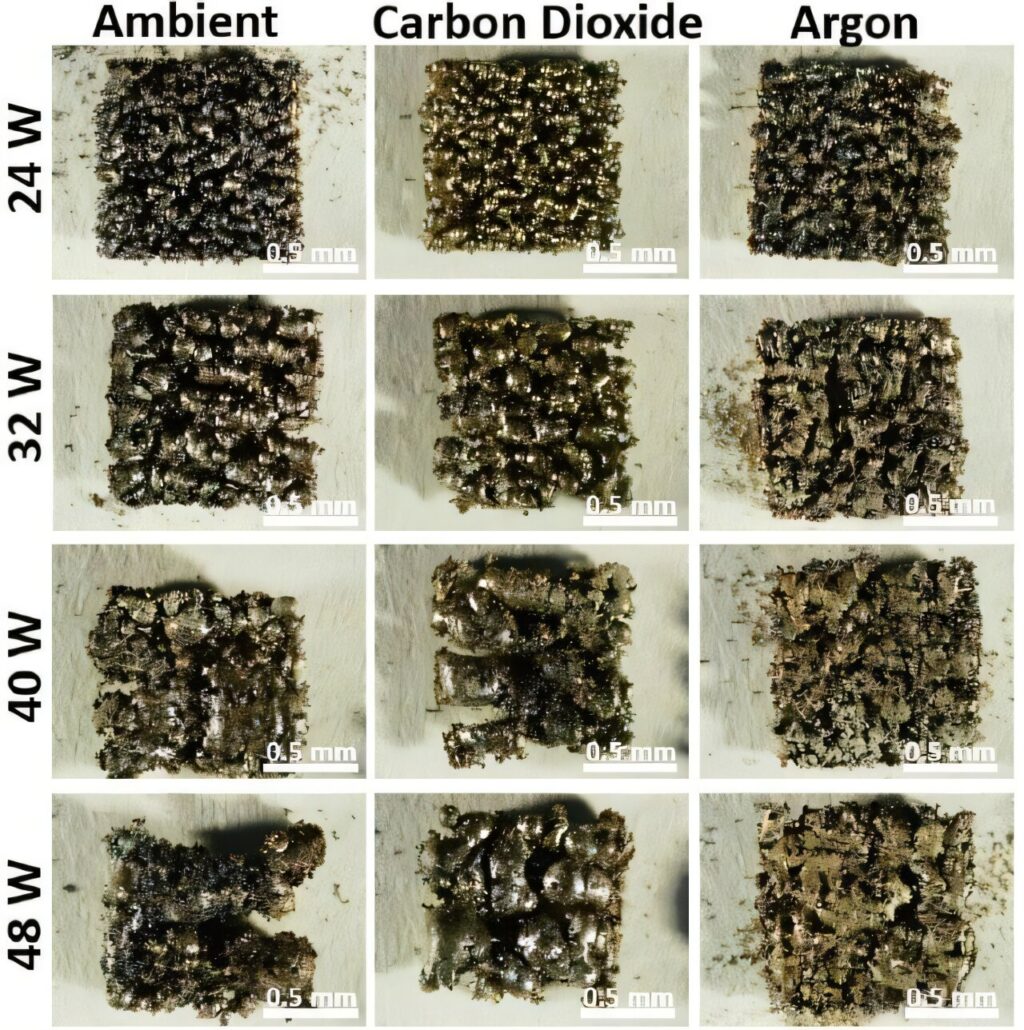
The paper details experiments comparing argon, CO2, and ambient Earth air in SLM printing. Although CO2 was less effective than argon, it was adequate for many applications. In tests printing solid square layers, argon achieved approximately 98% shape retention, while CO2 managed around 85%. Ambient air, however, resulted in less than 50% retention, rendering parts unusable.
“The partial pressure of oxygen in a pure CO2 environment is actually less than the pressure pushing the oxygen down in the nitrogen-rich atmosphere on Earth,” the study explains.
This means that although some oxygen is present, it is not as aggressively forced into the melt pool, reducing oxidative damage.
Implications for Space and Industry
This discovery holds potential beyond space exploration. Given the high cost of argon, substituting it with CO2 could significantly reduce expenses for metal 3D printing companies. The question remains whether companies will accept the trade-off in visual quality for cost savings.
Meanwhile, astronauts on Mars, far removed from Earth-based manufacturers, prioritize functionality over aesthetics. Utilizing Mars’ atmosphere for in-situ resource utilization could be a practical solution for producing necessary components on-site.
As the space industry continues to innovate, this research may bring humanity one step closer to establishing a sustainable presence on Mars. By leveraging the resources available on the Red Planet, future missions could become more feasible and cost-effective, paving the way for long-term settlement.