


Wildfires raging across central and southern Chile have left at least 18 people dead, scorched thousands of acres of forest, and destroyed hundreds of homes, local authorities report. The South American nation is currently enduring a severe heatwave, exacerbating the crisis.
President Gabriel Boric has declared a state of catastrophe in the central Biobio region and the neighboring Ñuble region, approximately 500 kilometers south of Santiago, the capital. This emergency designation facilitates enhanced coordination with the military to control more than two dozen active wildfires that have already ravaged 8,500 hectares, according to the national forestry agency.
Government Response and Local Challenges
In a press conference from Concepción, a city heavily impacted in the Biobio region, President Boric expressed support and condolences to the victims. He cautioned that the initial reports of 18 fatalities and 300 homes destroyed might increase as the full extent of the damage becomes clearer. The President estimated that the number of affected homes in the Biobio region alone is “certainly more than a thousand, just so far.”
The fires have forced the evacuation of 50,000 people, with President Boric emphasizing that “the first priority, as you know, in these emergencies is always to fight and extinguish the fire.” However, his address came amid complaints from local authorities about delayed governmental assistance.
“Dear President Boric, from the bottom of my heart, I have been here for four hours,” Rodrigo Vera, the mayor of Penco, a small coastal town, said on a local radio station. “A community is burning and there is no [government] presence.”
Weather Conditions and Firefighting Efforts
Firefighters are struggling to contain the flames, with high temperatures and strong winds complicating their efforts. On Sunday, temperatures soared past 38 degrees Celsius, and the scorching weather is expected to continue through Monday.
“Weather conditions for coming hours are not good and indicate extreme temperatures,” said Interior Minister Álvaro Elizalde.
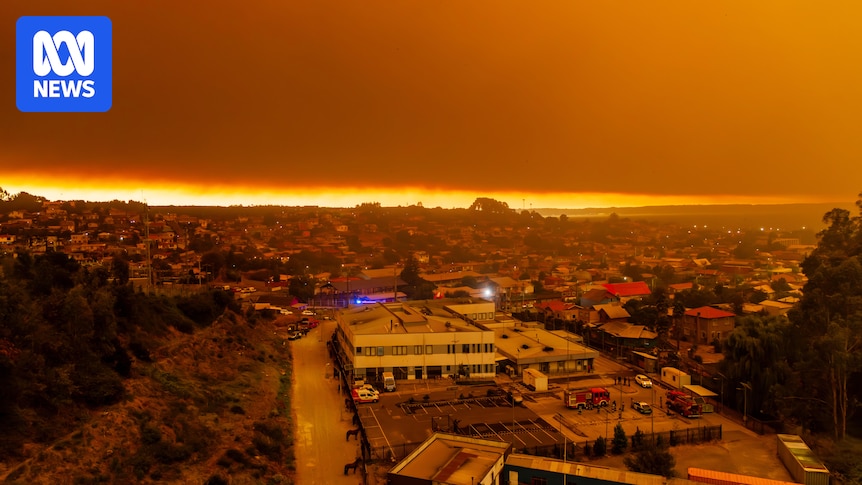
Residents recounted how the fires caught them off guard after midnight, trapping many in their homes. “Many people didn’t evacuate,” said John Guzmán, 55, observing the scene in Penco, where smoke filled the sky with an orange haze. “They stayed in their houses because they thought the fire would stop at the edge of the forest.”
The fire has devastated much of Penco, incinerating cars, a school, and a church. Thousands have sought refuge in makeshift emergency shelters. “We fled running, with the kids, in the dark,” said Juan Lagos, 52.
Historical Context and Regional Impact
Wildfires afflict central and southern Chile every summer, typically peaking in February as temperatures rise and the country grapples with a prolonged drought. In 2024, massive fires along Chile’s central coastline resulted in at least 130 deaths, marking the nation’s deadliest natural disaster since a catastrophic earthquake in 2010.
Neighboring Argentina is also facing challenges in containing wildfires that have consumed thousands of acres of forest in recent weeks, as the southern Patagonia region experiences similar hot and dry conditions.
Looking Ahead
The current situation in Chile underscores the urgent need for comprehensive strategies to combat wildfires, particularly in the face of climate change and prolonged droughts. As the nation continues to battle these fires, the government and local authorities are working to provide immediate relief and long-term solutions to prevent future disasters.
With the state of catastrophe in effect, the Chilean government is expected to deploy additional resources and personnel to the affected regions. The international community is also likely to offer support as the country navigates this crisis.
As the fires continue to burn, the focus remains on saving lives, protecting property, and restoring the affected communities. The coming days will be crucial in determining the full impact of this natural disaster and the effectiveness of the response efforts.