



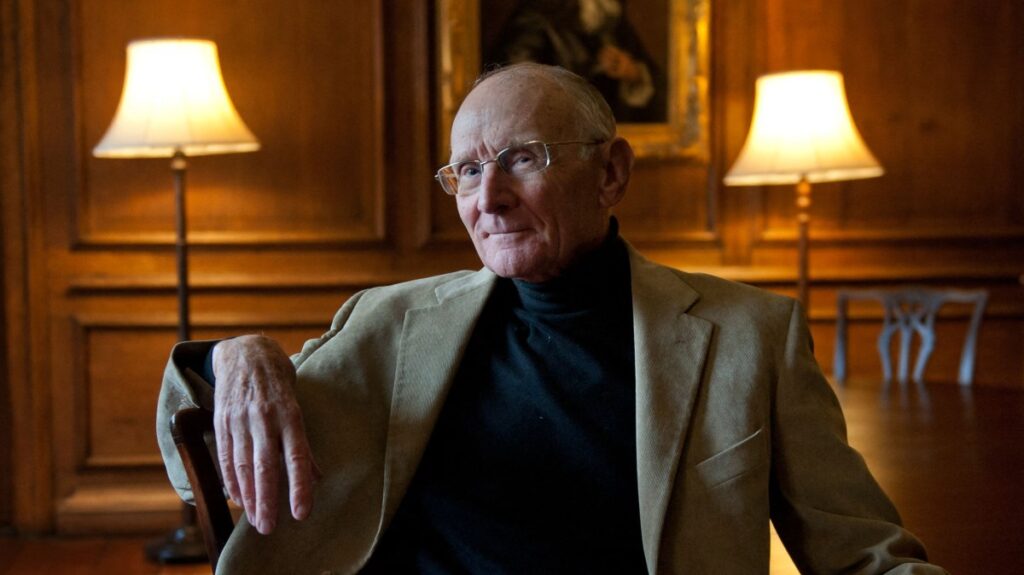
John Carey, the esteemed literary critic who served as the chief literary critic for The Sunday Times for an impressive 46 years, has left an indelible mark on the world of literature. From 1977, Carey delivered insightful reviews every fortnight, regardless of rain, shine, holiday, or illness. His dedication and passion for literature made him an ideal critic, admired by many and feared by some.
Carey’s approach to literary criticism was characterized by his intense modesty and ascetic lifestyle. He shunned the superficial aspects of literary life, rarely attending parties and maintaining a minimal circle of literary friends. For Carey, the review was paramount, and he was determined not to let anything or anyone interfere with his work. His fierce moral compass, shaped by his lower-middle-class upbringing and commitment to Orwellian egalitarianism, drove him to challenge pomposity and snobbery in his critiques, often targeting literary giants such as Virginia Woolf, Anthony Powell, and TS Eliot.
Uncompromising Integrity and Intellectual Prowess
Carey was known for his uncompromising integrity, refusing to let personal relationships or favors influence his writing. This unwavering commitment to honesty sometimes led to dramatic encounters, such as the infamous incident at a Sunday Times Books Christmas party where a fellow critic, angered by a review, poured a glass of wine over Carey’s head.
His intellectual prowess was undeniable. As a Merton professor of English literature at Oxford University for 25 years, Carey authored revelatory books on literary figures like Dickens, Milton, Thackeray, and John Donne. He had a talent for unraveling complex ideas and making them accessible, often using humor to engage his audience. In one instance, he critiqued a Shakespeare biography with the quip, “Surely Shakespeare’s life cannot have been as boring as this.”
A Versatile and Passionate Reviewer
John Carey’s versatility as a reviewer was remarkable. He could write about anything, from editing “The Faber Book of Science” to reviewing books on Tintin and Tintoretto. His humor, often overlooked due to his intimidating intelligence, shone through in his reviews. He once described the Victorian historian Thomas Carlyle as “so poisonous it’s a wonder his mind didn’t infect his bloodstream” and likened philosopher Roger Scruton’s writing to “someone trying to unwrap his lunchtime sandwich with the aid of a fork-lift truck.”
Carey’s love for reviewing was evident in his meticulous approach. Every six months, he would receive a list of forthcoming titles and promptly return a carefully annotated selection, eager to tackle any additional assignments. Reviewing was akin to a drug for Carey; without a project, he would become restless.
Controversial Yet Celebrated
Despite his many admirers, Carey had his share of critics. Some never forgave him for his critique of literary modernism’s elitism in his 1992 book, “The Intellectuals and the Masses.” His 2005 work, “What Good Are the Arts?” also stirred controversy. However, his influence and impact were undeniable.
Nobel laureate Kazuo Ishiguro praised Carey, noting that he never came across as an academic and that his insights were deeply personal and lived. Sunday Times reviewer Dominic Sandbrook admired Carey’s courage, clarity, and enthusiasm for books, describing him as “unstuffy, democratic, and populist in the best sense of the word.”
A Lasting Legacy
Carey’s influence extended beyond his reviews. One of the first books he reviewed was a pamphlet of poems by a young Irish writer named Seamus Heaney. Carey’s enthusiasm helped bring attention to Heaney, who would go on to win the Nobel Prize in Literature.
For those who worked with him, Carey was more than a critic; he was a mentor and a friend. His example of clarity and engagement shaped The Sunday Times books pages, and his presence was felt in every edition. As his editor, it was an honor to work alongside him, striving to live up to his high standards.
John Carey was a literary critic like no other. Fierce, kind, principled, and brilliant, he set a standard for literary criticism that will be remembered for generations. His passion for books and writing inspired many, and his absence will be keenly felt. As we bid farewell to John Carey, we celebrate his remarkable legacy and the profound impact he had on the world of literature.