




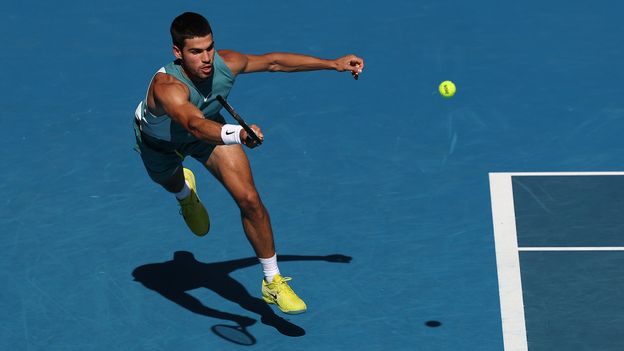
An unusual tennis competition is set to debut at the Australian Open, offering amateurs a tantalizing chance to compete against the world’s top tennis stars in one-point matches. This novel format raises the question: Could an unknown player really topple a global tennis giant?
The One Point Slam, running alongside the traditional Australian Open Grand Slam, promises a sporting spectacle like no other. With a million-dollar prize at stake, the competition is open to both amateurs and professionals. Each match hinges on a single point, dramatically increasing the possibility of an upset.
To claim the A$1 million (£490,000/$672,000) prize, a player needs to win just five or six points. But how realistic is it for an amateur to defeat the world’s elite? Let’s delve into the numbers.
The Mechanics of the One Point Slam
The tournament will feature 48 competitors: 24 professional players, eight amateur winners from state championships across Australia in 2025, eight qualifiers, and eight wildcards. Among the professionals are top-ranked players like Carlos Alcaraz and Jannik Sinner, as well as fan-favorites such as Nick Kyrgios. On the women’s side, Iga Swiatek and Coco Gauff are set to participate, adding to the tournament’s allure.
The single-point format inherently increases the likelihood of an upset. Unlike traditional matches, where skill and consistency often prevail, a single-point match leaves little room for error, allowing luck to play a more significant role. This unpredictability is precisely what the organizers hope will captivate audiences.
Understanding the Skill-to-Luck Ratio
In sports, fans typically prefer skill to triumph over luck. The more points played, the greater the chance for the better player to assert dominance. A simple mathematical principle supports this: the probability of victory increases with the number of points played.
Consider a basic scoring system where the first player to reach a predefined number of points wins. The probability of the better player winning increases with their advantage and the number of points played (N). This probability grows as the square root of N, illustrating that longer matches favor the more skilled player.
However, by reducing the match to a single point, the One Point Slam maximizes unpredictability. This mirrors changes in other sports, such as table tennis, where scoring adjustments have been made to enhance spectator excitement without significantly altering the skill-to-luck ratio.
Historical Context and Comparisons
Sports have often experimented with scoring systems to maintain viewer interest. In 2001, the International Table Tennis Federation reduced the points needed to win a game from 21 to 11 while increasing the number of games required for a match, balancing the skill-to-luck ratio.
Similarly, tennis has seen variability in outcomes based on match length. Since 2000, there have been 37 different female Grand Slam winners compared to 22 male winners, partly due to women playing best-of-three sets versus men’s best-of-five. This difference allows for greater variability in outcomes, favoring less predictable results.
The Potential for Upsets
In the One Point Slam, the gap between amateurs and pros is stark. While it’s unlikely an amateur could prevail over a full match, set, or even game, the single-point format offers the best chance for an upset. The pressure of playing just one point against a top player could lead to unexpected outcomes.
Even if an amateur doesn’t claim victory over Carlos Alcaraz, they can still boast of taking the men’s world number one to match point. That’s quite a bragging right.
Beyond sports, the principle of increasing trials to reduce luck’s impact is seen in fields like law and medicine. Larger juries or multiple medical tests enhance accuracy, underscoring the universal applicability of this concept.
As the One Point Slam unfolds, tennis fans worldwide will watch eagerly to see if an amateur can seize the moment and make history. Whether or not an upset occurs, the tournament promises to be a thrilling addition to the Australian Open.
If you enjoyed this story, sign up for The Essential List newsletter for a curated selection of features, videos, and must-read news delivered to your inbox twice a week. For more stories on science, technology, environment, and health, follow us on Facebook and Instagram.