


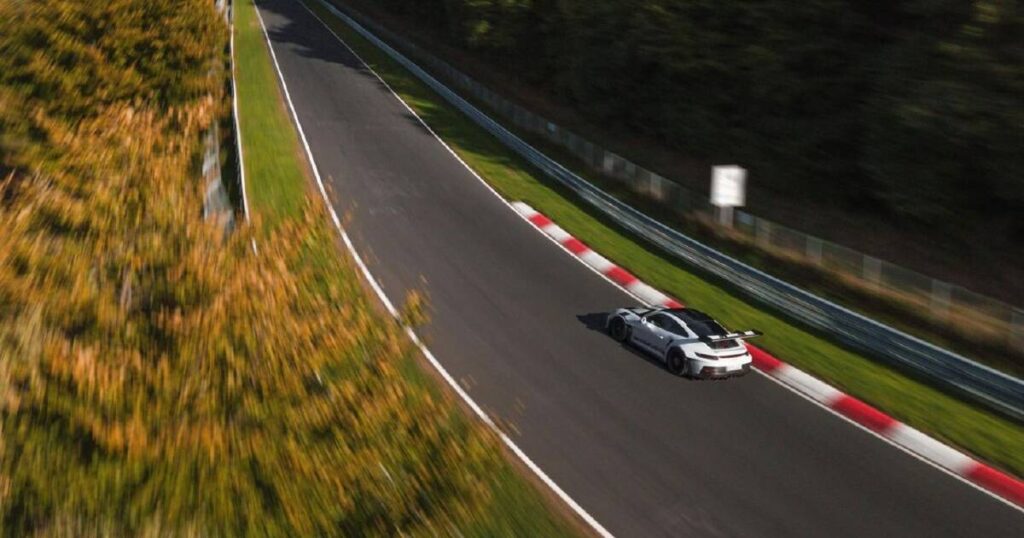
If you have even a fleeting interest in cars, the name Nurburgring is likely familiar. Nestled in the forests of Germany, this 20.8 km circuit, known as the Nurburgring Nordschleife, is revered by many as a motoring mecca. Its reputation is not just for its length but for the myriad of surface and corner types that make it a formidable challenge for drivers and engineers alike.
The Nurburgring Nordschleife, distinct from the shorter Nurburgring Grand Prix Circuit, is notorious for its difficulty. A single mistake can cost precious seconds off a lap time—where seven minutes is considered exceptionally fast—or lead to a catastrophic crash. This treacherous nature has earned it the nickname ‘Green Hell’.
The Marketing Power of Lap Times
Sports car manufacturers often tout impressive lap times at the Nordschleife as a testament to their vehicles’ capabilities. Recently, BYD’s premium brand Yangwang highlighted its U9 electric supercar’s performance there. However, a brand with a more storied history at the ‘Ring is Porsche.
Porsche’s new 911 Turbo S was unveiled with an impressive 7:03.92 lap time, achieved by racing driver and Porsche brand ambassador Jörg Bergmeister. This time is 14 seconds faster than its predecessor, marking a significant improvement. But why do brands invest so heavily in achieving these times, and do consumers really care about performance on a track they may never visit?
Consumer Perception and Technological Advancements
During the Icons of Porsche Festival in Dubai, CarsGuide posed this question to Frank Moser, Porsche Vice President for Product Lines 911 and 718. Moser explained that while a Nordschleife lap time might not be the primary factor for customers deciding to purchase a new Turbo S, it showcases the technological advancements and dynamic improvements made to the car.
“The Nurburgring Nordschleife is very important for us because the customer can see how the technological step is going ahead,” Moser told Australian media. “But I think customers decide first of all, how the car looks, what is the power of the car.”
This is particularly relevant for a model like the 911, which maintains a consistent look and feel across generations. Demonstrating a 14-second reduction in lap time underscores the new Turbo S’s enhanced capabilities.
Engineering Behind the Speed
When asked about the changes enabling a sports car that’s 85kg heavier to achieve such a feat, Moser was prepared with specifics. The enhancements are not solely due to increased power, although the hybrid system now delivers 711 horsepower (523kW) and 800 Newton meters of torque.
“Power is not everything you need on a race track, so we fine-tuned the suspension as well,”
Moser explained. The integration of the Porsche Dynamic Chassis Control into the 400-volt system allows for faster and more precise handling.
Additionally, mechanical changes such as larger rear brake discs and wider tires contribute to improved grip and stopping power. Aerodynamic optimizations, including a variable front spoiler lip and adjustable rear wing, further enhance performance.
The Driver’s Perspective
Jörg Bergmeister, who set the impressive lap time, shared his experience. “Fast!” he laughed when asked how it felt to shave 14 seconds off the previous time. With nearly 200 more horsepower than the GT models he typically races, the Turbo S offers a unique driving experience.
Despite its power, Bergmeister noted the car’s versatility as both a daily driver and a track performer. “When you go to a track, and any track I’ve taken the car to, [you’re] just smiling, because you can just play with the car,” he said.
The feedback from the track is invaluable for Porsche engineers, allowing them to refine the car’s performance. Bergmeister emphasized the improved handling and throttle response, which make the car feel more nimble despite its increased weight.
The Broader Implications
For Porsche and other manufacturers, the Nurburgring is more than just a marketing tool; it’s a proving ground for innovation. The lap times serve as a benchmark for engineering excellence, pushing the boundaries of what road cars can achieve.
While not every customer may prioritize a car’s track performance, the technological advancements required to achieve these times benefit all drivers, enhancing safety, efficiency, and driving pleasure.
As automotive technology continues to evolve, the significance of lap times at iconic circuits like the Nurburgring will likely endure, symbolizing both the heritage and the future of high-performance vehicles.