
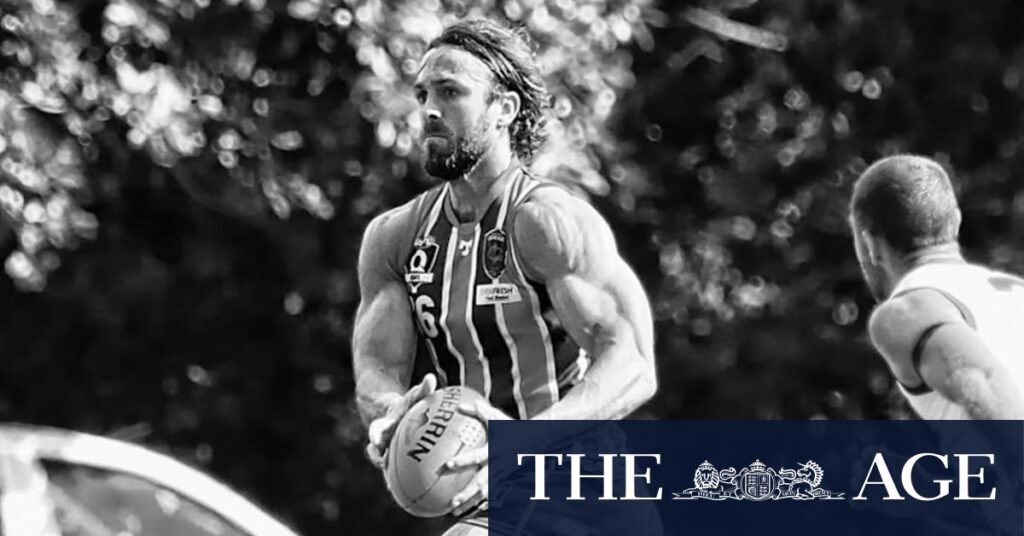
Banned former Brisbane Lions midfielder Rhys Mathieson has publicly accepted responsibility for the positive steroid test that led to his three-year suspension from football. Speaking on the “Rip Through It” podcast with former teammate Mitch Robinson, Mathieson addressed the circumstances surrounding his ban, emphasizing that his actions were not intended to enhance his football performance.
The Australian Football League (AFL) confirmed Mathieson’s anti-doping sanction in a statement released on Thursday. The suspension, which was initially set at four years, was reduced following extensive meetings and Mathieson’s admission of guilt. The positive test, conducted on August 10 last year while Mathieson was playing for Wilston-Grange in the Queensland Australian Football League (QAFL), detected the presence of the banned steroid Oxymetholone.
Background and Reaction
Mathieson, who learned of his positive test results in November last year while on holiday in New Zealand, will remain suspended until August 10, 2027. However, he will be eligible to resume training with a club as early as June 10 of that year. Since ending his 72-game AFL career in 2023, Mathieson has shifted his focus to bodybuilding, a pursuit that has attracted attention due to his significant physical transformation.
On the podcast, Mathieson explained, “I’d been waiting eight years for this. Yes, AFL was the No.1 priority, but I always had this in the back of my head, and once I started doing it, I fell in love with it.” He described his enthusiasm for the bodybuilding lifestyle, including the regimented meals and supplements that were not permissible during his AFL career.
The Transition to Bodybuilding
Mathieson expressed his passion for health and fitness, noting that he even adopted a bodybuilding-style lifting regime during his AFL days, despite club advice. “I dived into a lot of gym supplements [after my AFL career ended],” he said. “I mean, a lot – a lot of it, and some you just buy off the shelves and whatever, and some boys had their own. I was willing to put anything in my body to transform.”
He further shared his aspirations to transition from professional football to professional bodybuilding, stating, “I like the science behind transforming your body, and I really have a passion for it. I love to see these guys compete, and one day, maybe, I will compete.”
Challenges and Controversies
Despite his enthusiasm for bodybuilding, Mathieson faced challenges when transitioning back to football at the start of last year. Recruited by Wilston-Grange, he struggled with physical readiness due to his increased weight and the effects of his bodybuilding regimen. “I couldn’t run laps, my lower back was sore, I was doing soft tissues [injuries],” he admitted.
Mathieson also described the anti-doping process as “bizarre,” highlighting the lengthy period before he was informed of his positive test and the invasive nature of the investigation. He recounted an incident where authorities visited his girlfriend and relatives, demanding his phone and raising questions based on the information they had gathered.
“One night my girlfriend was calling me, and they’re pounding this door down, and she was scared … turns out it was ASADA,” Mathieson said. “They wouldn’t [tell her who they were], or why they’re there. So, again, I didn’t like that side of it. It’s way too much.”
Support and Future Prospects
The AFL Players’ Association has acknowledged Mathieson’s ban and expressed its commitment to supporting him throughout the suspension. Mathieson remains focused on his bodybuilding goals, viewing the sport as a new avenue for his competitive spirit and passion for fitness.
As Mathieson navigates the consequences of his actions, his story underscores the complexities athletes face when balancing personal interests with professional obligations. The situation also highlights the rigorous enforcement of anti-doping regulations in sports and the personal toll such investigations can take on athletes and their families.
Looking ahead, Mathieson’s journey from football to bodybuilding may serve as an example of resilience and adaptation, offering insights into the multifaceted lives of professional athletes.