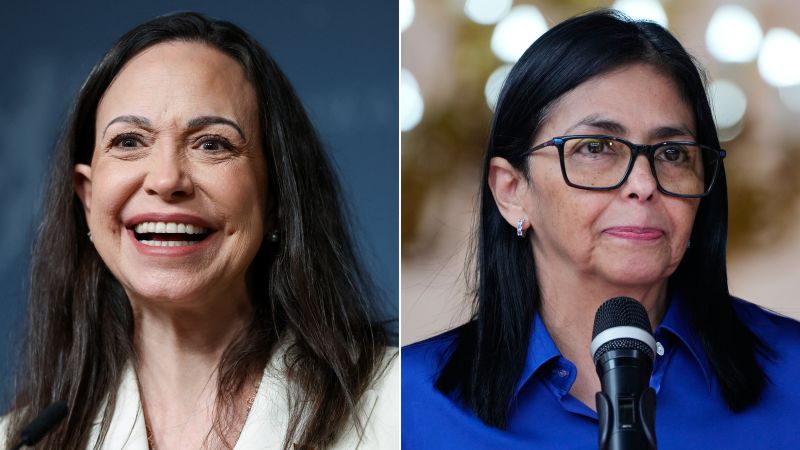
As millions of Venezuelans anxiously await the fate of their economically and politically beleaguered nation, a power struggle has emerged between two influential female leaders. María Corina Machado and Delcy Rodriguez are vying for control over Venezuela’s future and for the favor of U.S. President Donald Trump.
Opposition leader and Nobel Prize laureate María Corina Machado has gained prominence for her relentless pursuit of democracy in Venezuela, standing against the now-ousted dictator Nicolás Maduro. Following the disputed 2024 presidential election, where government-controlled authorities declared Maduro the winner, Machado has largely remained in hiding. This was until Maduro’s dramatic capture by U.S. special forces two weeks ago.
Her rival, Delcy Rodriguez, Maduro’s former vice president, is now acting president. Known as a staunch defender of the Maduro regime, Rodriguez faces the challenge of balancing appeasement of Washington with maintaining loyalty among Maduro’s supporters back home.
The Trump Factor
At the heart of this political tug-of-war is President Donald Trump, who ordered the raid that captured Maduro and declared U.S. oversight of Venezuela in the interim. Although Trump has refrained from further military action, the threat looms large. He recently announced plans to target drug cartels on land, following months of strikes on drug boats at sea, and continues to project military might with a significant U.S. naval presence in the Caribbean.
Trump’s decisions could significantly influence Venezuela’s leadership trajectory. While he has praised Rodriguez, he has not endorsed Machado, despite her having allies within his administration. Trump’s discussions with other world leaders suggest his stance could shift rapidly, with praise turning to threats or vice versa. Machado’s upcoming meeting with Trump at the White House could prove pivotal.
Nobel Prize or Bargaining Chip?
Both leaders have been in direct communication with Trump. On Wednesday, Trump described Rodriguez as a “terrific person” after a phone conversation, noting their positive rapport. Machado, however, will meet Trump in person, with a scheduled lunch at the White House on Thursday.
Machado’s Nobel Peace Prize nomination, supported by figures like Secretary of State Marco Rubio, initially seemed to bolster her position. However, her winning the award may have complicated matters, as Trump has expressed a personal desire for the Nobel Prize. “I can’t think of anybody in history that should get the Nobel Prize more than me,” Trump remarked last week.
Machado has attempted to mend fences by dedicating part of her award to Trump and even suggesting she would offer it to him, despite the Norwegian Nobel Institute stating it is non-transferable. This week’s lunch could be Machado’s best opportunity to sway Trump, despite her current disadvantage.
A Precarious Balancing Act
Meanwhile, Rodriguez faces her own challenges. Although she condemned the U.S. operation that captured Maduro as a violation of Venezuela’s sovereignty, she has since adopted a more conciliatory approach. Her government has released high-profile prisoners, including several Americans, as a gesture of goodwill.
Rodriguez’s relationship with the U.S. is complex. Despite being under U.S. sanctions for alleged human rights violations, she has worked to strengthen bilateral ties, particularly through Venezuela’s vast oil reserves. In 2017, Venezuela’s oil subsidiary donated half a million dollars to Trump’s inauguration committee. Since becoming acting president, Rodriguez has offered oil shipments to the U.S. and authorized a visit by U.S. chargé d’affaires Joe McNamara to discuss reopening the U.S. embassy in Caracas.
“Rodriguez has to convince the Trump administration that she is working with them, to their ends, cooperatively,” said Will Freeman, Fellow for Latin America Studies at the Council on Foreign Relations. “But she also has to convince hardliners in the Maduro regime… the military as well, that she’s not going to sell them out.”
Rodriguez’s efforts appear to be yielding results, with Trump and key administration officials viewing her as a pragmatic partner. However, her balancing act remains fraught with risk.
Looking Ahead
As Machado and Rodriguez continue their battle for Venezuela’s future, the stakes could not be higher. Their interactions with Trump could determine the direction of the country’s leadership and its relationship with the United States. With both leaders navigating complex political landscapes, the coming days may prove decisive in shaping Venezuela’s path forward.