



Additive manufacturing, more commonly known as 3D printing, is set to revolutionize the way astronauts operate in space, particularly for long-term settlements on other planets. This technology’s ability to transform basic materials like plastic strips or metal powder into essential tools is a game changer for space exploration. However, the complex chemistry involved and the varied applications—from constructing settlement bricks to creating everyday items like toothbrush holders—pose significant challenges.
New Research on Mars 3D Printing
Recent research by Zane Mebruer and Wan Shou of the University of Arkansas, published in a pre-print paper on arXiv, highlights a breakthrough in 3D printing technology that could save millions on Mars missions. The study examines a crucial aspect of a metal 3D printing process known as selective laser melting (SLM), which is used to print 316L stainless steel—a staple material across many industries. The researchers discovered that Mars’ atmosphere could be utilized to print metal parts, offering a cost-effective alternative to importing materials from Earth.
Challenges of Shield Gases on Mars
On Earth, the oxygen-rich atmosphere poses a challenge for 3D printing by oxidizing materials, leading to brittle and unstable end products. To counteract this, 3D printers employ a “shield gas” to exclude air and its disruptive oxygen. Typically, argon—a non-reactive noble gas—is used, but it is costly and scarce on Mars. For mission planners, this means that transporting argon from Earth would be an expensive endeavor. However, the new research suggests using Mars’ carbon dioxide-rich atmosphere as an alternative shield gas.
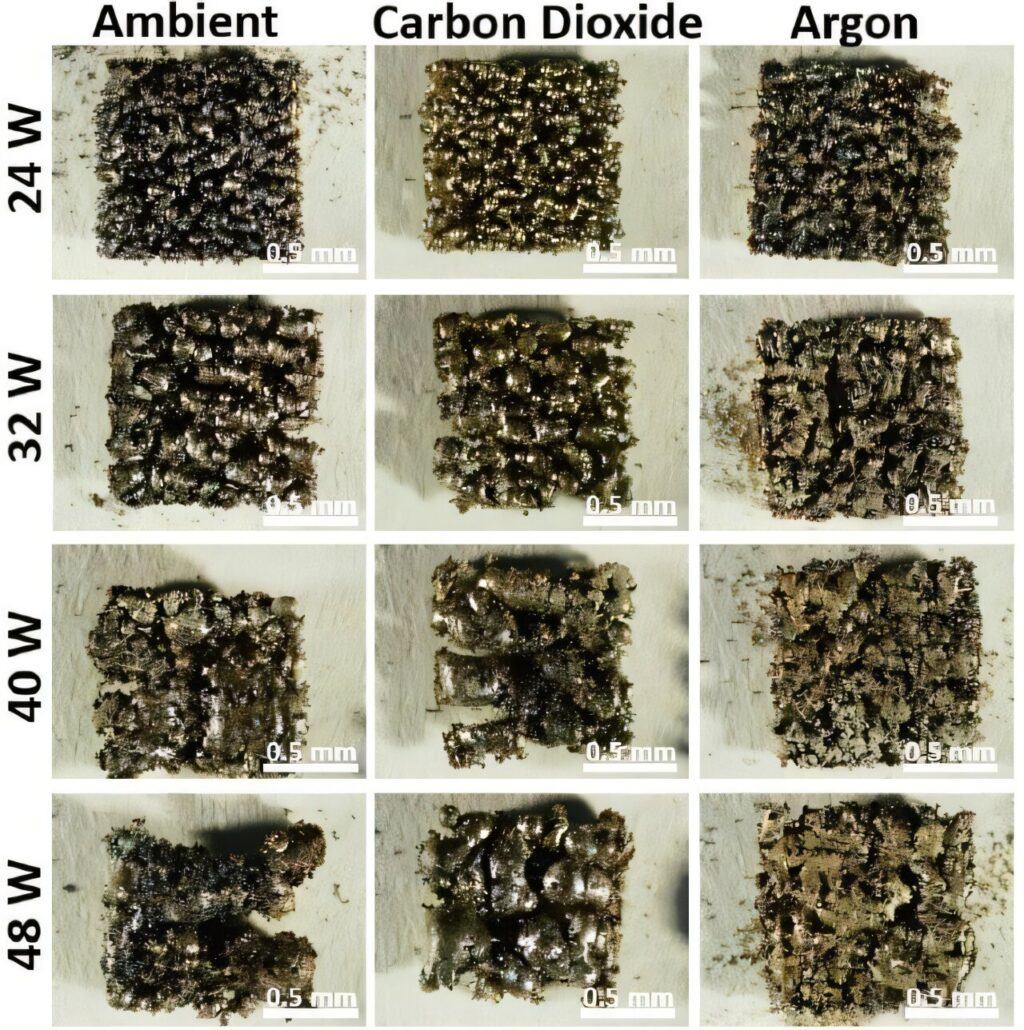
At first glance, using carbon dioxide might seem counterintuitive due to its oxygen content. Yet, the experiments conducted by Mebruer and Shou reveal that while CO2 is not as effective as argon, it performs adequately for non-critical metal parts such as hinges or door handles.
In tests, argon showed about 98% effectiveness in maintaining shape, whereas carbon dioxide had around 85% “area retention.” Ambient air, in contrast, yielded less than 50%, rendering the parts produced under it essentially useless.
Why Carbon Dioxide Can Work
The success of CO2 as a shield gas lies in its behavior at high temperatures. During the laser melting process, carbon dioxide dissociates, introducing reactive O2 into the system. However, the partial pressure of oxygen in a pure CO2 environment is lower than in Earth’s nitrogen-rich atmosphere, reducing oxidative damage to the metal.
Analysis of the printed parts showed that even those created with argon contained some oxygen. Parts printed with CO2 had about 1.6 times more oxygen content than those with argon, yet significantly less than those printed in ambient air, making them functionally viable.
Implications for Space and Industry
This research has far-reaching implications beyond space exploration. Given the high cost of argon, substituting it with CO2 for metal 3D printing could significantly reduce expenses for companies. While the aesthetic quality of the prints may be compromised, the cost savings could be substantial.
For astronauts, the practicality of using Mars’ atmosphere for in-situ resource utilization is invaluable. Setting up a printer to harness the planet’s natural resources could be a crucial step toward sustainable long-term settlements.
“Astronauts on Mars are unlikely to care about aesthetics as long as the parts function,” the researchers noted, highlighting the practicality of their approach.
This development represents a significant stride toward making human settlements on Mars a reality. By leveraging the planet’s own resources, the dream of a sustainable presence on Mars moves one step closer to fruition.