
In a development that has sent ripples across the Atlantic, European leaders are grappling with a diplomatic crisis instigated by former US President Donald Trump’s renewed interest in acquiring Greenland. This demand has not only stirred a sense of disbelief but is also hardening opinions on how Europe should respond. The situation is reminiscent of past conflicts and alliances, as Europe reflects on its historical ties with the United States.
For many Europeans, the memories of solidarity with the US are still fresh. European nations stood alongside America in the aftermath of the September 11 attacks, with over 850 soldiers from European allies losing their lives in Afghanistan as part of a NATO-backed operation against terrorism. Now, however, the US, under Trump’s leadership, is threatening its allies with economic repercussions in a bid to annex Greenland, a territory of Denmark, a steadfast ally for over eighty years.
European Leaders React
Anders Fogh Rasmussen, Denmark’s former Prime Minister and ex-NATO Secretary-General, expressed his “angered disbelief” at Trump’s threats, especially after Denmark’s significant contributions in Iraq and Afghanistan. In a poignant article for The Economist, Rasmussen wrote,
“We must draw an impassable line in the snow of Greenland.”
He emphasized the need for Europe to stand firm against autocratic power politics, particularly when alliances seem to be taken for granted.
While European leaders publicly maintain a calm demeanor, the undercurrents of tension are evident. British Prime Minister Sir Keir Starmer has voiced a desire to avoid a trade war, even as Trump threatens to impose tariffs starting at 10% next month, escalating to 25% by June. Meanwhile, European Commission President Ursula von der Leyen is adopting a firm but non-inflammatory stance.
The Call for Stronger Measures
French President Emmanuel Macron is advocating for a more drastic approach, urging the European Union to deploy a “trade bazooka” — comprehensive trade and investment sanctions against the US. Rasmussen supports this strategy, arguing that while Trump may believe he holds all the leverage, Europe possesses the capability to deliver a significant economic blow to the American economy. He cautions, however, that any such move would have repercussions for Europe as well.
The use of the term “appeasement” by Polish Prime Minister Donald Tusk is particularly telling, evoking memories of Europe’s past struggles against authoritarian regimes. This historical context is shaping a more assertive European response, with leaders contemplating how far they are willing to go in this trade conflict.
Learning from China’s Strategy
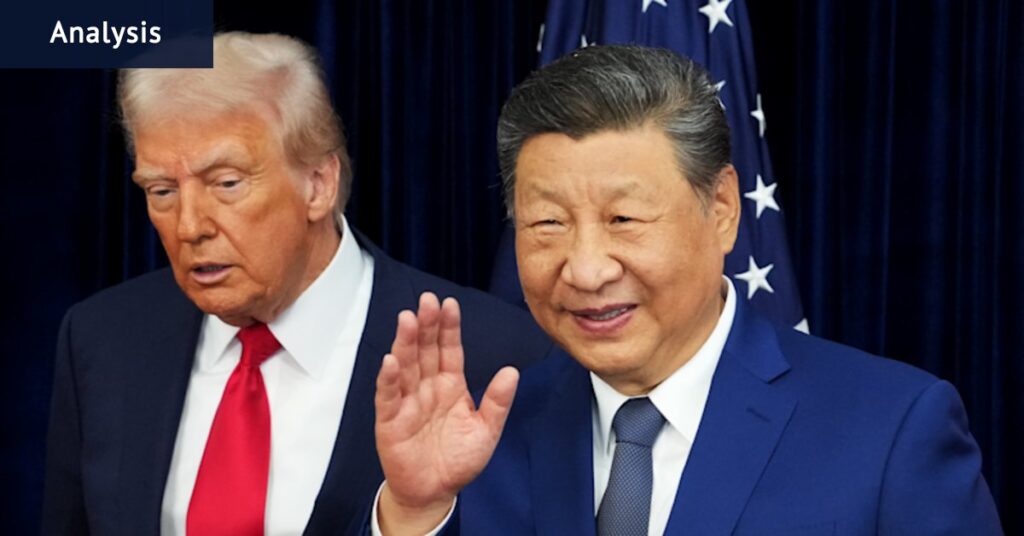
In this complex geopolitical landscape, Europe might take a page from China’s playbook. Historically, Europe has approached the US as a friend, seeking to negotiate and prevent high tariffs. In contrast, China has treated the US as a competitor, responding with strategic retaliations. For instance, Chinese President Xi Jinping imposed tariffs on American soybeans, directly impacting US farmers, and threatened to withhold critical minerals essential to the US tech industry.
This is not an endorsement of trade wars, which are detrimental to all parties involved. However, with Trump, Europe finds itself embroiled in a trade war regardless of its actions. The softer European approach has seemingly failed, as Trump perceives any conciliatory gestures as weaknesses to exploit.
The Road Ahead
The upcoming World Economic Forum in Davos presents a critical juncture for European leaders. German Chancellor Friedrich Merz, von der Leyen, and others are expected to meet Trump on the sidelines. The question remains: will they extend cordial handshakes, or will their simmering anger manifest?
Despite a seemingly softer tone from Trump, who suggested a potential compromise before departing for Davos, European leaders are aware of the need for a robust response. Europe’s strategic power is limited compared to China; its economy is smaller, and it relies on the US for defense. Nonetheless, the EU is a formidable economic entity, comprising 14% of the global economy, according to the International Monetary Fund, trailing only the US and China.
Macron’s proposed “bazooka” extends beyond tariffs, targeting intellectual property rights, financial market access, and foreign investment restrictions — all crucial to US multinational corporations. Moreover, the EU is a significant buyer of US soybeans, purchasing $3.6 billion annually.
Yet, internal divisions within Europe could undermine its response to Trump’s pressures. The UK, with distinct defense interests, often diverges from the EU, and unity within the bloc is elusive. Political challenges also abound, as major European leaders, including Starmer, Macron, and Merz, face declining popularity.
Conclusion
Trump’s abrupt and chaotic reshaping of the transatlantic alliance is occurring at a precarious time, with NATO members engaged in a conflict with Russia. Many Europeans view this as a betrayal, and Rasmussen’s call for a strong retaliatory stance on trade reflects the prevailing sentiment.
“Mr Trump, like Vladimir Putin and Xi Jinping, believes in power and power only. Europe must prepare to play by those same rules,”
he writes.
As Europe navigates this diplomatic quagmire, the world watches closely, aware that the outcomes could redefine global alliances and economic dynamics for years to come.