




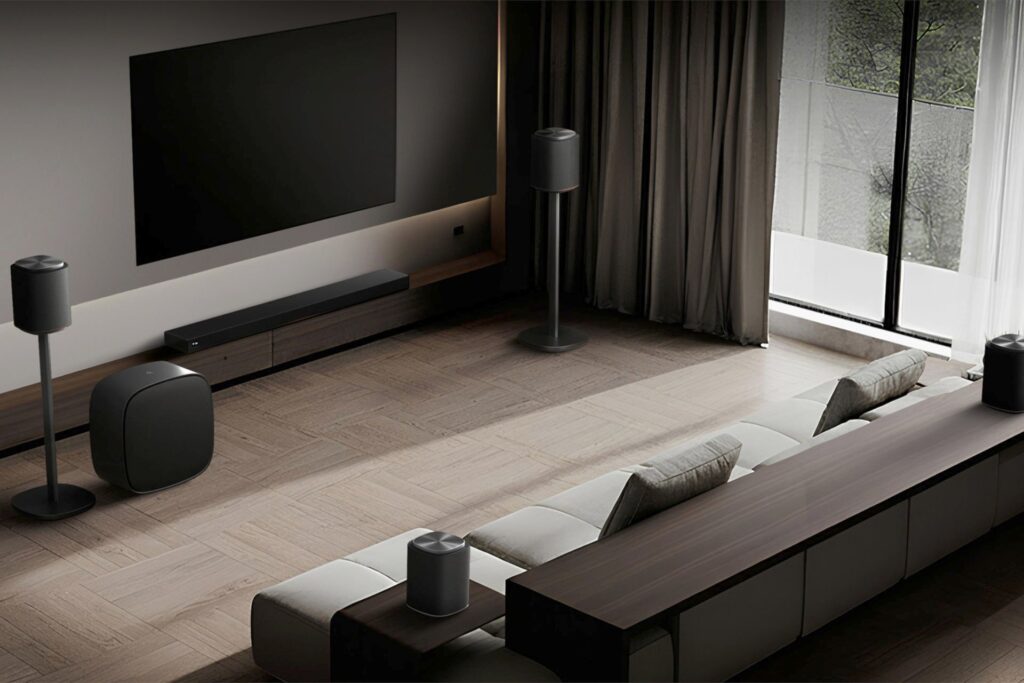
Dolby Atmos FlexConnect has been around for a little while now, but it made a significant leap towards mainstream home use during CES 2026. LG announced the first soundbar to incorporate this advanced technology, marking a pivotal moment in home audio systems.
Confirmed as part of the LG Sound Suite, an innovative audio system designed to simplify the addition of extra speakers, the H7 soundbar integrates FlexConnect as a central feature. This development aims to streamline home audio setups by minimizing wires and eliminating the need for hyper-specific configurations.
According to Dolby, the technology is designed to make it easier for users to configure a high-quality speaker setup, “no technical expertise required.”
Understanding Dolby Atmos FlexConnect
At the core of Dolby Atmos FlexConnect is the promise that users can place compatible speakers wherever they prefer, and the system will adapt to the space instead of requiring the space to adapt to the speakers. This requires a central FlexConnect-compatible device that acts as a hub for wireless speakers.
Until now, televisions served as the central device. TCL TVs, dating back to 2024, were among the first to support Dolby Atmos FlexConnect. However, compatibility is expanding, starting with the LG H7 soundbar and various LG TVs.
Users can connect wireless speakers to this central device without worrying about optimal placement. As Dolby and LG explain, the speakers can be placed wherever fits the existing living room layout, furniture included. Once connected, FlexConnect automatically adjusts the Dolby Atmos sound based on the viewing setup, optimizing audio output based on the positioning of each speaker.
How LG Sound Suite Enhances Flexibility
With soundbars now incorporating Dolby Atmos FlexConnect, LG is promoting increased flexibility in living room audio setups. The H7 soundbar can enable FlexConnect on any TV, eliminating the need for a new screen.
Interestingly, FlexConnect requires substantial computing power; the H7 soundbar utilizes the same Alpha 11 AI Processor Gen 3 chip found in LG’s OLED TVs. This is likely due to LG Sound Suite adding its own processing on top of Dolby Atmos FlexConnect.
In addition to wireless speaker pairing and optimization, Sound Suite supports its own layer of room calibration and AI processing to refine audio. Part of this involves creating a “listening sweet spot” based on the user’s location. LG achieves this through a combination of ultra-wideband technology and its ThinQ app, which pinpoints the viewer’s position.
Components of the LG Sound Suite
LG Sound Suite refers to a specific set of speakers, not just another label for Dolby’s technology. Alongside the 5.1.3-channel H7 soundbar, the range includes the M7 and M5 speakers, and the W7 subwoofer. Each component utilizes parts from Peerless, a Danish audio brand renowned for its high-quality speaker technology.
LG has yet to confirm Australian prices or release dates for the LG Sound Suite. Overseas, the H7 soundbar is priced at US$999, suggesting it will be one of the brand’s more expensive models when it launches locally.
Implications for Home Audio Enthusiasts
For home cinema enthusiasts, this emerging technology could significantly simplify the setup of wireless surround sound systems compared to their wired counterparts. The introduction of the LG H7 soundbar and its integration with Dolby Atmos FlexConnect represents a major step forward in making sophisticated audio setups accessible to a broader audience.
As the market for home audio continues to evolve, LG’s commitment to innovation through products like the H7 soundbar may set new standards for convenience and quality. The move represents a shift towards more adaptable and user-friendly home entertainment systems, potentially influencing future developments in the industry.
Looking ahead, the success of the LG Sound Suite and its reception by consumers will likely determine how quickly these technologies become standard in home audio systems worldwide.