


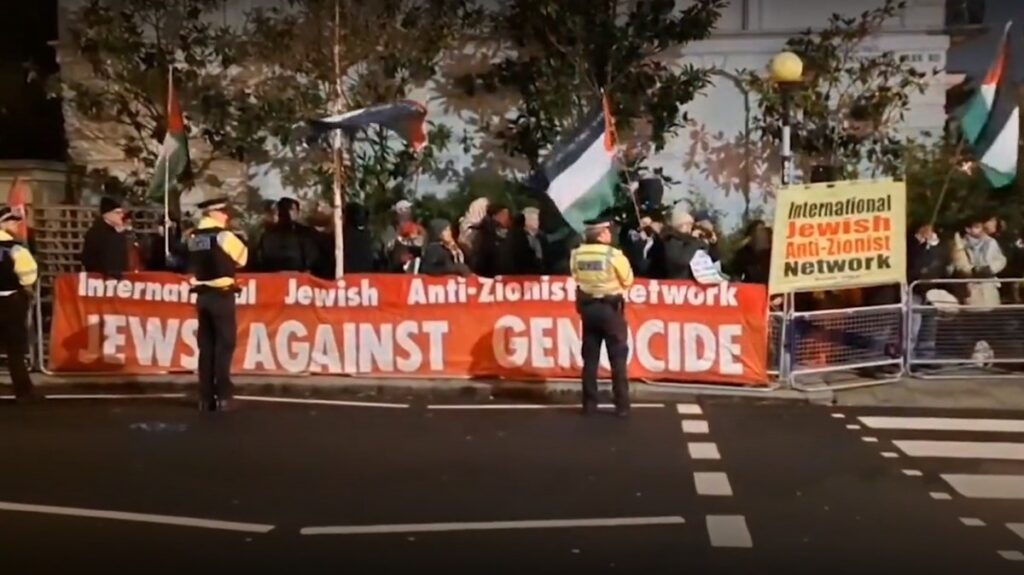
In a strong rebuke, UK Business Secretary Kemi Badenoch has condemned both police actions and protesters at an Israeli restaurant in Notting Hill, London. The protests, which have been occurring regularly for the past three months, have sparked significant controversy and debate over the limits of free speech and the nature of legitimate protest.
Badenoch criticized the events, stating, “This intimidation by a gang of bigots is frightening ordinary people, abusing the law, wasting police time, trying to ruin a small business and using the privileges of British freedom of speech to protect a mob of bullying brownshirts. It must be banned now.” She expressed shock at the scenes of a crowd “shouting racism and intimidating innocent clients and staff who are defended by a large police presence.”
Background of the Protests
The protests have been primarily directed at Miznon, an Israeli-owned restaurant, due to its association with the Gaza Humanitarian Foundation (GHF). The GHF, a US and Israeli-backed organization, faced criticism after the United Nations reported that hundreds of Palestinians were killed near its sites while seeking food. This led to the resignation of Segal, a former GHF spokesman, amid calls to boycott his restaurants.
According to a video posted on the International Jewish Anti-Zionist Network (IJAN) account on X, protesters have been gathering weekly or fortnightly outside the restaurant. An organizer mentioned that “local residents” have been involved in these protests, citing the restaurant’s connections as their primary concern.
Police and Public Reaction
The Metropolitan Police have been present during these protests as part of a broader policing strategy aimed at balancing the right to protest with the need to maintain public order. A police spokesperson stated, “Officers were present as part of a policing plan to ensure people can exercise their right to protest peacefully, while ensuring that those in the wider community can go about their lives without serious disruption.”
During a recent protest, a 35-year-old man was arrested on suspicion of chanting slogans intended to stir up religious hatred. The protest disbanded shortly after the arrest, and the individual has since been bailed.
Business Response and Antisemitism Concerns
David Goldstein, managing director of TSC Hospitality, the parent company of Miznon in the UK, has expressed grave concerns about the nature of the protests. He stated, “This is not legitimate protest: it is targeted harassment driven by antisemitism. We have been singled out because we are an Israeli business. Our staff have faced racist abuse and intimidation, including being called ‘murderers’, and one protester was arrested for chanting violent slogans. This is the seventh time we’ve been targeted by protesters. Enough is enough.”
“Antisemitism is surging, and it is unacceptable that Jewish and Israeli-owned businesses in London are being threatened in this way. We will not close our doors. The authorities must recognize this has gone far beyond protest into racism and harassment and put an end to it.”
Historical Context and Expert Opinions
The protests at Miznon are part of a broader pattern of increasing tension and division over Middle Eastern politics within the UK. Historically, the Israeli-Palestinian conflict has sparked heated debates and protests across Europe, often leading to accusations of antisemitism and racial discrimination.
Experts warn that such protests, if not carefully managed, can exacerbate community tensions and lead to further polarization. Dr. Sarah Mendelson, a political analyst specializing in Middle Eastern affairs, commented, “While the right to protest is a fundamental democratic principle, it is crucial that these protests do not cross the line into hate speech or intimidation. Authorities must tread carefully to uphold both public order and civil liberties.”
Looking Ahead
The situation at Miznon highlights the ongoing challenges faced by businesses with international ties in politically sensitive contexts. As the protests continue, the UK government and law enforcement agencies are under pressure to find a balance between protecting the rights of protesters and ensuring the safety and security of businesses and their patrons.
Meanwhile, community leaders and policymakers are urged to engage in dialogue to address the underlying issues driving these protests and to foster a more inclusive and tolerant society. The coming weeks will likely see further developments as authorities and community stakeholders seek to navigate these complex dynamics.