


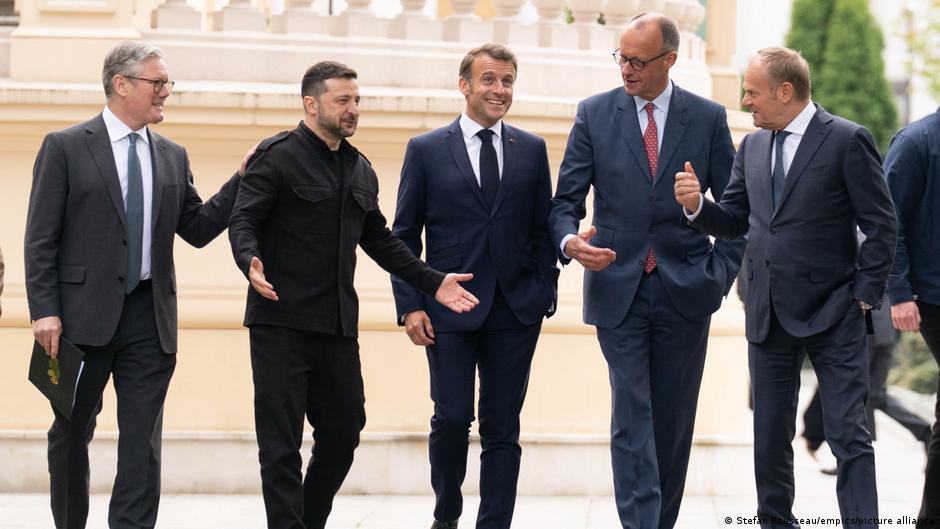
As European allies gathered in Paris to consolidate security guarantees for Ukraine, the presence of peace envoys sent by former President Donald Trump provided a glimmer of hope that the United States remained engaged with the European Union, despite Trump’s previous threats to annex Greenland. “We have largely finished the security protocols,” stated Steve Witkoff, one of the two emissaries, alongside leaders from France, Germany, the UK, and Ukraine at the French presidential palace.
“This is important so that when this war ends, it ends forever,” Witkoff emphasized. While France and the UK committed to deploying troops to Ukraine in a postwar context, the US refrained from offering protection for these forces should Russia threaten their security.
European Commitment to Ukraine’s Future
This week, France, the UK, and Ukraine signed a declaration of intent to deploy a multinational force dedicated to Ukraine’s defense, reconstruction, and strategic sustainability. Experts noted that the formal document provides a more robust assurance to Ukraine. On Tuesday, German Chancellor Friedrich Merz announced Germany’s potential military role, suggesting troop deployment to NATO territories neighboring Ukraine after a ceasefire is achieved.
For the first time, Spanish Prime Minister Pedro Sanchez expressed a willingness to contribute troops to a peacekeeping mission in Ukraine, although the specifics of Spain’s involvement remain uncertain. Jacob Funk Kirkegaard, a senior fellow at the Brussels-based think tank Bruegel, explained that the term “multinational” is deliberately used to include other European and non-European nations, such as Australia or Turkey, a key player in the Black Sea region.
Coalition of the Willing
The Paris meeting took place under the framework of the “coalition of the willing,” consisting of approximately 30 countries, excluding the United States, that have pledged to assist Ukraine with security guarantees. The coalition’s statement mentioned plans to build “defensive fortifications” within Ukraine, though details were sparse.
“These fortifications could resemble those in NATO member states near Russia, such as Finland, involving mines and barbed wire,” Kirkegaard suggested.
The coalition also intends to participate in a US-led monitoring-and-verification mechanism post-ceasefire to monitor Russian compliance with peace terms. This effort would involve procuring and using drones, sensors, and satellites to oversee the contact line. The statement emphasized that Ukrainian forces would remain the primary line of defense, with coalition troops primarily serving as trainers rather than combatants.
Challenges and Uncertainties
Despite efforts to establish a long-term security framework for Ukraine, numerous questions remain unanswered. President Emmanuel Macron indicated France might deploy “several thousands” of troops, but securing parliamentary approval for funding could prove challenging amid France’s political and economic turmoil.
In the UK, the decision to sign the declaration has sparked criticism from opposition leaders and experts who argue that Britain’s military resources are already stretched thin. A recent strategic defense review highlighted a decline in the size and readiness of the UK’s Armed Forces since the Cold War’s end. Addressing parliament, UK officials stated that troop numbers for Ukraine would align with ongoing military plans.
Germany’s potential troop deployment to NATO territories neighboring Ukraine also requires Bundestag approval. Other coalition members have been vague about their contributions, preferring to disclose details once peace is achieved.
Ukrainian President Volodymyr Zelenskyy questioned, “Would all the coalition partners respond strongly if Russia attacks again? I ask all of them, and I still have not gotten a clear answer.”
The US Role: A Crucial Missing Piece
The absence of a US commitment remains a significant obstacle to a European presence in post-war Ukraine. Trump’s envoys in Paris did little to alleviate European concerns about US support for their troops in the event of Russian aggression.
Austrian military historian Markus Reisner, from the Theresian Military Academy in Vienna, noted that the draft declaration’s core message was to encourage US commitment to a future European deployment. “Without US assurance, Europe is not prepared to continue,” he said.
“It seems inconceivable that European armed forces would establish a large-scale presence in Ukraine without US support and its specialized military capabilities,” Reisner warned. “This is especially true as long as Russia considers Western soldiers in Ukraine to be military targets.”
The unfolding situation highlights the critical role of US involvement in ensuring the success and safety of any European-led peacekeeping efforts in Ukraine. As the coalition of the willing moves forward, the need for a comprehensive and unified approach remains paramount.