



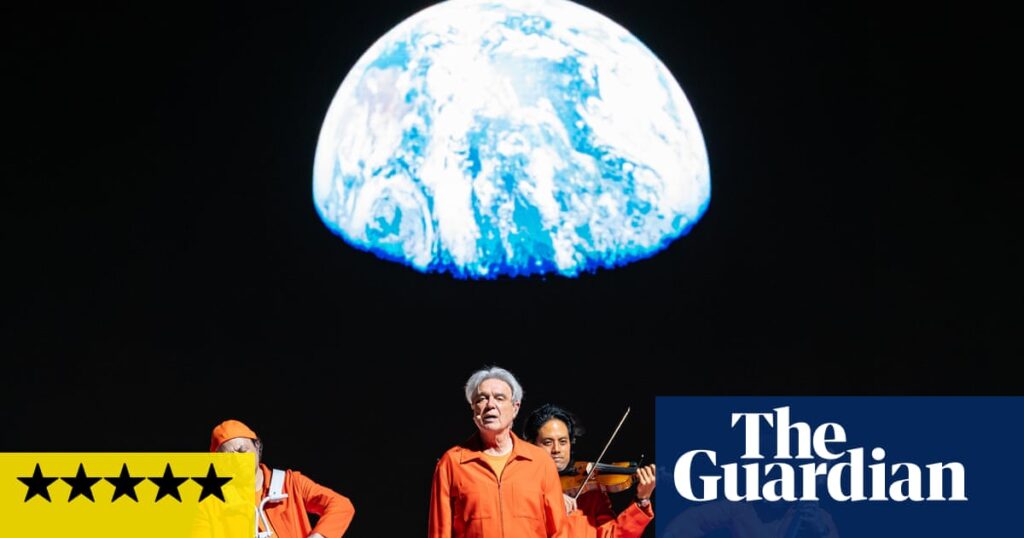
Dressed in vibrant iridescent orange, David Byrne and his 12-piece backing band appeared ready to ignite the stage at the Brisbane Entertainment Centre. On a vast, uncluttered stage, devoid of traditional amplifiers and microphones, the former Talking Heads frontman exhibited the same twitchy energy that has captivated audiences for decades.
The spectacle, reminiscent of the legendary Stop Making Sense tour of 1984, unfolded incrementally, beginning with “Heaven” from Talking Heads’ 1979 album Fear of Music. Despite being 73, Byrne’s passion for the here and now was evident, as the first visual backdrop depicted Earth, emphasizing its uniqueness as “the only planet we’ve got”. Over the course of two hours, fans were treated to a performance that felt like a vivid commentary on the world’s current state.
The Marching Band Experience
Byrne’s performance was a dynamic display, with band members, including Ray Suen on violin, Kely Pinheiro on cello, and Daniel Mintseris on a waist-worn synthesizer, joining him on stage. The musicians, equipped with portable instruments, moved like a marching band, with video screens projecting diverse settings behind them. From an empty department store to a cornfield, the visual journey complemented the musical one.
The band’s diversity was a central theme, as Byrne rhetorically questioned, “What if we all judged people by their appearances?” A playful audience response, “You’re very sexy, David!” led to a moment of levity, underscoring the deceptive nature of appearances. Byrne’s commentary on punk’s evolution into a movement of love and kindness contrasted sharply with the harsh realities of today’s world, as epitomized by political figures like Stephen Miller.
Hope, Vulnerability, and Humanity
Despite the world’s challenges, Byrne’s humanity shone through. His vulnerability was palpable in “My Apartment Is My Friend” from his new album Who Is the Sky?, where he shared a glimpse into his life in New York City. The video screens provided a tour of his apartment, a place that has witnessed his highs and lows. Byrne’s admission of living alone resonated with the audience, adding a personal touch to the performance.
In “T-shirt,” an older solo song, Byrne explored identity politics with pointed slogans like “Make America Gay Again” and “Everyone Watches Women’s Sports,” eliciting cheers and laughter. These solo pieces, while not the main attraction for many, seamlessly integrated into the show, maintaining its superb pacing and choreography.
Classic Hits and New Interpretations
While Byrne’s new material was well-received, it was the Talking Heads classics that truly energized the crowd. “This Must Be the Place (Naive Melody)” was the first to bring fans to their feet, while Pinheiro’s cello work on “Psycho Killer” added a fresh dimension to the familiar tune. Her performance was pivotal, particularly on “Houses in Motion,” where she introduced a new double-time coda, showcasing her musical prowess.
The performance reached its most intense during “Life During Wartime,” a song that remains eerily relevant. As Byrne sang, “The sound of gunfire off in the distance / I’m getting used to it now,” footage of ICE squads and New York City police clashing with protesters played behind him, creating a powerful and unsettling moment.
A Spectacular Conclusion
The show concluded with “Burning Down the House,” a fitting finale that encapsulated the evening’s themes. As the song exploded into life, it served as a reminder of the fragility of the American dream and the importance of vigilance. Byrne’s performance was not just a concert; it was a commentary on contemporary society, wrapped in an electrifying spectacle of music and dance.
David Byrne’s show was a testament to his enduring creativity and ability to connect with audiences on both an emotional and intellectual level. As the audience left the Brisbane Entertainment Centre, they carried with them not just memories of a fantastic performance, but also a renewed sense of hope and humanity.