


Hawaiian Airlines, renowned for its warm island hospitality and extensive network connecting the Hawaiian Islands with the mainland United States and international destinations, is set to embark on a significant transformation. Beginning in 2028, the airline will introduce a comprehensive overhaul of its Airbus A330 fleet, marking a pivotal shift in its premium offerings. This ambitious project includes the launch of Hawaiian’s first-ever true premium economy cabin and a fully redesigned first-class product, capturing the attention of frequent flyers and positioning Hawaiian Airlines to compete more effectively with global carriers.
The announcement comes as Hawaiian Airlines seeks to enhance its onboard experience in response to rising premium travel expectations. The introduction of these new cabins is part of a broader strategy to elevate the airline’s service offerings and align them with international standards.
Introducing the A330 Premium Economy Cabin
Starting in 2028, Hawaiian Airlines will embark on a complete refresh of its 24 Airbus A330-200 aircraft. The centerpiece of this transformation is the introduction of a brand-new premium economy cabin, a first for the airline. Premium economy, a class that bridges the gap between economy and business, has gained popularity worldwide for offering enhanced comfort at a more accessible price point than business class.
Historically, Hawaiian Airlines has not offered a true premium economy experience. Instead, its A330s feature 88 ‘economy comfort’ seats, providing passengers with 36 inches of pitch and six inches of recline, an improvement over the standard 31-inch pitch in regular economy. The new premium economy cabin will represent a significant upgrade, aligning Hawaiian Airlines with international carriers and domestic competitors like Delta.
While specific details about the seat configuration are yet to be revealed, industry standards suggest a likely 2-3-2 arrangement. Passengers can expect features akin to a US domestic first-class product, including generous recline and enhanced privacy, potentially with headrest winglets for added comfort.
Redefining First Class on the A330
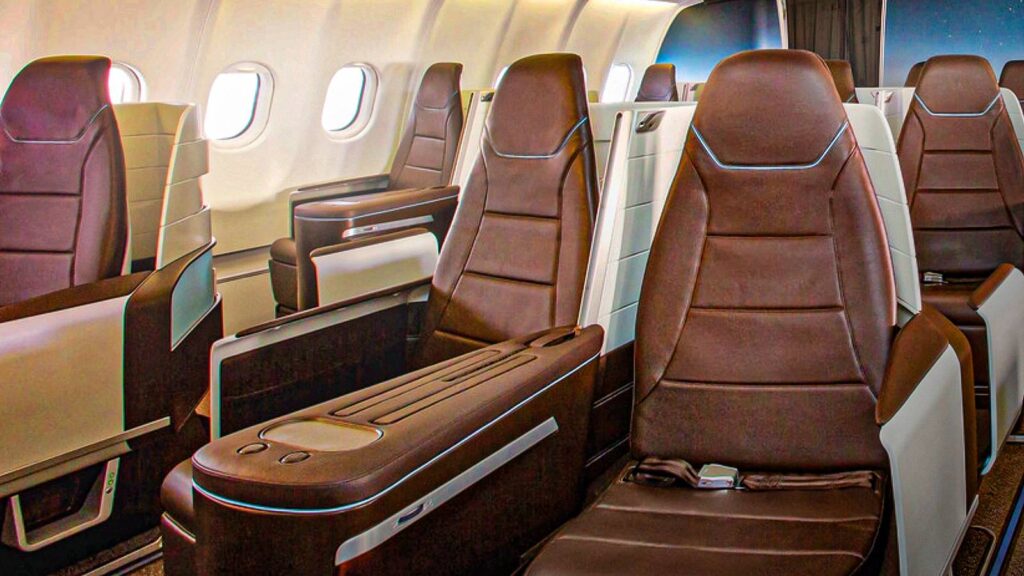
In tandem with the premium economy cabin, Hawaiian Airlines is investing in a complete overhaul of its A330 first-class product. Currently, the A330s feature a lie-flat first-class product in a 2-2-2 configuration, which lacks direct aisle access for window seat passengers—a key feature in modern business class offerings.
The planned refresh will introduce new business class seats, expected to resemble those found on Hawaiian’s 787-9s. These seats offer direct aisle access, lie-flat capabilities, and personal privacy. According to Alaska Air Group Chief Commercial Officer Andrew Harrison, the new first-class and premium economy offerings are anticipated to generate significantly more revenue in the coming years.
“We’re going to be reconfiguring the A330 and increasing the first class, the J cabin. Over the next few years, [the new first class and premium economy] will generate significantly more revenue than they do today.”
Given the A330’s shorter length compared to the 787-9, Hawaiian’s first-class cabin will likely be smaller, but the redesign will enable the airline to maintain competitiveness in the premium travel market, particularly on international and high-density domestic routes.
Enhancing the Inflight Experience
Beyond cabin upgrades, Hawaiian Airlines is also set to enhance its inflight entertainment and connectivity. As part of the A330 overhaul, the airline will introduce high-definition seatback entertainment screens with Bluetooth audio connectivity, similar to those on its 787-9s. This upgrade will be complemented by the rollout of fast, free onboard WiFi powered by Starlink technology, a significant advancement for the airline, which historically did not offer inflight WiFi.
Additionally, Hawaiian Airlines is launching a modernized mobile app to streamline booking and trip management, offering self-service features like flight changes and award travel redemption. The airline is also investing in new technology for its employees and plans to merge its passenger service system with Alaska Airlines by late April.
The $600M Kahu’ewai Hawai’i Investment Plan
Hawaiian Airlines’ A330 transformation is part of a broader $600 million investment plan known as Kahu’ewai Hawai’i. This initiative aims to deliver benefits across the airline and Hawaiian communities, with renovations at all five Hawaiian airports it serves, including Honolulu, Līhu’e, Kahului, Kona, and Hilo. These upgrades will improve passenger flow and comfort, featuring open, bright spaces and more seating options.
Additionally, Hawaiian Airlines will construct a new 10,600 square foot first-class lounge at Honolulu’s Daniel K. Inouye International Airport, designed with light cream and blue colors, wood accents, and native Hawaiian plants.
The Future of Hawaiian Airlines
As Hawaiian Airlines enters 2026, its fleet of 75 aircraft continues to evolve. The airline’s widebody fleet includes 34 Airbus A330s, with 24 A330-200s configured for passenger service and 10 A330-300s operating cargo flights for Prime Air. With an average age of under 13 years, these aircraft have a promising future ahead.
On the narrowbody side, Hawaiian maintains a fleet of 19 Boeing 717s and 18 A321neo aircraft. However, the future of these aircraft remains uncertain as Hawaiian evaluates its fleet strategy in light of its merger with Alaska Airlines.
Ultimately, Hawaiian Airlines’ upcoming A330 transformation represents more than a routine cabin refresh; it marks a turning point for the airline as it redefines its role following its merger with Alaska Airlines. With the introduction of a true premium economy cabin, modernized first class, industry-leading WiFi, and sweeping airport investments, Hawaiian is aligning its onboard experience with the expectations of today’s premium travelers. Once these upgrades roll out later this decade, they promise to make the long journey to and from the Hawaiian islands more comfortable while maintaining the Aloha spirit.