

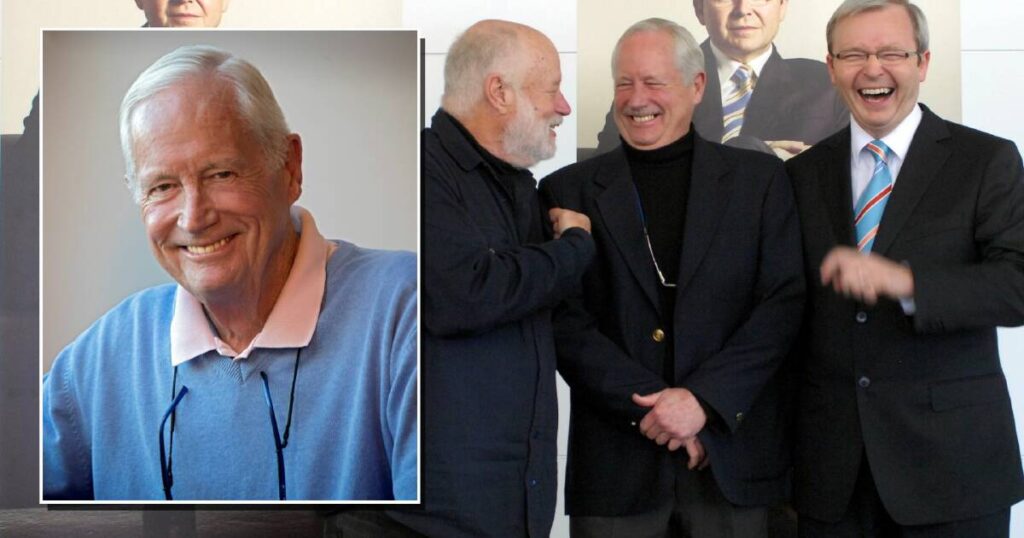
Sunlight streams through the windows of Robert Macklin’s bedroom, casting a warm glow over the room where he lies contentedly against the pillows. The renowned writer, surrounded by books, family, and the comforting sounds of conversation and laughter from the kitchen, faces the final hours of his life with a sense of peace. Just 18 hours remain before Macklin, who has chosen to end his life on his own terms, will be gone. “I am so relieved. So relieved,” he expresses with a calm certainty.
It is mid-afternoon on Thursday, January 15, and by this time tomorrow, the 84-year-old journalist and author will have passed away. His decision comes after a long battle with chronic obstructive pulmonary disease (COPD), a condition that has progressively worsened over the past year. “You get breathless, and that is horror-land,” Macklin explains. “You panic, and it becomes more and more intensive, more and more difficult to get back to normality. Finally, you’ll find that there is no way back to normality. That’s what is happening to me, and I’m just chopping it off just before the event.”
Reflecting on a Life Well-Lived
Macklin’s life has been one of remarkable achievements and experiences. Diagnosed with COPD in 2017, a consequence of 30 years of smoking, he has since lived with the knowledge that the disease would eventually claim his life. Yet, he considers himself fortunate, having enjoyed a fulfilling career as a journalist and author of over 30 books, including a biography of former Labor leader Kevin Rudd and a novel adapted into a film starring James Spader.
“This is partly one of the things that allowed me to say, yes, I will opt to go out now, because I have had an extraordinary life,” Macklin reflects. “I’ve done all of the things that I wanted to do. So I’m not horrified at the thought of going, at the thought of leaving this world.”
The Decision for Voluntary Assisted Dying
Despite his condition, Macklin had not engaged deeply with the debates surrounding voluntary assisted dying until recently. The legal framework for such a decision became a reality in Canberra in November, offering him a dignified choice as his health deteriorated. “The process of VAD is very considerable – you really have to be sure this is what you want,” he notes. “But the people that they’ve got to do it are so generous with their time and their emotions, their sense of propriety, that you feel that you are being very carefully looked after.”
“It’s one step up in our evolution to have this capability, and I think it’s been extraordinarily well handled in Canberra.” – Robert Macklin
With the support of his family, Macklin has navigated the rigorous process required to access voluntary assisted dying. His son Ben describes the journey as one that offers Macklin the freedom to change his mind at any moment, right up until the final decision. “At every step of the way, Dad has the opportunity, or the option, to say, ‘Alright, I’m actually not ready. Let’s stop now and we can reassess later’, right up until the very, very, very, very last moment,” Ben explains.
A Family’s Perspective
Wendy, Macklin’s wife of 60 years, finds solace in the choice her husband has made. “It’s so beautifully organised,” she says, reflecting on the calm and purposeful atmosphere in their home. The couple had once considered traveling to Mexico to obtain illegal drugs for a peaceful end, should they face terminal illness. Now, with legal options available, Wendy acknowledges the relief in being able to make such a decision.
As the family prepares for Macklin’s final day, they find themselves laughing and reminiscing, a testament to the love and memories they share. Wendy plans to sit with Macklin as he drifts into his final sleep. “I will just sit in the lounge here – it takes a little while. It’s certainly better than my poor mother in the hospital, pleading to go,” she reflects.
“If you’ve lived as long as us, you have been with loved ones dying. In my case, my mother and a couple of friends. The others, their loved ones, all said it went on too long.” – Wendy Macklin
Looking Ahead
As Macklin’s story comes to a close, his family cherishes the time they have spent together, grateful for the opportunity to say goodbye on their own terms. The decision for voluntary assisted dying remains a deeply personal one, yet Macklin’s experience highlights the importance of choice and dignity in the face of terminal illness.
In the coming days, as the family adjusts to life without him, they will hold onto the legacy of a man who lived life fully and left on his own terms. Macklin’s decision serves as a reminder of the power of agency and the profound impact of a life well-lived.