



The construction company involved in a recent crane collapse that resulted in two fatalities near Bangkok is the same firm linked to a previous crane accident that left 32 people dead in Nakhon Ratchasima, according to Thailand’s Transport Minister. The incidents, occurring just a day apart, have raised serious concerns about safety practices within the construction industry.
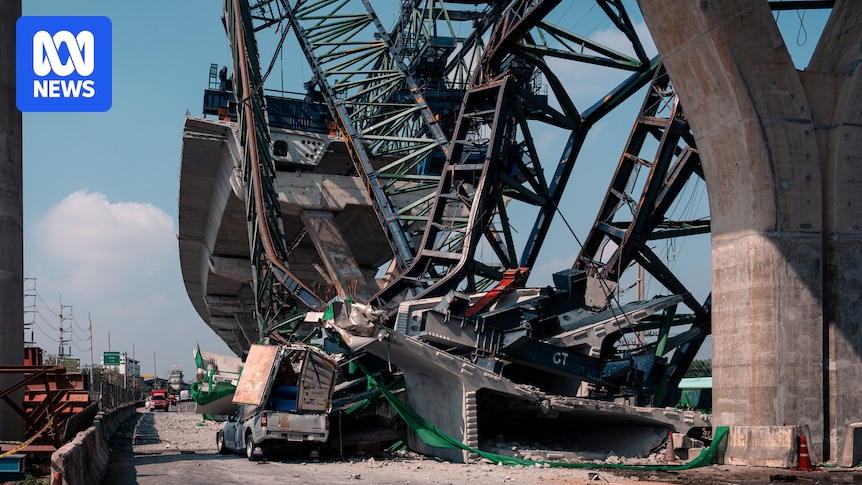
Dash-cam footage verified by AFP captured the dramatic moment when the crane toppled onto a highway, sending clouds of dust and debris into the air. Vehicles were seen pulling over or reversing to avoid the falling rubble. Transport Minister Phiphat Ratchakitprakarn identified the construction firm as Italian-Thai Development, a major player in Thailand’s infrastructure projects, which has now been linked to two catastrophic crane failures in as many days.
Repeated Safety Concerns
The company was working on a section of a China-backed high-speed rail project in Nakhon Ratchasima province when a massive crane collapsed on Wednesday, derailing a passenger train beneath. Of the nearly 200 passengers onboard, 32 lost their lives. “We have to find out the facts, whether it was an accident or something else,” Minister Ratchakitprakarn stated, acknowledging the fatalities.
Italian-Thai Development has faced scrutiny before, with several deadly accidents reported at its construction sites in recent years. The latest incident occurred Thursday morning at the under-construction Rama II Expressway in Samut Sakhon province, just outside Bangkok, where two people were killed, according to local police chief Sitthiporn Kasi.
Rama II Expressway: A Troubled Project
The Rama II Expressway, a crucial artery connecting Bangkok to the southern regions of Thailand, has been undergoing major expansion efforts aimed at increasing capacity and reducing congestion. However, the project has been plagued by delays and fatalities, earning it the moniker “Death Road.” In March, a concrete beam from an elevated roadway under construction collapsed, resulting in several deaths. Additional crane collapses in November 2024, May 2023, and January 2024 have further marred the project’s progress.
Implications for the High-Speed Rail Project
The crane collapse in Nakhon Ratchasima is considered one of Thailand’s deadliest rail accidents in recent years. The massive gantry crane, used by Italian-Thai for the high-speed rail project, fell onto a passenger train. The health ministry reported that 32 people were confirmed dead, with three missing and 64 hospitalized, including seven in critical condition.
On Thursday, construction workers and victims’ relatives gathered at the scene to pay their respects. The crane remained precariously perched on concrete pillars intended for the future elevated rail line, a joint venture between Thailand and China. Italian-Thai has expressed condolences and pledged to compensate victims’ families and cover medical expenses for the injured.
“We are committed to ensuring the safety of our projects and will cooperate fully with the investigation,” stated a spokesperson for Italian-Thai Development.
Accountability and Future Steps
The national rail operator has ordered Italian-Thai to suspend construction activities pending a thorough investigation. Minister Ratchakitprakarn emphasized that all parties involved, including Italian-Thai and a Chinese consultancy firm, would be held accountable. The crane operator, a Thai national, was among those who perished in the Nakhon Ratchasima incident, as confirmed by a worker from Italian-Thai who wished to remain anonymous.
As investigations continue, the spotlight remains on the construction industry’s safety standards and regulatory oversight. The recent tragedies have prompted calls for stricter enforcement of safety protocols and more rigorous inspections to prevent future accidents.
With two deadly crane collapses in quick succession, the pressure is mounting on Italian-Thai Development and the Thai government to address these critical safety issues. The outcomes of the investigations will likely influence future infrastructure projects and safety regulations in Thailand.