



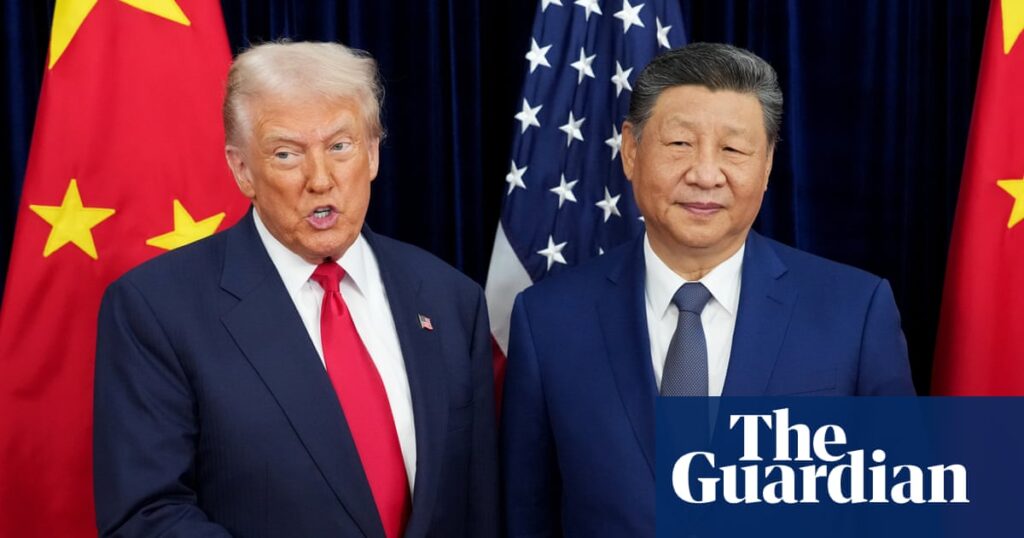
A year after Donald Trump’s return to the White House, a global survey suggests that his nation-first “Make America Great Again” strategy may be inadvertently enhancing China’s global stature. The survey, conducted by the European Council on Foreign Relations (ECFR), reveals that many around the world perceive Trump’s policies as bolstering China’s influence rather than America’s.
The ECFR’s survey, encompassing 21 countries, highlights a significant shift in global perceptions. It indicates that under Trump’s leadership, the United States is less feared by its traditional adversaries, while its allies, particularly in Europe, feel increasingly alienated. This shift is most pronounced in Europe, where many no longer view the U.S. as a reliable ally, opting instead to support rearmament.
Changing Global Perceptions
The survey, which polled nearly 26,000 respondents across 13 European countries, the U.S., China, India, Russia, Turkey, Brazil, South Africa, and South Korea, found that majorities in nearly all surveyed territories anticipate China’s global influence to grow over the next decade. This sentiment is particularly strong in South Africa (83%), Brazil (72%), and Turkey (63%).
Interestingly, while the U.S. remains influential, outside of Brazil, India, South Africa, and Turkey, there is no majority belief that American influence will continue to expand. This trend is reflected in the declining perception of the U.S. as an ally, with India being the only country where a majority still views the U.S. as a partner sharing common values and interests.
Europe’s Evolving Stance
The survey underscores a marked change in European perceptions of the U.S. Only 16% of EU citizens now consider the U.S. an ally, while a notable 20% see it as a rival or enemy. This shift is echoed in Russia, where respondents increasingly view Europe as an adversary, and in Ukraine, where support is shifting from Washington to Brussels.
“Europe could end up squeezed or simply ignored,” the report’s authors caution, urging European leaders to adapt to the new geopolitical landscape.
China’s Rising Influence
As perceptions of the U.S. decline, China’s image is on the rise. The survey indicates that majorities in countries like South Africa (85%), Russia (86%), and Brazil (73%) view China as either a necessary partner or an ally. In contrast, only in Ukraine and South Korea do majorities see China as a rival or adversary.
Moreover, many countries expect their relationships with China to strengthen. In China itself, 61% of respondents perceive the U.S. as a threat, while only 19% feel the same about the EU. This view is mirrored by a majority in China who consider the EU a great power.
Implications for Global Power Dynamics
The survey’s findings suggest a significant shift in the global balance of power. With the war in Ukraine entering its fifth year, Russia’s view of Europe as an adversary has grown, while Ukrainians increasingly look to Europe for support. Meanwhile, optimism about the EU is not universally shared, with many Europeans doubting the bloc’s ability to deal on equal terms with the U.S. or China.
“Political leaders in Europe should no longer ask themselves whether their own citizens grasp the radical nature of the current geopolitical changes. They do,” the report’s authors assert.
The authors, including Ivan Krastev, Mark Leonard, and Timothy Garton Ash, argue that Trump’s actions, such as interventions in Venezuela and territorial ambitions in Greenland, demonstrate a preference for being feared over being loved. This approach, they suggest, is inadvertently boosting China’s global standing.
As the world navigates these shifting dynamics, European leaders are urged to be both realistic and daring, finding new ways to assert themselves in a multipolar world. The survey highlights the urgency for Europe to redefine its role or risk being overshadowed by other global powers.