



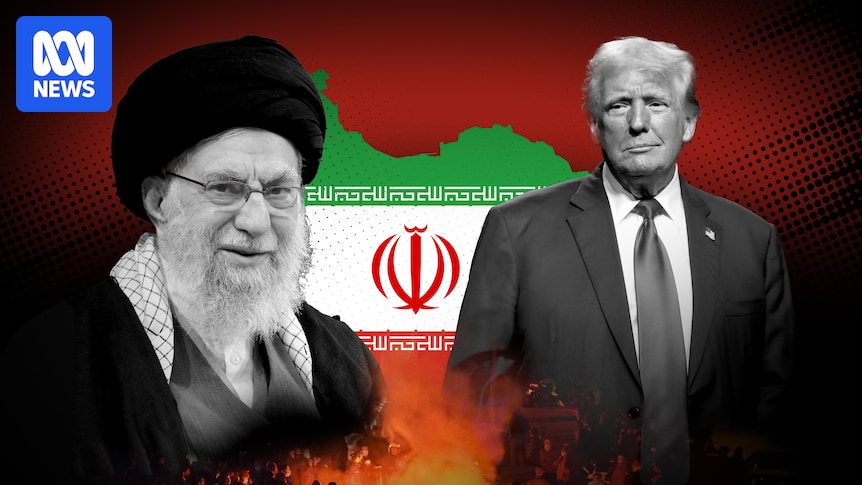
US President Donald Trump has assured Iranians that “help is on the way” as mass protests continue to sweep across cities in Iran. The president’s remarks have sparked concerns about the possibility of military action against Iran, a move that could redefine the long and complex history between the two nations.
Trump’s potential actions could mark a new chapter in US-Iran relations, which have been fraught with tension and conflict over the past seven decades. From covert operations to diplomatic standoffs, the relationship has been shaped by a series of pivotal events.
The Historical Context of US-Iran Relations
1953: Operation Ajax
In the aftermath of World War II, Iran’s decision to nationalize the British-owned Anglo-Iranian Oil Company led to economic sanctions from London, crippling Iran’s economy. Fearing Soviet influence in the region, the US, under President Dwight D. Eisenhower, orchestrated a CIA-led coup to overthrow Iran’s government, reinstating a pro-Western monarchy. Shah Mohammad Reza Pahlavi, although unpopular domestically, relied heavily on American support to maintain his rule.
1979: The Iranian Revolution
Amid escalating civil unrest, Shah Mohammad Reza Pahlavi fled Iran in January 1979. By December, Grand Ayatollah Ruhollah Khomeini had returned from exile to establish an Islamic theocracy, fundamentally altering Iran’s relationship with the US. This shift set the stage for decades of strained interactions.
1979-1981: The Hostage Crisis
On November 4, 1979, Iranian students seized the US Embassy in Tehran, taking 66 hostages, including 52 Americans held for over a year. The crisis led to the severance of diplomatic ties and the imposition of economic sanctions by the US. The hostages were eventually released after 444 days under the Algiers Accords.
Escalating Tensions and Attempts at Diplomacy
2002: The ‘Axis of Evil’
In his 2002 State of the Union address, President George W. Bush labeled Iran as part of an “axis of evil,” accusing it of pursuing weapons of mass destruction. This rhetoric intensified suspicions and led to further sanctions, despite some back-channel communications between the two countries post-9/11.
2013-2016: Easing Tensions
Under President Barack Obama, the US sought to reduce tensions through diplomacy. In 2015, the Joint Comprehensive Plan of Action (JCPOA) was signed, requiring Iran to limit its nuclear activities in exchange for sanction relief. This agreement marked a significant, albeit temporary, thaw in relations.
2018-2019: Withdrawal from the JCPOA
President Trump withdrew the US from the JCPOA in 2018, citing its ineffectiveness in curbing Iran’s nuclear ambitions. He reinstated severe economic sanctions, pushing Iran into a deep recession and escalating uranium enrichment efforts.
Recent Developments and Future Prospects
2020: The Assassination of Qassem Soleimani
The US drone strike that killed Iranian Major General Qassem Soleimani in Baghdad in 2020 marked a significant escalation. Soleimani was a key figure in Iran’s military operations and his death heightened tensions, leading to protests in both Iran and Iraq.
2025: Operation Midnight Hammer
In a bold military move, the US launched Operation Midnight Hammer in 2025, targeting Iran’s nuclear sites with B-2 bombers and Tomahawk missiles. The operation, praised by Trump as a “spectacular military success,” further strained relations, as Iran refused to allow inspections of the damaged sites.
2026: Protests and Promises of Intervention
As protests erupted across Iran in late 2025, driven by economic distress and governmental opposition, Trump promised intervention if Iranian authorities resorted to violence against demonstrators. His statements have raised the stakes, with Iranian officials threatening retaliation against US interests.
The unfolding situation in Iran highlights the fragile nature of US-Iran relations and the potential for significant geopolitical shifts. As the world watches, the actions taken by both nations could have far-reaching consequences for regional stability and international diplomacy.