


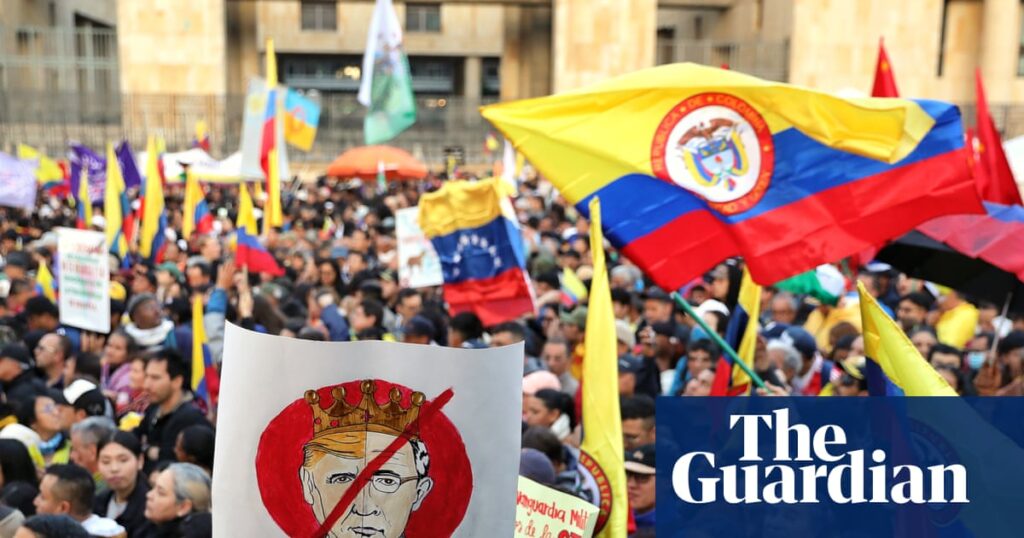
Thousands of protesters have taken to the streets across Colombia, expressing outrage over former U.S. President Donald Trump’s threats to expand military operations into their country. This follows a recent and deadly U.S. special forces raid in Venezuela. The demonstrations have erupted in several cities, with Cúcuta, a city on Colombia’s eastern border with Venezuela, seeing hundreds march towards its historic cathedral, waving Colombia’s national flag and chanting, “Fuera los yanquis!” or “Out with the Yanks!”
The protests come in response to Trump’s suggestion of potential military intervention in Colombia, following the dramatic capture of Venezuelan President Nicolás Maduro during a raid in Caracas. This incident has sparked widespread condemnation across Latin America, with many accusing Trump of imperialistic ambitions.
Colombian Leaders and Citizens React
Colombia’s left-wing President, Gustavo Petro, called for the rallies, emphasizing the illegality of the U.S. intervention in Venezuela. Speaking to a large crowd in Bogotá’s Bolívar Plaza, Petro criticized the actions while maintaining a diplomatic tone after a conversation with Trump. “We cannot lower our guard,” he stated, urging for actions to match words.
Protesters echoed these sentiments with fervor. Janet Chacón, a businesswoman among the demonstrators, described Trump as “the devil” and “the most abhorrent person in the world.” José Silva, another protester, criticized the U.S. Congress for not taking action against Trump, labeling him a “maniac” and a “thug.”
Regional and International Reactions
The backlash against Trump’s actions has not been confined to Colombia. Protests have also occurred in major Latin American cities, including Mexico City, São Paulo, and Buenos Aires. Reimont Otoni, a Brazilian congressman, led protests in Rio de Janeiro, denouncing the U.S. intervention as a form of imperialism.
Otoni acknowledged the crisis in Venezuela but argued that military intervention was not the solution. “There isn’t the slightest chance that an aerial bombardment or the kidnapping of a country’s president will fix this,” he stated, criticizing European leaders for their silence on the issue.
“The message from the people of Latin America is: ‘Donald Trump, get your hands off Latin America. Latin America isn’t the US’ backyard,’” said Reimont Otoni.
Historical Context and Implications
This is not the first time Trump has taken controversial actions in Latin America. Since returning to power, he has made several bold moves, including threatening to “take back” the Panama Canal and intervening in Honduras’ presidential election. These actions have raised concerns among Latin American diplomats about the potential for further U.S. interventions.
Benjamin Gedan, a former South America director at the National Security Council, criticized Trump’s approach as “unhinged” and damaging to U.S. diplomatic relationships. He argued that Trump’s focus on resource acquisition over democratic principles alienates potential allies.
“It seems like Trump goes out of his way to maximize the diplomatic wreckage,” Gedan remarked.
Future Prospects and Concerns
The current situation has left many in Latin America apprehensive about future U.S. actions. Marta Jiménez, a teacher in Cúcuta, expressed fears that other countries could become targets. “It might be Nicaragua, Brazil, Ecuador, Peru – any of them,” she warned.
As tensions continue to rise, the international community watches closely. The potential for further conflict looms, with Trump’s recent comments about possible military action in Mexico adding to the uncertainty. The situation underscores the fragile state of U.S.-Latin American relations and the need for diplomatic solutions to complex regional issues.
The protests in Colombia and beyond signal a growing resistance to perceived U.S. imperialism, with citizens and leaders alike calling for respect and autonomy in the region. As the world awaits further developments, the calls for peace and sovereignty resonate louder than ever.