

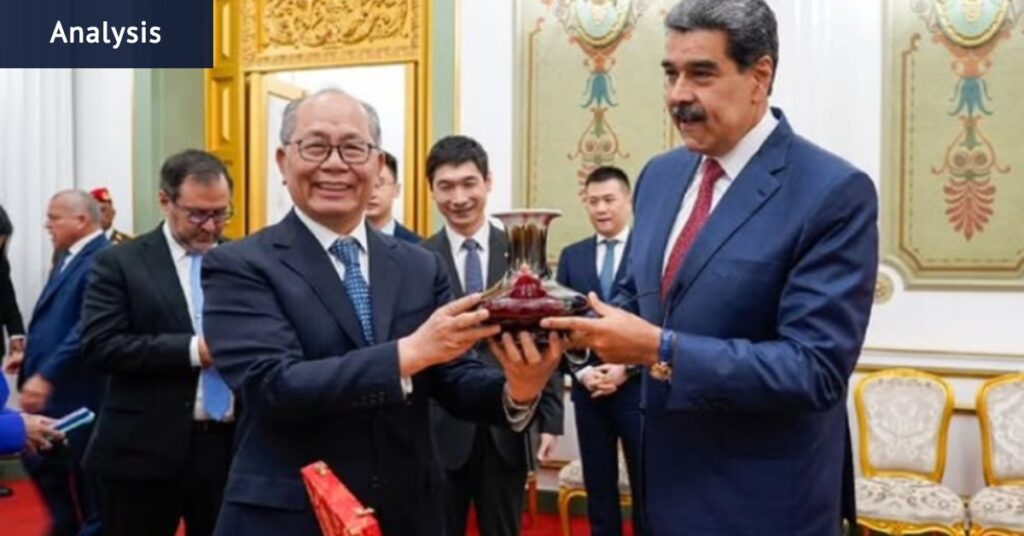
January 7, 2026 — Singapore: In a dramatic turn of events, hours before US forces captured Venezuelan leader Nicolás Maduro in a surprise raid, he was seen in the company of Beijing’s special envoy for Latin American affairs at the presidential palace in Caracas. The meeting, which was captured on camera, highlighted the close ties between Venezuela and China, a relationship Maduro described as akin to a familial bond.
“I thank President Xi Jinping for his continued brotherhood, like an older brother,” Maduro declared to Chinese diplomat Qiu Xiaoqi. The two exchanged gifts and pleasantries in the opulent Miraflores Palace, a scene that was later immortalized on Maduro’s social media accounts. The timing of this encounter, juxtaposed with the subsequent US military operation, places Beijing in an awkward position, raising questions about its awareness of the impending raid.
The next image that captured global attention was starkly different: Maduro, shackled and blindfolded, aboard a US warship, en route to face narco-conspiracy charges in a New York courtroom. There, he would proclaim himself a “kidnapped president” and a “prisoner of war.”
Beijing’s Reaction and International Implications
Beijing’s response was one of stunned outrage, swiftly channelled through its state-controlled media outlets. The Chinese government accused the United States of acting as a global enforcer, disregarding international norms and sovereignty when convenient. President Donald Trump’s declaration to temporarily govern Venezuela and seize its oil reserves has only fueled Chinese accusations of American imperialism.
“We have never believed that any country can act as the world’s police, nor do we accept that any nation can claim to be the world’s judge,” stated Chinese Foreign Minister Wang Yi.
Legal scholars around the world have voiced concerns that the US operation in Venezuela likely contravenes international laws prohibiting the use of force. This incident adds another layer of complexity to the already tense US-China relations, as Beijing positions itself as a counterbalance to American influence.
Economic and Strategic Complications
Maduro’s ousting presents significant economic challenges for China, Venezuela’s largest oil customer. Despite the oil trade only constituting about 4-5% of China’s total imports, the outstanding $12 billion in loans to Venezuela remains a pressing concern for Beijing.
Moreover, the geopolitical ramifications extend beyond economic interests. The US action in Venezuela has sparked renewed debates over Taiwan, with parallels drawn to the US’s stance on leadership legitimacy. The question arises: if the US can remove a leader it deems illegitimate, what prevents China from applying similar logic to Taiwan?
Expert Opinions on the Taiwan Equation
Despite the provocative nature of the US raid, many analysts argue that it is unlikely to influence Beijing’s strategy toward Taiwan. Dylan Loh, a Chinese foreign policy expert at Nanyang Technological University, suggests that the incident serves more as a reminder of US military capabilities than a direct threat to China’s ambitions.
“This was a clear demonstration of American might: Trump can and will act decisively and kinetically, and I think this will worry Zhongnanhai,” Loh remarked.
Bonnie Glaser, an Indo-Pacific expert at the German Marshall Fund, concurs, noting that the capture of Maduro is “not a blueprint for Chinese takeover of Taiwan.” She emphasizes that China’s strategy relies on long-term psychological tactics rather than immediate military action.
Broader Implications for International Law
The raid on Venezuela may have broader implications for international law and global order. As the US continues to assert its dominance, Beijing is likely to push back against what it perceives as American hypocrisy.
“Privately, I expect Beijing will emphasize to Washington it expects to be given the same latitude for great power exemptions to international law that the US takes for itself,” noted Ryan Hass, former China director on the US National Security Council.
As the geopolitical landscape continues to shift, the world watches closely. The US strike on Venezuela could foreshadow further challenges to the international legal framework, with potential repercussions in regions like the South China Sea.
As President Trump hints at future ambitions, including potential actions in Greenland, the international community braces for what 2026 may bring in terms of global power dynamics and the erosion of international norms.