

It’s a hot day in early December, and the Tasmanian winds are fierce. Firefighting teams are stretched thin, battling blazes at both Dolphin Sands and St Helens on the east coast. While they mop up at Dolphin Sands, where 19 homes have been lost, the fire at St Helens continues to rage. Suddenly, a remote artificial intelligence camera detects a small plume of smoke a few kilometers away near St Mary’s, in the tinder-dry bush. It’s 8:30 in the morning. An alarm sounds, real-time pictures are verified, and fire headquarters is promptly alerted. A helicopter is dispatched from the St Helens blaze to the precise coordinates, successfully extinguishing the flames. From the initial alert to extinguishment, only two hours have passed. For the exhausted firefighters still working on the coast, it’s a disaster averted.
AI Technology Revolutionizes Fire Detection
The swift response to the fire is a significant relief for Shaun Suitor from Sustainable Timber Tasmania (STT). His organization is one of the key agencies involved in firefighting across Tasmania’s remote regions, alongside the Parks and Wildlife Service. “The early detection allowed the STT duty officer to send staff and equipment there to put it out really quickly,” Mr. Suitor said.
The fire detection technology, developed by Indicium Dynamics, a software company based in southern Tasmania, is proving to be a game changer. “The St Helens fire was spotted by remote cameras as well, although it was also called in by locals at the same time,” said the company’s chief executive, Rob Vernon. The technology is particularly effective for remote fires, some of which are ignited by lightning.
Government Support and Expansion Plans
Now, with a $1.4 million federal government grant, STT and Indicium Dynamics will double their remote firefighting technology by deploying a new generation of remote cameras, drones, and supporting technology across Tasmania. This expansion follows the successful trial of cameras, which have already demonstrated their value.
“In the 2024/25 season, they detected more than 550 fires around the state; 123 of those went directly through to fire management agencies,” Mr. Vernon stated.
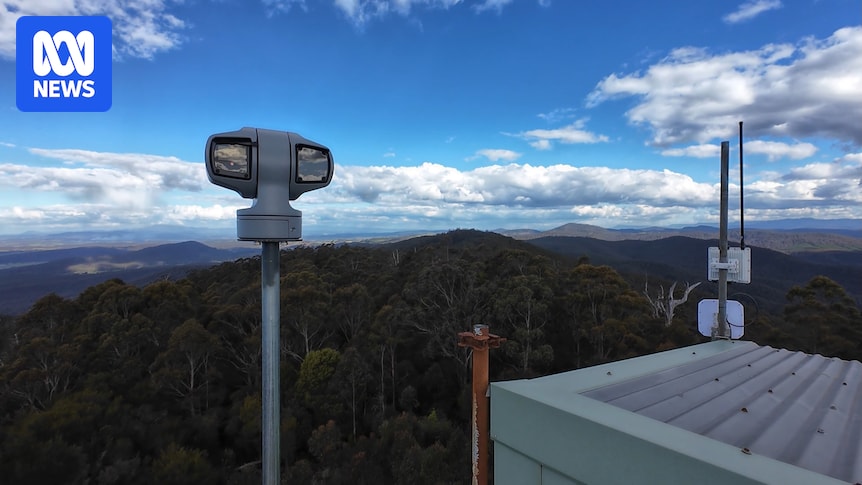
The trial cameras were strategically placed on existing fire towers, located on hilltops and elevated areas with clear views of the horizon. These towers, often manned by fire spotters during the risk season, may eventually see a reduced need for human presence as technology advances.
Advanced Capabilities and Future Prospects
The cameras operate 24/7, scanning the landscape in 360 degrees for smoke up to 30 kilometers away. “The AI’s really good out to 20, 30 kilometers, but our daytime record is detecting fires 78 kilometers away,” Mr. Vernon noted. However, it’s not just the fire spotting that authorities find beneficial. The images captured by the cameras, combined with other data points, offer a comprehensive view of fire conditions.
“We’ve got access to the cameras themselves, we’ve got weather stations that are deployed and measuring wind speed and direction, and we’re subsequently able to stitch in satellite information,” Mr. Vernon explained.
The company is also developing portable, off-grid towers and cameras, as well as remotely operated drones that can be deployed in remote areas during fire risk periods.
“We need this investment to help our fire staff as much as possible,” Mr. Vernon emphasized. The hope is that this arsenal of next-generation technology will ensure Tasmania is prepared to tackle the increasing number of bushfires.
Implications and Looking Ahead
The move to double the fire detection technology represents a significant step forward in Tasmania’s firefighting capabilities. “We naturally still want and need brave women and men on the front lines of any fire, but our role is to augment their capabilities, and we’re really excited about our opportunity to do that,” Mr. Vernon said.
With climate change contributing to more frequent and intense bushfires, the importance of early detection and rapid response cannot be overstated. As Tasmania pioneers this advanced technology, it sets a precedent for other regions facing similar challenges. The expansion of AI-driven fire detection systems could become a model for effective wildfire management worldwide.