




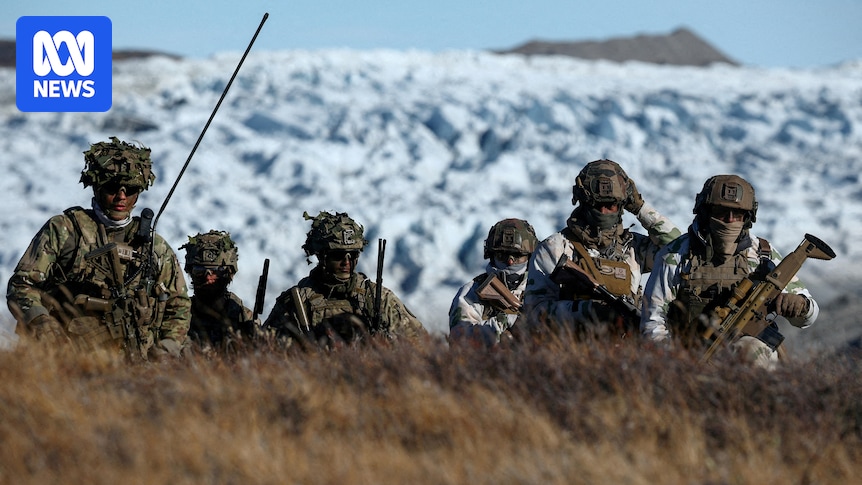
Donald Trump has made clear his intention for the United States to acquire Greenland. In the wake of a special forces operation to extradite Venezuelan President Nicolás Maduro to the US on drug trafficking and weapons charges, Trump has repeatedly emphasized the strategic necessity of Greenland for security reasons. Experts argue that Greenland’s location is pivotal for American ambitions of hemispheric dominance, further enhanced by its rich deposits of rare earth minerals and oil.
Despite its massive size and sparse population, Greenland remains a Danish territory, even as it exercises a degree of self-governance and harbors aspirations for full independence. This raises the question: How can the United States achieve the president’s goal?
Military Action: A Controversial Option
While the notion of the US invading Greenland may seem improbable, the Trump administration has not dismissed the possibility. “The president and his team are discussing a range of options to pursue this important foreign policy goal, and of course, utilizing the US military is always an option at the commander in chief’s disposal,” stated government spokesperson Karoline Leavitt to AFP.
Experts suggest that a US invasion of Greenland would be “very short and sharp” due to the overwhelming superiority of the US military. Donald Rothwell, professor of international law at the ANU College of Law, noted Denmark’s limited capacity to resist such an action. “I just can’t see Denmark wanting to militarily resist in any significant way,” he said, highlighting the potential for devastating consequences.
“If the United States decides to militarily attack another NATO country, then everything would stop — that includes NATO and therefore post–Second World War security.” — Danish Prime Minister Mette Frederiksen
The diplomatic fallout from such an action would be significant, threatening to fracture America’s longstanding relationships in Europe. European leaders have rallied around Denmark, asserting that Greenland’s sovereignty lies with its people.
Purchase Agreement: A Historical Precedent
Could the United States buy Greenland? Susan Stone, chair of economics at Adelaide University, notes that purchasing territory was common in the 19th century, with the US acquiring large swathes of land through deals like the Louisiana Purchase and the acquisition of Alaska from Russia in 1867. However, such transactions have become rare, as they often conflict with modern values of democracy and self-determination.
Despite this, Stone suggests that a deal could theoretically be made if both Greenland and Denmark agreed. “Willing buyer, willing seller, it is possible,” she said. However, Greenland has shown no interest in being sold, complicating the potential for such an agreement.
Compact of Free Association: A Diplomatic Middle Ground
A Compact of Free Association could offer a compromise, allowing Greenland to maintain a degree of independence while aligning more closely with the United States. Professor Rothwell explains that such compacts exist between the US and several Pacific nations, granting them self-governance while the US manages their defense and foreign affairs.
Greenland’s path to independence is already underway, having achieved “home rule” in 1979 and greater autonomy in 2009. A successful referendum could see Denmark grant full independence, paving the way for a compact with the US.
“I think that what we offer as the United States is much more compelling than what the Russians and the Chinese have to offer.” — Former US National Security Council chief of staff Alexander B Gray
Negotiating such an agreement would require careful diplomacy, involving consultations with both Denmark and Greenland’s existing government. This approach could satisfy Greenland’s aspirations for self-determination while addressing US strategic interests.
As the Trump administration weighs its options, the implications of each path are profound, with potential impacts on international relations, legal precedents, and the geopolitical landscape. The coming months will reveal whether the US can navigate these complex waters to achieve its goals regarding Greenland.