




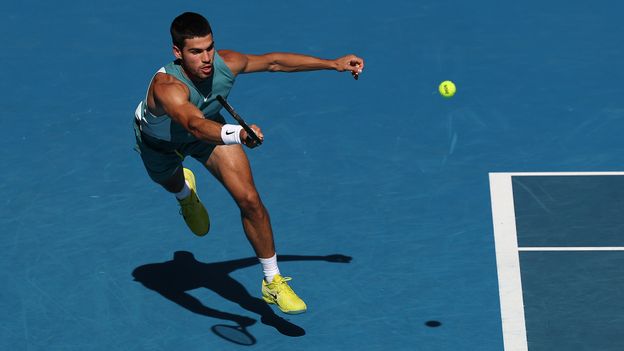
An unprecedented tennis competition is set to debut at the Australian Open, offering amateurs a tantalizing chance to face off against some of the world’s top tennis stars in a unique one-point match format. The One Point Slam, running alongside the traditional Grand Slam tournament, promises a thrilling spectacle where each match is decided by a single point. This innovative format raises the question: can an unknown player truly topple a tennis titan to claim a million-dollar prize?
The prospect of an amateur defeating a world-class player for a share of the A$1 million (£490,000/$672,000) prize fund is a tantalizing one. With the tournament featuring 48 competitors, including 24 professionals and eight amateur winners from state championships across Australia, the stage is set for potential upsets. The lineup includes tennis luminaries such as Carlos Alcaraz, Jannik Sinner, Nick Kyrgios, Iga Swaitek, and Coco Gauff, making the challenge all the more daunting.
The Mathematics of Upsets
The single-point format significantly increases the chances of an upset, as it minimizes the opportunity for superior players to dominate through skill alone. This format introduces a higher element of unpredictability, relying more on chance and less on sustained performance. Tournament organizers are banking on this unpredictability to captivate audiences, offering a departure from the traditional multi-set matches where skill typically prevails.
In sports, the likelihood of a better player winning increases with the number of points played. For instance, in a simple scoring system where the first to reach a certain number of points wins, the probability of the superior player triumphing rises as more points are played. This is mathematically represented by a formula that considers the player’s advantage and the number of points required for victory.
The probability of victory increases with a player’s advantage and the number of points played, illustrating why longer matches favor skilled players.
Historical Context and Comparisons
This isn’t the first time a sport has altered its scoring system to enhance spectator engagement. Table tennis, for example, revised its scoring from a first-to-21 format to a first-to-11 format in 2001, while increasing the number of games needed to win a match. This adjustment maintained the skill-to-luck ratio, ensuring matches remained competitive and exciting for fans.
Similarly, in tennis, the balance between skill and luck is influenced by the number of points needed to win a game, multiplied by the number of games and sets required for a match. This complexity is why men’s Grand Slam tournaments, which require winning three sets, tend to see less variability in winners compared to women’s tournaments, which are decided in two sets.
Since 2000, there have been 37 different female Grand Slam winners and only 22 different male Grand Slam winners, highlighting the impact of match length on outcomes.
Implications and Future Prospects
The One Point Slam offers a rare opportunity for amateurs to test their mettle against the best, albeit under intense pressure. While the odds are stacked against them, the format provides the best possible chance for an upset. Even if an amateur doesn’t secure a victory over a player like Carlos Alcaraz, the experience of taking the world number one to match point is a significant achievement.
This experiment in tennis scoring could pave the way for similar innovations in other sports, where organizers seek to balance skill and unpredictability to enhance viewer engagement. Whether the One Point Slam becomes a staple of the tennis calendar remains to be seen, but its debut at the Australian Open is sure to generate excitement and debate among fans and players alike.
As the tournament unfolds, all eyes will be on the amateurs daring to challenge the elite, each hoping to seize their moment of glory on the grand stage of the Australian Open.