



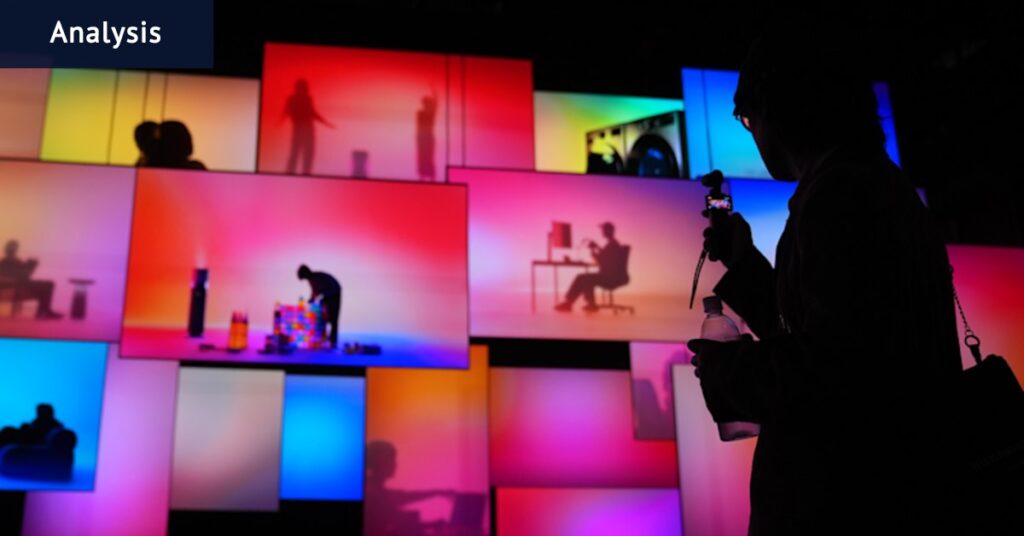
Las Vegas, Nevada: The annual Consumer Electronics Show (CES) in Las Vegas has once again become the global stage for unveiling the latest in television technology. This year, the spotlight is on Micro RGB, a groundbreaking innovation that could redefine picture quality standards in consumer TVs. Unlike conventional models, Micro RGB utilizes individually controlled red, green, and blue LEDs instead of standard blue or white backlights, promising unprecedented color accuracy.
The excitement on the show floor is palpable, with major players like Samsung, LG, Hisense, and TCL all showcasing their interpretations of this technology. Each company offers a unique approach, and the price variations are equally diverse.
Understanding the Tech: A Closer Look at TV Innovations
The TV industry is notorious for its complex jargon, leaving consumers bewildered by terms like OLED, QLED, and Mini LED. These technologies each have distinct characteristics. OLED TVs, for instance, use organic compounds that emit light independently, offering perfect blacks and excellent contrast. However, they have limitations in brightness and a slight risk of burn-in.
QLED, a term popularized by Samsung, refers to LCD TVs enhanced with a quantum dot layer for improved color, but they still depend on a backlight. Mini LED technology refines this by using thousands of tiny LEDs for better contrast, yet lacks the pixel-level control of OLED.
Enter Micro RGB, the latest buzzword. It advances Mini LED technology by incorporating separate red, green, and blue LEDs, enhancing color accuracy by having the light source itself produce the colors rather than filtering them.
“Micro RGB is the next evolution of LED-backlit TVs, promising OLED-like color accuracy with superior brightness. Whether it delivers remains to be seen in real-world testing.”
Samsung: Pioneering the Micro RGB Frontier
Samsung has captured attention with its ambitious 130-inch Micro RGB prototype, a centerpiece at CES. Although not intended for retail, this prototype demonstrates the potential of Micro RGB technology on a grand scale. According to Hun Lee, Samsung’s executive vice president of visual display, “Micro RGB represents the peak of our picture quality innovation.”
Soon to be available are Samsung’s Micro RGB models ranging from 55 to 115 inches. The 115-inch model, priced at $41,999, is already on sale in Australia. These TVs boast 100 percent coverage of the BT.2020 color standard, a first for consumer televisions, certified by VDE, a German testing body.
Samsung anticipates a “super cycle” of TV upgrades, driven by the timing of major sporting events like the FIFA World Cup. The broader lineup, including sizes from 55 to 75 inches, will be available through 2026, aiming to make this cutting-edge technology more accessible.
LG: Redefining Thin with OLED evo W6
LG has turned heads with its OLED evo W6 Wallpaper TV, a mere nine millimeters thick. This ultra-thin design is achieved by relocating the TV’s components to a separate “Zero Connect” box, allowing for a nearly invisible setup. Available in 73- and 83-inch sizes, the W6 supports 165Hz refresh rates and gaming features like Nvidia G-Sync.
LG is also entering the Micro RGB arena with its evo lineup, claiming full coverage of BT.2020, DCI-P3, and Adobe RGB color spaces. Pricing and availability for the Australian market remain under wraps.
Hisense and TCL: Broadening Accessibility and Brightness
While Samsung and LG target the high-end market, Hisense is making strides to democratize RGB MiniLED technology. The UR8 and UR9 series aim to bring this innovation to more affordable 55-inch screens. Hisense’s 116UXS flagship model introduces a fourth “Sky Blue-Cyan” LED, potentially achieving 110 percent BT.2020 coverage.
Meanwhile, TCL diverges from the Micro RGB trend, opting for “SQD-Mini LED” technology in its X11L model. With a staggering peak brightness of 10,000 nits and 20,000 local dimming zones, TCL is pushing the boundaries of HDR content display.
“If competitors are following us, it shows the direction we’ve followed is the right direction,” said Christopher Mayer, Hisense’s ANZ product lead.
Both Hisense and TCL have yet to announce Australian pricing and availability, but their innovations are expected to reach local markets soon.
The unveiling of these new technologies at CES 2026 marks a significant shift in the television industry. As manufacturers vie for consumer attention, the promise of enhanced color accuracy and brightness could lead to a new era of home entertainment. Whether these advancements will translate into widespread consumer adoption remains to be seen, but the groundwork for the next generation of TVs is clearly being laid.