

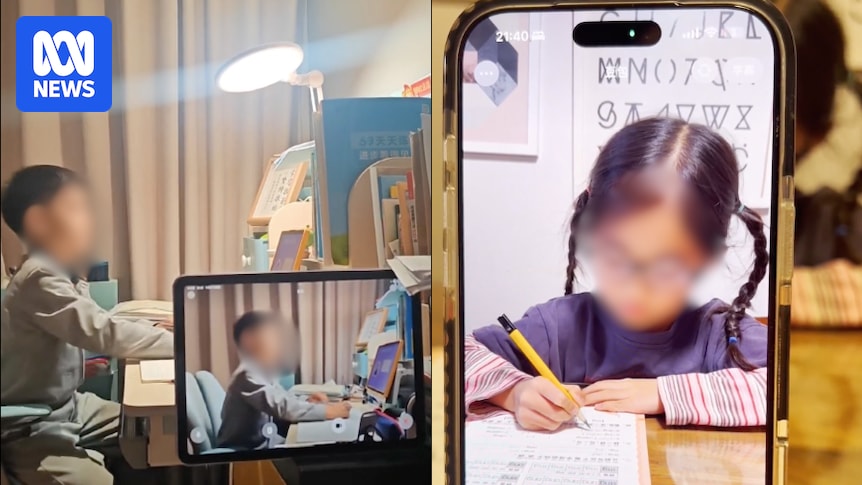
When Lu Qijun is occupied with her duties as a television journalist in China’s Guangdong province, she relies on artificial intelligence to monitor her son’s homework. By placing her phone on his desk, a camera remains active, and a calm voice provides guidance. This voice belongs to Dola, an AI chatbot developed by ByteDance, the company behind TikTok.
Lu is among the 172 million monthly users of the app, according to QuestMobile, a Chinese statistics platform. The app not only supervises homework but also acts as a tutor, offering a modern solution to educational challenges in China.
AI as a Cost-Effective Educational Tool
The appeal of AI tools like Dola extends beyond convenience. As China’s economic growth slows, families are reassessing educational expenditures. Private tutoring, once a staple for urban middle-class families, is now harder to justify financially, even as students face demanding academic schedules.
“Parents are anxious about spending heavily, only to end up with a ‘rotten-tail kid,'” Lu remarked, referencing a meme about young adults who remain jobless despite significant educational investments. The app allows her to upload trusted parenting books and study materials, tailoring guidance to her son’s needs.
“It’s like having my own parenting bible,” Lu said. “Now I can read a book or answer messages while he is doing his homework.”
AI: A Solution to Parental Stress?
In China, parental involvement in education extends beyond school hours, with parents expected to manage homework and extra classes. This expectation is especially challenging for the generation shaped by the one-child policy, who must support aging parents while raising their own children.
Some parents find AI helps reduce conflict. Wu Yuting, from Henan province, noted that the AI’s calm tone contrasts with the tension that often arises during homework sessions. “They think I talk too much,” Wu said of her children, appreciating the AI’s patient demeanor.
Dr. Qi Jing, an associate professor at RMIT University, cautioned against using AI to avoid necessary conflicts. “Children’s brains need conflict, struggle, and challenges to develop properly,” she explained.
Balancing AI Use with Traditional Supervision
As AI becomes more integrated into education, tools like Dola Aixue are gaining popularity, with 8.76 million monthly active users. For parents like Lu, AI is a tool used judiciously. She limits its prompts to avoid distracting her son and prefers to supervise personally when time permits.
Elaine Zhou, a Shanghai-based mother, uses AI for her sons’ homework but remains cautious about overuse, privacy, and inappropriate content. “For children, AI is highly efficient and easy to use,” Zhou said, emphasizing the need for careful monitoring.
Setting Boundaries for AI in Education
Experts stress the importance of clear boundaries when using AI in education. Dr. Qi Jing noted that AI lacks the contextual understanding necessary to replace human supervision. “Behaviors like playing with a pen or pausing briefly aren’t necessarily distractions,” she said.
Jeannie Paterson, co-director of the Centre for AI and Digital Ethics at the University of Melbourne, highlighted the need for age-appropriate language and safeguards against harmful content in AI products for children. She warned that excessive AI interaction could hinder social skill development.
“Developers should monitor performance carefully for signs that the AI is not aligned with the best interests of the child,” Paterson advised. “It can assist with some tasks but does not care or love the child.”
As AI continues to evolve, it presents both opportunities and challenges in education. While it offers practical solutions for busy parents, it also necessitates careful consideration of its impact on children’s development and family dynamics.