

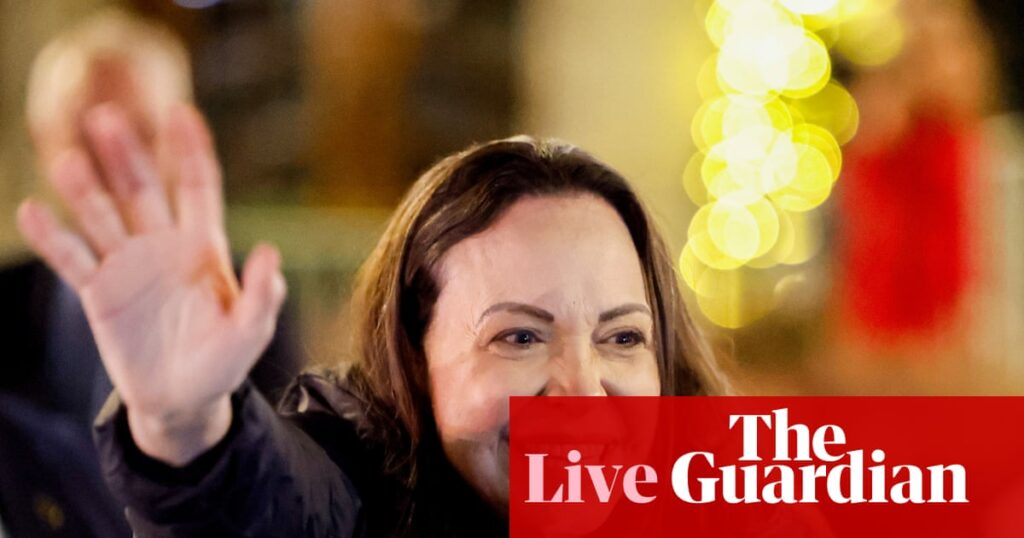
In a surprising move, exiled Venezuelan opposition leader María Corina Machado announced on Fox News that she would like to share her Nobel Peace Prize with former U.S. President Donald Trump. Machado, who appeared on Sean Hannity’s show, stated her intention to return to Venezuela soon, despite the political turmoil following the U.S. military intervention to depose President Nicolás Maduro.
The announcement comes amidst reports that Trump was displeased with Machado for accepting the Nobel Prize instead of attributing it to him. Sources close to the White House revealed to the Washington Post that Trump felt alienated by Machado’s acceptance of the award, which he believed should have been his due to his role in the military operation.
Machado’s Controversial Nobel Prize Acceptance
María Corina Machado, a prominent figure in the Venezuelan opposition, was awarded the Nobel Peace Prize last year for her efforts in advocating for democratic reforms in Venezuela. However, her acceptance of the prize has been met with mixed reactions, particularly from Trump, who reportedly viewed it as an “ultimate sin.”
Speaking on Fox News, Machado expressed her admiration for Trump, stating, “I certainly would love to be able to personally tell him that the Venezuelan people want to give it to him and share it with him.” Despite her praise, Machado admitted she has not yet formally offered the prize to Trump.
U.S. Military Intervention and Political Fallout
The backdrop to this controversy is the recent U.S. military operation aimed at ousting Nicolás Maduro, who is accused of electoral fraud and human rights abuses. Trump has dismissed the notion of Machado leading Venezuela, citing her lack of support and respect within the country. “She’s a very nice woman, but she doesn’t have the respect,” Trump remarked.
Meanwhile, the political situation in Venezuela remains tense. Reports from Agence France-Presse indicate that gunfire erupted near the Venezuelan presidential palace in response to unidentified drones, highlighting the ongoing instability in the region.
Reactions from U.S. Political Figures
U.S. political figures have offered varied responses to the situation in Venezuela. Senate Minority Leader Chuck Schumer criticized the Trump administration’s lack of a clear plan for Venezuela’s future, describing their approach as “vague” and “based on wishful thinking.” In contrast, House Speaker Mike Johnson emphasized that the U.S. is not at war and that the intervention is not a regime change but a demand for behavioral change by the regime.
“This is not a regime change,” Johnson stated. “This is a demand for a change of behavior by a regime.”
Economic Implications and Oil Industry Concerns
The economic implications of the U.S. intervention are significant, particularly concerning Venezuela’s oil industry. Trump suggested that U.S. taxpayers might fund the rebuilding of Venezuela’s oil infrastructure, a move that has raised eyebrows among industry experts. The Wall Street Journal reported skepticism from major oil companies like Chevron and ExxonMobil, who are wary of investing in Venezuela due to political uncertainties.
Energy Secretary Chris Wright is expected to meet with representatives from these companies to discuss potential investments, but the outcome remains uncertain.
Historical Parallels and Future Prospects
The situation in Venezuela draws historical parallels to past U.S. interventions in Latin America, where regime changes have often led to prolonged instability. Experts warn that without a clear strategy, the U.S. risks repeating the mistakes of the past.
Looking ahead, the international community will be closely monitoring the developments in Venezuela. The potential for further unrest remains high, and the role of external powers, including the U.S., will be critical in shaping the country’s future.
As Machado prepares to return to Venezuela, her political future and the broader implications of the Nobel Peace Prize controversy will continue to unfold, impacting both domestic and international dynamics.