




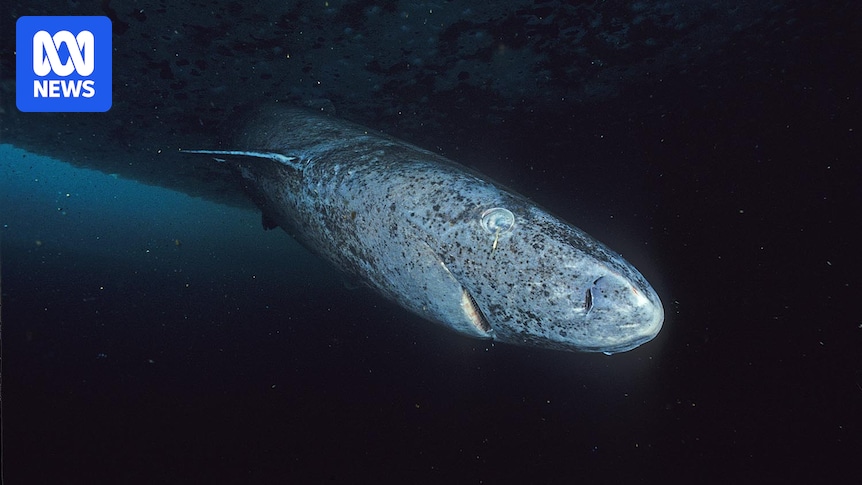
Swimming slowly through the icy depths of the North Atlantic and Arctic Oceans, the Greenland shark, with its cloudy eyes and mottled skin, might appear to be in decline. Yet, this remarkable creature, known scientifically as Somniosus microcephalus, can live for up to 400 years, making it one of Earth’s longest-living vertebrates. Recent research published in Nature Communications reveals that the shark’s eyes, previously thought to be nearly non-functional, remain robust and operational even after a century, potentially holding secrets that could benefit human eye health.
Australian marine biologist Lily Fogg, the lead author of the study from the University of Basel, highlights a unique mechanism that preserves the shark’s ocular health. “That’s something humans can’t do, so if we can study that and work out what that mechanism is, they could have biomedical applications,” she explained.
Decoding the Anatomy of Shark Eyes
In their quest to understand the Greenland shark’s visual capabilities, researchers examined the eyes of ten deceased sharks, aged between 100 and 134 years. These eyes, approximately 5–6 centimeters in diameter, are enveloped by thick protective tissue. Unlike human eyes, which contain both cone and rod cells for light detection, Greenland shark eyes possess only rod cells, allowing them to see in low-light conditions.
Dr. Dorota Skowronska-Krawczyk, a senior author from the University of California, Irvine, explains that this means the sharks perceive their world in black and white. “You don’t have high resolution; you see light and darkness, but you really don’t see the shapes very well, or you cannot distinguish probably fast movements,” she said.
Greenland sharks, which can grow up to seven meters long, inhabit a range from the sea surface to depths of thousands of meters. “They’re probably not using the vision right down in the deep,” Dr. Fogg noted. “It’s possible that they’re using it to find the right depth… but they’re obviously still using their visual system for something.”
Parasites and Vision: A Surprising Coexistence
Despite the presence of crustacean parasites on their corneas, the sharks’ ability to detect light remains unaffected. The copepods, Ommatokoita elongata, which resemble white tassels, do not hinder the sharks’ light detection capabilities. “The copepod parasites attached to the cornea probably reduce image clarity,” said Laura Ryan, a neurobiologist at Macquarie University. “But the study indicates that the retina and visual pathways remain intact and functional.”
Even with these parasites, the study found no degeneration in the eyes examined. “The structure of the eye looks beautiful. I mean it’s basically pristine,” Dr. Skowronska-Krawczyk remarked.
Implications for Human Health
The research suggests that a set of DNA repair genes, ERCC1 and ERCC4, might be responsible for maintaining the long-term health of the shark’s retina. “The high expression of DNA repair genes suggests a powerful molecular mechanism that helps maintain retinal health over centuries — a cool finding,” Dr. Ryan commented.
Patricia Jusuf, a visual neuroscientist at the University of Melbourne, sees promising potential for these findings in human medicine. “The same genes are also functioning in DNA repair pathways in humans,” she noted. “When these genes do not work properly in mammals, we see detrimental effects associated with premature aging.”
“The fact that these greater than 100-year-old sharks showed little sign of retinal degeneration suggests that these DNA repair pathways might hold the key for maintaining retinal health and vision over a long life span.”
Dr. Jusuf emphasized that rods are often the first to be affected by age-related macular degeneration and retinitis pigmentosa in humans. “Being able to manipulate DNA repair pathways to slow down or halt degeneration of these rod photoreceptors in humans holds great benefits for the more than 200 million people affected by visual loss due to these degenerative conditions,” she said.
Exploring Further Genetic Secrets
The Greenland shark belongs to the Somniosidae family, also known as “sleeper sharks.” Little is known about its relatives in the Southern Hemisphere, such as the southern sleeper shark and the Pacific sleeper shark, which inhabit waters around Australia and New Zealand. These species may harbor additional genetic secrets beneficial to humans, but further research is necessary.
Dr. Skowronska-Krawczyk stressed the importance of conducting basic biological studies without predetermined outcomes, as it was the curiosity of researchers that led to the discovery of the Greenland shark’s longevity. “And only then could we start working and thinking about [medical] applications,” she concluded. “So it’s very important to study basic science and to fund basic science.”