



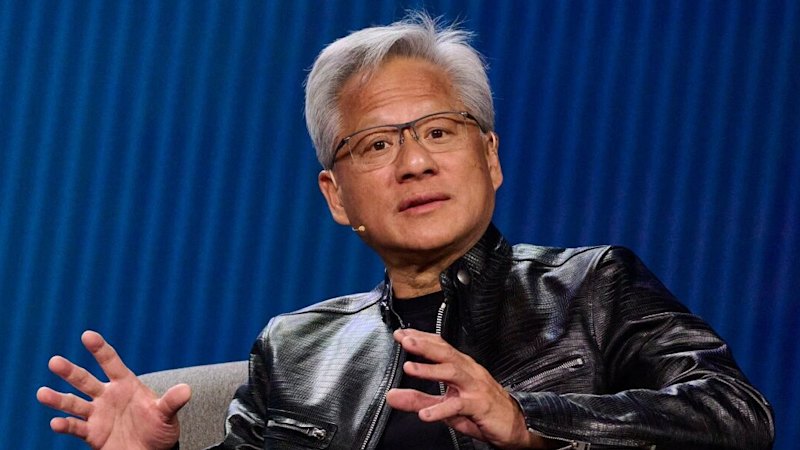
Las Vegas, Nevada: Nvidia’s chief executive Jensen Huang has firmly stated that he has no intentions of stepping down from leading the world’s most valuable company. Reflecting on his 32-year tenure, Huang shared his secret to longevity: “don’t get fired, and don’t get bored.”
The Taiwanese-American billionaire, now the world’s ninth-richest person with an estimated worth of $US170 billion ($250 billion), made these remarks following his keynote address at the Consumer Electronics Show in Las Vegas. During the event, he announced that Nvidia’s next-generation Vera Rubin AI chip platform was in “full production,” months ahead of Wall Street expectations.
Leadership and Succession Concerns
When asked about his status as the longest-serving chief executive among major technology companies, Huang, 62, expressed his commitment to continue “for as long as I deserve this.” He emphasized the significant responsibility that comes with being the CEO of Nvidia, stating, “We are the captain of this industry.”
However, his comments may not alleviate investor concerns regarding succession planning at Nvidia, a company that has become critically important to global financial markets. Nvidia alone constitutes roughly 8 percent of the S&P 500 index, and its $US4.6 trillion market capitalization is comparable to the entire GDP of Germany.
“It took us 33 years to get here, almost 34 years now. You do something for 34 years, you’re going to figure it out. Even I can figure it out.” – Jensen Huang
Despite its massive influence, Nvidia has no publicly disclosed succession plan. Governance experts have repeatedly warned that Huang’s departure, whether planned or unexpected, could trigger significant market volatility.
A Remarkable Journey
Huang’s rise to becoming one of the world’s wealthiest individuals is a quintessentially American success story. Born in Taipei in 1963, he was sent to the United States at the age of nine, initially destined for a prestigious boarding school. Due to a mix-up, he ended up at Oneida Baptist Institute in rural Kentucky, a reform school where his roommate bore knife scars.
Young Jensen worked his way through high school, cleaning toilets and teaching his roommate to read. He graduated at 16, pursued electrical engineering at Oregon State University, and worked the graveyard shift at a Denny’s diner for $US2.65 an hour. It was at a Denny’s booth in San Jose that Huang, along with two university friends, founded Nvidia on April 5, 1993. He was 30 years old at the time.
Three decades later, the former dishwasher now helms the most valuable company on Earth. More than 96 percent of Huang’s fortune has been amassed since 2020, driven by the artificial intelligence revolution that transformed Nvidia’s graphics processing chips into essential hardware for applications ranging from ChatGPT to autonomous vehicles.
The Future of AI and Competitive Pressures
During his nearly two-hour session in Las Vegas, Huang, clad in his signature Tom Ford leather jacket, addressed topics from China export controls to the future of gaming graphics. He spoke with the vigor of a man half his age, seamlessly transitioning between technical details and philosophical musings on intelligence.
“Demand for Nvidia GPUs is skyrocketing. Models are increasing by a factor of 10, an order of magnitude, every single year.” – Jensen Huang
The announcement of the Vera Rubin platform was the event’s highlight. Named after the astronomer who revolutionized the understanding of galaxy motion, the platform promises tenfold improvements in AI training efficiency over its predecessor, Blackwell. A 10 trillion-parameter model can now be trained in one month using just a quarter of the chips, Huang claimed.
Yet, Nvidia faces mounting competition. Advanced Micro Devices is gaining traction with major clients, including OpenAI and Oracle. Tech giants Google, Amazon, and Microsoft are designing their own chips through partnerships with Broadcom, whose market value has surged past $US1.6 trillion amid the custom silicon boom.
Market Dynamics and Future Outlook
Despite Nvidia’s stock being down 8 percent from its October peak, shedding approximately $US460 billion in market value, Wall Street analysts remain optimistic. A significant majority, 76 out of 82, rate it a ‘buy’. However, the path forward appears more challenging than the explosive growth seen in 2023 and 2024.
Huang remains undeterred. He highlighted that Nvidia employs just 40,000 people, dubbing it “the smallest large company in the world,” with exceptionally low turnover rates, as many employees stay for 20 to 25 years.
“We have supply chain partners and collaboration partners all over the world who are counting on us to do our part. There’s a great responsibility that comes with our company.” – Jensen Huang
As Nvidia continues to navigate the complexities of the tech industry, Huang’s leadership and vision remain pivotal. The company’s future, while promising, is intertwined with the broader dynamics of the global market and the ongoing evolution of artificial intelligence technology.