

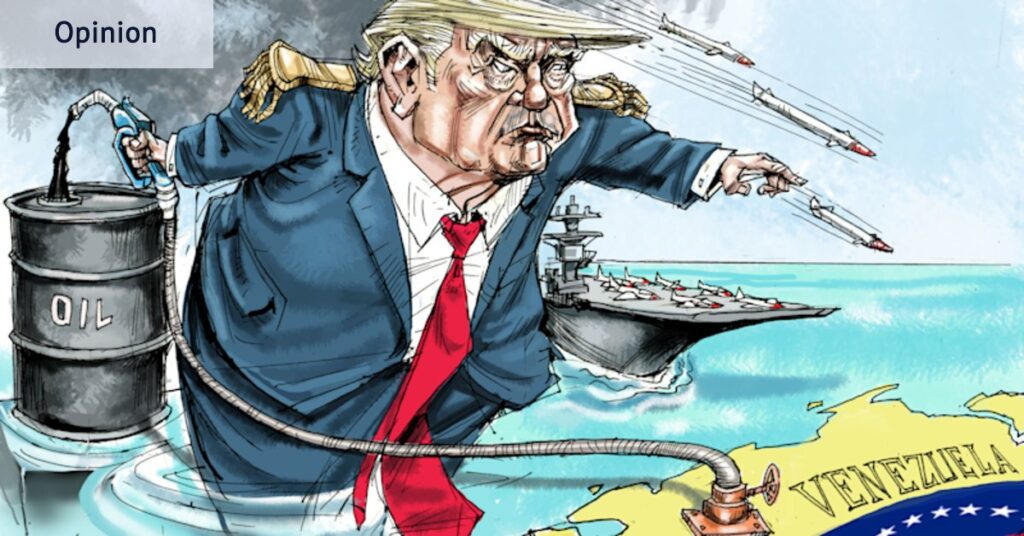
January 5, 2026 — In a dramatic escalation of international tensions, U.S. President Donald Trump’s recent military intervention in Venezuela has drawn stark comparisons to Russian President Vladimir Putin’s controversial actions in Ukraine. The move has sparked widespread condemnation and raised questions about the implications for global diplomacy and international law.
The situation unfolded as President Trump ordered a military invasion of Venezuela, citing the need to change the government regime. This action has been widely criticized as an act of aggression, echoing the sentiments of the Nuremberg trials, which deemed such acts the “supreme crime” due to the resultant loss of life and destruction.
International Law and the UN Charter
According to the UN Charter of 1945, member states are prohibited from invading another nation except in self-defense. The notion that Venezuela posed an imminent threat to the United States has been dismissed by experts, leaving Trump’s actions without a legitimate legal defense. This has drawn parallels to Putin’s invasion of Ukraine, both leaders wielding nuclear arsenals and veto power within the UN Security Council.
The indictment against Venezuelan President Nicolas Maduro and his wife in New York did not provide any international legal authority for their arrest or the occupation of Venezuela. The invasion, therefore, is seen as a unilateral use of armed force, lacking the backing of any treaty or international court approval.
Economic Motives and Historical Context
The invasion’s underlying motives appear to be economically driven, with the U.S. aiming to control Venezuela’s oil reserves. The U.S. plans to reorganize the Venezuelan economy, empowering American oil companies to seize infrastructure and profits previously nationalized under former President Hugo Chavez. This strategy represents a stark reversal of international law, which mandates compensation for the consequences of illegal invasions.
Historically, the U.S. has faced criticism for similar interventions. The case of Panama’s Manuel Noriega, who was overthrown in a U.S. invasion, is often cited as a precedent. However, unlike Noriega, Maduro’s government, despite its controversial record, was democratically elected, complicating the narrative further.
Global Repercussions and Future Implications
The international community is watching closely as this development unfolds. Countries like Australia and Britain, which have military alliances with the U.S., face uncomfortable decisions about participating in operations led by Trump’s administration. The situation also raises concerns about potential future conflicts, such as a possible confrontation over Taiwan, given China’s historical claims and the precedent set by Trump’s actions.
Moreover, Trump’s invasion sets a dangerous precedent for other world leaders, potentially emboldening them to act similarly without fear of consequence. This is particularly concerning in the context of China’s ambitions regarding Taiwan, where a similar justification could be used to assert control.
Legal and Human Rights Considerations
Geoffrey Robertson KC, a human rights barrister and former president of the UN War Crimes Court in Sierra Leone, argues that international law still has a role to play. Although the U.S. is not a party to the International Criminal Court (ICC), Venezuela is, which opens the possibility of prosecuting war crimes committed on its territory.
“International law has one last chance,” Robertson stated, highlighting the potential for legal action against Trump for the unlawful detention of Maduro and the civilian casualties resulting from the bombing of Caracas.
Ironically, Maduro had previously announced plans to withdraw Venezuela from the ICC, a move he never completed, leaving the court as a potential avenue for justice.
As the world grapples with the implications of Trump’s actions, the situation serves as a stark reminder of the fragile state of international relations and the enduring power dynamics that shape global politics. The unfolding events in Venezuela are not just a regional issue but a significant moment with far-reaching consequences for international law and order.