




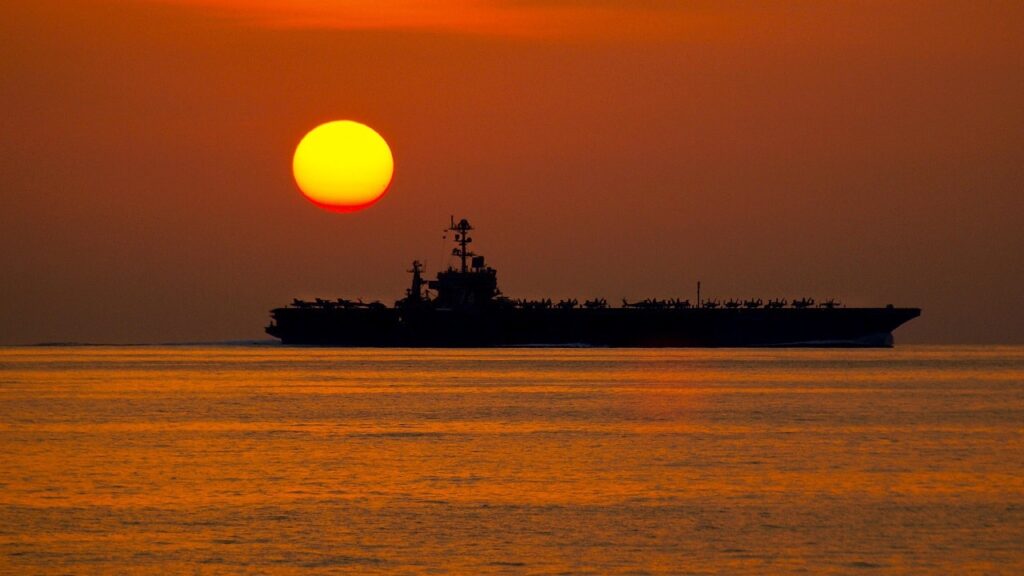
In December 2025, the USS Abraham Lincoln aircraft carrier strike group made a strategic deployment to the Indo-Pacific region, arriving in Guam on December 12 before patrolling the Philippine and South China Seas. This mission is designed to maintain open shipping lanes, reassure allies such as Japan and the Philippines, and challenge China’s expansive maritime claims in the region.
The deployment of the USS Abraham Lincoln, alongside other U.S. naval assets like the amphibious assault ship USS Tripoli and the fast-attack submarine USS Seawolf, underscores the United States’ commitment to maintaining a significant presence in the Indo-Pacific. However, this operation occurs under the looming threat of China’s “carrier killer” arsenal, particularly the maneuverable DF-21D and the long-range DF-26 ballistic missiles, capable of targeting U.S. naval assets as far away as Guam.
The Strategic Importance of the South China Sea
The South China Sea holds a pivotal position in global geopolitics as one of the world’s most heavily trafficked maritime corridors. It carries trillions of dollars in trade annually and serves as a crucial route for energy shipments bound for East and Southeast Asia. Despite its importance, the sea is contested by multiple regional claimants, including China, the Philippines, Vietnam, Malaysia, Brunei, and Taiwan.
China’s claims, represented by the nine-dash line, cover most of the basin and overlap with the internationally recognized exclusive economic zones of other coastal states. The United States, while not taking an official stance on territorial claims, explicitly rejects those that contradict international maritime law, particularly the United Nations Convention on the Law of the Sea.
From Washington’s perspective, China’s expansive assertions, coupled with its construction of artificial islands and installation of military infrastructure, threaten to undermine freedom of navigation and set dangerous precedents for maritime governance. It is in this contentious environment that the USS Abraham Lincoln operates, signaling that these waters are not closed military zones subject to the unilateral control of any one state.
Deterrence and Reassurance
The deployment of the USS Abraham Lincoln serves multiple strategic purposes. Deterrence is a central reason, as the carrier’s presence in the region provides the United States with the ability to maintain combat power even if access to land bases is constrained during a crisis. This capability is crucial in scenarios involving tensions over Taiwan or confrontations between Chinese and Philippine forces.
Moreover, the carrier’s presence reassures U.S. allies in the region. Countries such as Japan, the Philippines, and Australia closely monitor U.S. deployment patterns as indicators of American commitment. In Southeast Asia, many governments seek a balance between economic engagement with China and security alignment with the United States.
The physical presence of carriers like the USS Abraham Lincoln provides tangible evidence that Washington is willing to expend resources and accept risks in defense of a free and open Indo-Pacific. Joint exercises, port visits, and coordinated patrols conducted around a carrier strike group deepen interoperability among allied forces and signal to Beijing that coercive actions against smaller states will not occur in a vacuum.
China’s Anti-Ship Arsenal
China’s military closely monitors American assets in its vicinity, and it possesses several tools to counter U.S. naval forces. The DF-21D, often referred to as the world’s first operational anti-ship ballistic missile, was developed to strike moving naval targets at ranges exceeding 1,500 kilometers. Its design complicates interception and challenges long-standing assumptions about the survivability of carriers operating within the First Island Chain.
U.S. planners treat the DF-21D as a credible threat that must be countered rather than dismissed.
The DF-26 extends this threat even further, with a reported range of more than 4,000 kilometers. It allows China to target naval forces operating far from the Chinese coast, including areas once considered relatively safe for carrier maneuver. The DF-26’s dual-capable nature, meaning it can carry either conventional or nuclear warheads, introduces additional complexity.
In a conflict scenario, differentiating between nuclear and non-nuclear launches would be extremely difficult, raising the risk of rapid escalation. This underscores the high-stakes nature of U.S. naval operations in the region and the potential for miscalculation.
Implications and Forward-Looking Analysis
The deployment of the USS Abraham Lincoln and its accompanying strike group highlights the ongoing strategic competition between the United States and China in the Indo-Pacific region. As both nations continue to assert their influence, the potential for confrontation remains a significant concern for regional stability.
Looking ahead, the United States is likely to maintain its robust naval presence in the region to counterbalance China’s growing military capabilities and reassure its allies. However, this strategy also requires careful management to avoid unintended escalations and ensure that diplomatic channels remain open.
The situation in the South China Sea will continue to be a focal point of international attention, with implications for global trade, security, and the balance of power in the Asia-Pacific region. As such, the actions of both the United States and China in this contested area will be closely watched by the international community.